Guide · 5 min read
How many sheets of plywood do I need?
The honest answer is: more than the square-footage math suggests. Dividing total part area by sheet area ignores kerf, grain, and the simple fact that real rectangles do not tile perfectly onto a panel. The only reliable way to know how many sheets of plywood you need is to nest your actual parts onto the sheet size you buy and count the sheets the layout requires. This guide explains why the quick estimate is wrong, how to do the rough math anyway as a sanity check, and how to get an exact, kerf-aware count in seconds with the free sheet cut list optimizer.
Why area math under-counts sheets
A 4×8 sheet is 32 ft² (about 2.97 m²). If your parts total 64 ft² it is tempting to say two sheets. In practice you almost always need more, because parts rarely pack to 100% of a panel.
Three things eat into usable area: blade kerf removed on every cut, grain direction that blocks rotating some parts, and geometry waste where an odd-sized part forces an offcut you cannot reuse on this job. Real-world yield on cabinet runs often lands around 65-85%, not 100%.
So the area estimate is a floor, not an answer. Use it to ballpark, then nest the parts to get the real number before you buy.
Quick estimate (sanity check only)
To rough it out: add up the area of every part (width × height × quantity), divide by the area of one sheet, then divide by an expected yield to allow for waste.
Example: parts total 64 ft², a 4×8 sheet is 32 ft², and you expect 75% yield. Sheets ≈ 64 ÷ 32 ÷ 0.75 ≈ 2.7, so plan for 3 sheets. Treat this as a budget check, not a cut plan.
| Step | Example |
|---|---|
| Total part area | 64 ft² |
| Sheet area (4×8) | 32 ft² |
| Expected yield | 75% |
| Estimated sheets | 64 ÷ 32 ÷ 0.75 ≈ 3 |
This estimate ignores kerf and grain; always confirm with a real nested layout.
Get the exact count by nesting parts
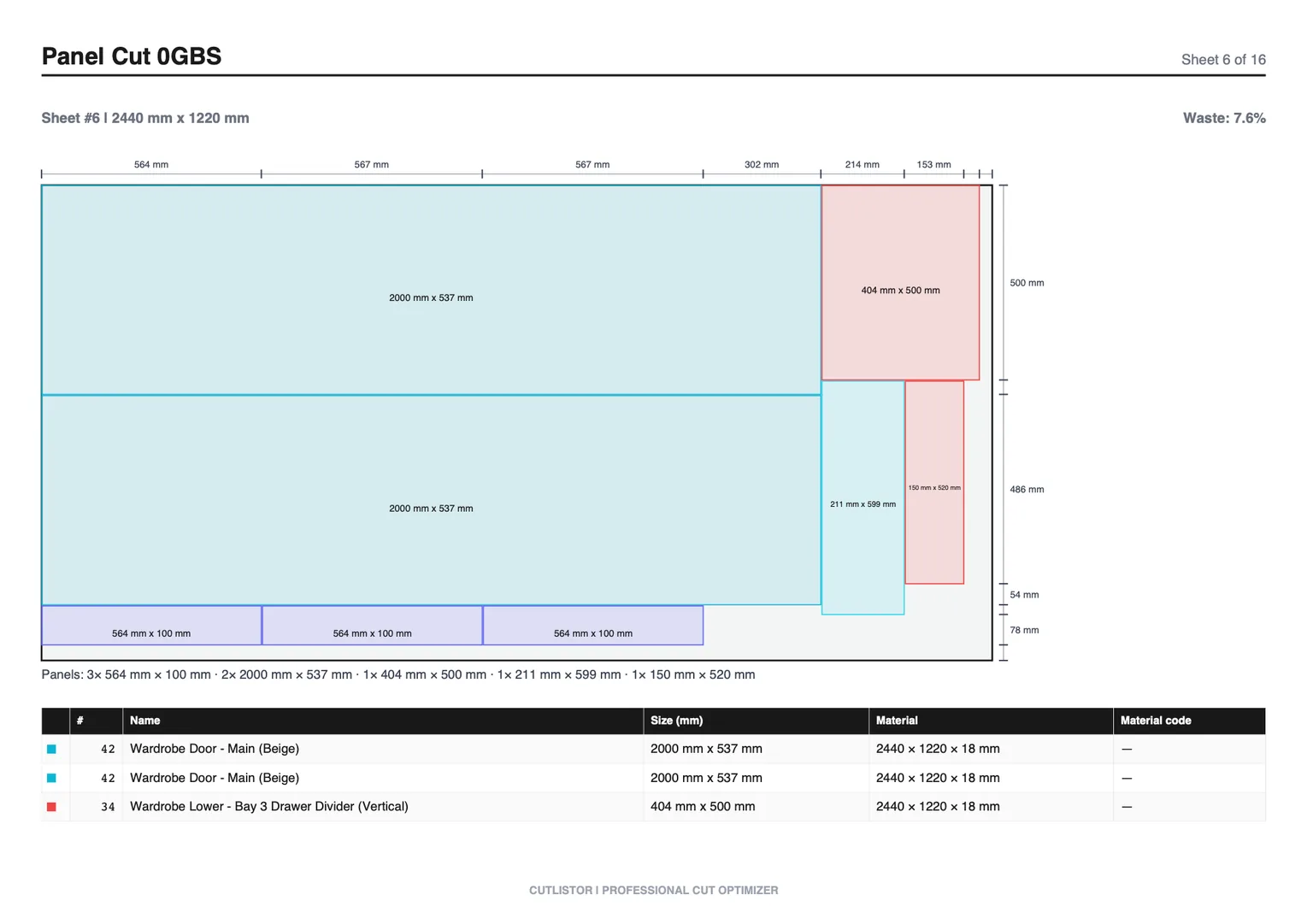
To know exactly how many sheets you need, list every part with its finished width, height, and quantity, enter the sheet size you actually purchase (96×48 in or 2440×1220 mm), set kerf to your blade, and run the layout. The optimizer reports the precise sheet count and the yield percentage so you can compare against your estimate.
If you buy pre-cut or 5×5 Baltic birch panels, enter that exact stock size instead of a generic 4×8 label. Wrong stock dimensions are the most common reason a sheet count surprises you at the yard.
When a dimension changes, edit the row and recalculate. The sheet count updates immediately instead of forcing you to redo the whole estimate by hand.
What changes the sheet count
Small inputs move the answer by a whole sheet, so it is worth getting them right.
| Factor | Effect on sheet count |
|---|---|
| Kerf set too low | Parts look like they fit when they do not - count is too optimistic |
| Grain locked on faces | Blocks rotation, can force an extra sheet |
| Wrong sheet size | Counts against the wrong panel - off at the yard |
| One oversized part | May claim a whole sheet on its own |
| Layout method | Least-waste packs tighter than straight rips |
Worked example: one base cabinet
A single 610 mm wide base unit in 18 mm birch ply on 2440×1220 mm stock might list two sides at 1829×610 mm, one bottom at 568×610 mm, three shelves at 568×610 mm, and a 356×140 mm drawer front.
Area math hints at one sheet, but after kerf and grain the optimizer may confirm one sheet with a healthy offcut - or push you to two if you add a back panel. Running the nest is the only way to be sure before you cut.
FAQ
- How many sheets of plywood do I need for a project?
- List your parts, enter the sheet size you buy, set kerf, and nest them in a cut list optimizer. The layout reports the exact sheet count. Area-only math under-counts because it ignores kerf, grain, and offcut waste.
- How many square feet is a 4×8 sheet of plywood?
- A 4×8 ft sheet is 32 square feet (about 2.97 m²). But you rarely use 100% of it, so divide by an expected yield of roughly 70-85% when estimating.
- Can I calculate plywood sheets for free?
- Yes. The free sheet cut list optimizer nests your parts on real sheet sizes and reports sheet count and yield, with daily limits on the free tier.
- Why does the optimizer say I need more sheets than my math?
- Because real rectangles do not tile perfectly. Kerf, grain locks, and odd part sizes leave unusable offcuts, so the true sheet count is usually higher than area ÷ sheet area.
- Does grain direction change how many sheets I need?
- Yes. Locking grain on visible faces prevents rotating those parts, which can reduce packing efficiency and sometimes adds a sheet.
Related guides
- What is a cut sheet?A cut sheet means two different documents depending on the trade: a cutting layout in the shop, a product spec sheet on site. What each contains, with examples.
- CNC nesting optimizer explainedWhat a CNC optimizer does, how rectangular nesting differs from true-shape, why bit diameter is your kerf, and where a cut list optimizer stops and CAM begins.
- Cut list examplesThree complete cut list examples - a bookcase, a run of base cabinets, and a deck frame - with the exact columns, real dimensions, and what each one turns into.
- What is a cutting plan?A cutting plan is the full set of layouts for a job plus the order you cut them in. What it contains, how to draw one, and how to judge whether it is any good.