Comparison · 8 min read
Cutlistor vs OptiCutter
OptiCutter is a long-standing browser-based optimizer covering both panel and linear cutting, with a strong multilingual interface and a marketed API. Cutlistor competes on the design-to-cut path: getting parts out of spreadsheets, PDFs and 3D models, and getting layouts into a CNC. Both are credible; they optimise for different buyers.
The short verdict
Pick OptiCutter if you need the interface in a language other than English, if you want a documented API to call from your own system, or if your team already knows it.
Pick Cutlistor if your parts arrive as files rather than typing - spreadsheets, PDF elevations, SketchUp or Fusion models - or if a CNC needs DXF at the other end.
Price
OptiCutter runs a free tier suitable for small projects with limited stock and parts, then a Professional plan at around €19 per month for unlimited use, and an Enterprise API plan at around €99 per month for programmatic access. Annual billing is discounted by roughly two months.
Cutlistor's free tier meters something different: editing parts and re-optimizing the layout are unlimited, and only PDF export and starting a new project count against a daily allowance of 3. Cut lists are capped at 20 rows, CSV and XLSX import is limited to 5 rows per file, and nothing is saved between sessions.
Paid plans start at $12 per month or $99 per year.
Note the currency difference when comparing: OptiCutter prices in euros, Cutlistor in US dollars, so the gap moves with the exchange rate.
| Cutlistor | OptiCutter | |
|---|---|---|
| Free tier | 3 PDF exports/day (optimizing unlimited), 20 rows, nothing saved | Limited stock and parts |
| Entry paid plan | $12/mo (USD) | ~€19/mo Professional |
| API plan | Not offered | ~€99/mo Enterprise API |
| Annual discount | 31% | ~2 months free |
Competitor pricing checked 23 July 2026. Prices change - verify on the vendor's own site before buying.
Both do sheet and linear - the difference is what surrounds it
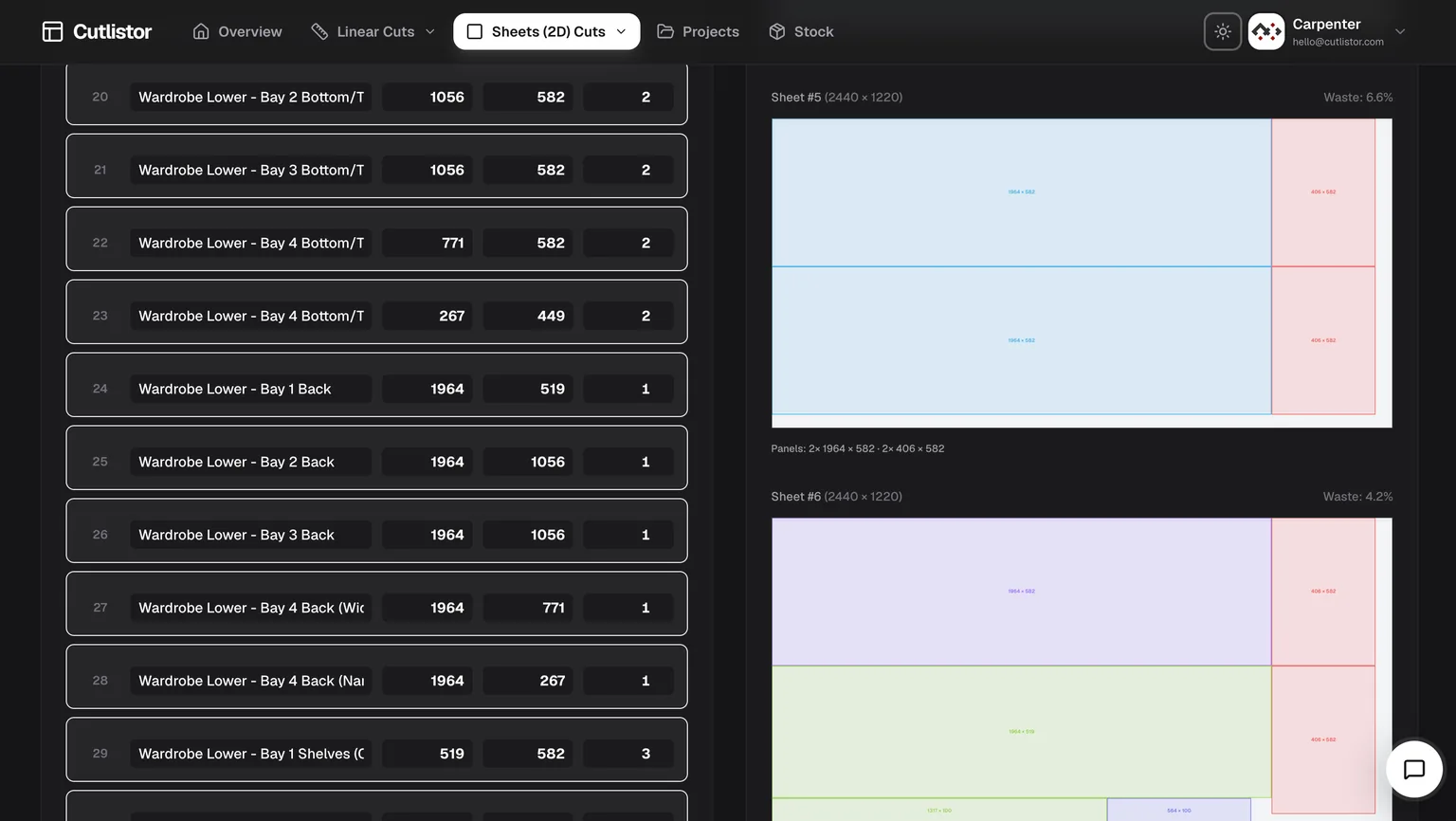
Unlike most browser optimizers, OptiCutter and Cutlistor both handle panel nesting and linear cutting properly. On the optimization itself they land in similar territory for typical jobs.
What separates them is the material that goes in and comes out. Cutlistor treats file ingestion as a core workflow rather than a convenience: CSV and XLSX import, AI scanning of PDF plans and hand sketches, and 3D mesh import from glTF, GLB and Collada. On the output side it writes DXF for CNC and CAM as well as annotated PDF cut plans.
| Capability | Cutlistor | OptiCutter |
|---|---|---|
| Sheet (2D) nesting | Yes | Yes |
| Linear (1D) optimization | Yes | Yes |
| Kerf handling | Yes | Yes |
| Grain direction lock | Yes | Yes |
| PDF cut plans | Yes | Yes |
| DXF export for CNC/CAM | Yes | Varies |
| AI plan / sketch import | Yes (paid quotas) | No |
| 3D CAD mesh import | Yes | No |
| Public API | No | Yes (Enterprise plan) |
| Multilingual interface | English | Many languages |
| Real-time layout refresh | Yes | Calculate-then-view |
No Calculate button, and no paying for speed
Cutlistor recalculates as you type. Change a part width, add a sheet, adjust the kerf - the layout redraws immediately. There is no Calculate button in the interface, because there is nothing to wait for.
That sounds cosmetic until you price a real job. Cut lists are not entered once; they are edited twenty times as a design settles. A tool that recalculates on demand charges you a click and a pause for every one of those edits, and the cost lands precisely when you are iterating hardest.
It is also worth noting what Cutlistor does not do: charge for calculation speed. Every plan, including the free tier, runs the same solver at the same speed. Some competitors reserve faster calculation for a higher tier - so the customer who edits most, and therefore waits most, is the one asked to pay extra to stop waiting.
Four ways to get parts in - most tools have one
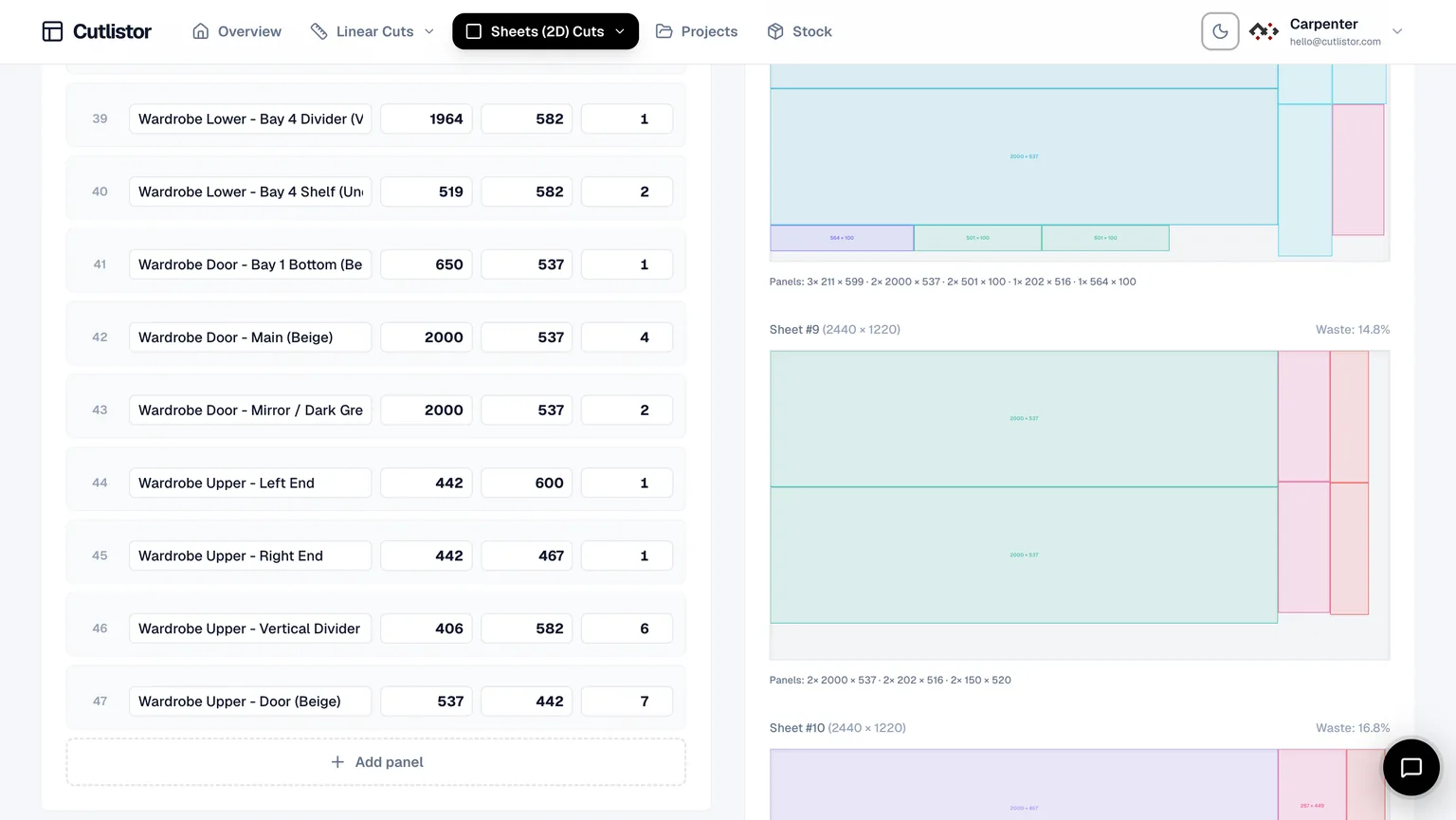
Typing a cut list by hand is where the time actually goes, and it is where almost every optimizer leaves you. Cutlistor accepts parts from four directions:
- CSV import, with automatic column matching so your existing headings work without renaming anything.
- Excel / XLSX import, reading the workbook directly rather than asking you to export to CSV first.
- AI scanning of PDF plans, drawings and photographed sketches - point it at an emailed elevation and get parts out.
- 3D CAD model import from glTF, GLB and Collada, so panels come straight out of a SketchUp or Fusion model.
You do not have to guess the format. Download a sample below, replace the rows with your own parts, and import it - sheet files take name, length, width, qty, grain direction, material code, material name and a free-text column; linear files take name, length, qty, material code, material name and a free-text column. Column matching handles the common variations, so headings like “Width (mm)” or “Quantity” are recognised without renaming.
| Import path | Cutlistor | Typical browser optimizer | Typical desktop optimizer |
|---|---|---|---|
| Manual entry | Yes | Yes | Yes |
| CSV | Yes, with column matching | Sometimes, fixed format | Usually |
| Excel / XLSX direct | Yes | Rarely | Sometimes |
| PDF plan or sketch (AI) | Yes | No | No |
| 3D CAD mesh | Yes (glTF, GLB, Collada) | No | Rarely |
Checked against each vendor's published feature list on the date shown at the foot of this page.
The detail features nobody else bothers with
Most optimizers stop at rectangles and lengths. Real work has awkward parts, and these are the ones that usually get handled by hand on a notepad:
- Laminate calculations - panels that gain thickness and cost on one or both faces, accounted for in the layout and carried into the exported documents rather than added afterwards.
- Edge banding, tracked per edge and shown on the diagram so whoever is banding knows which edges without asking.
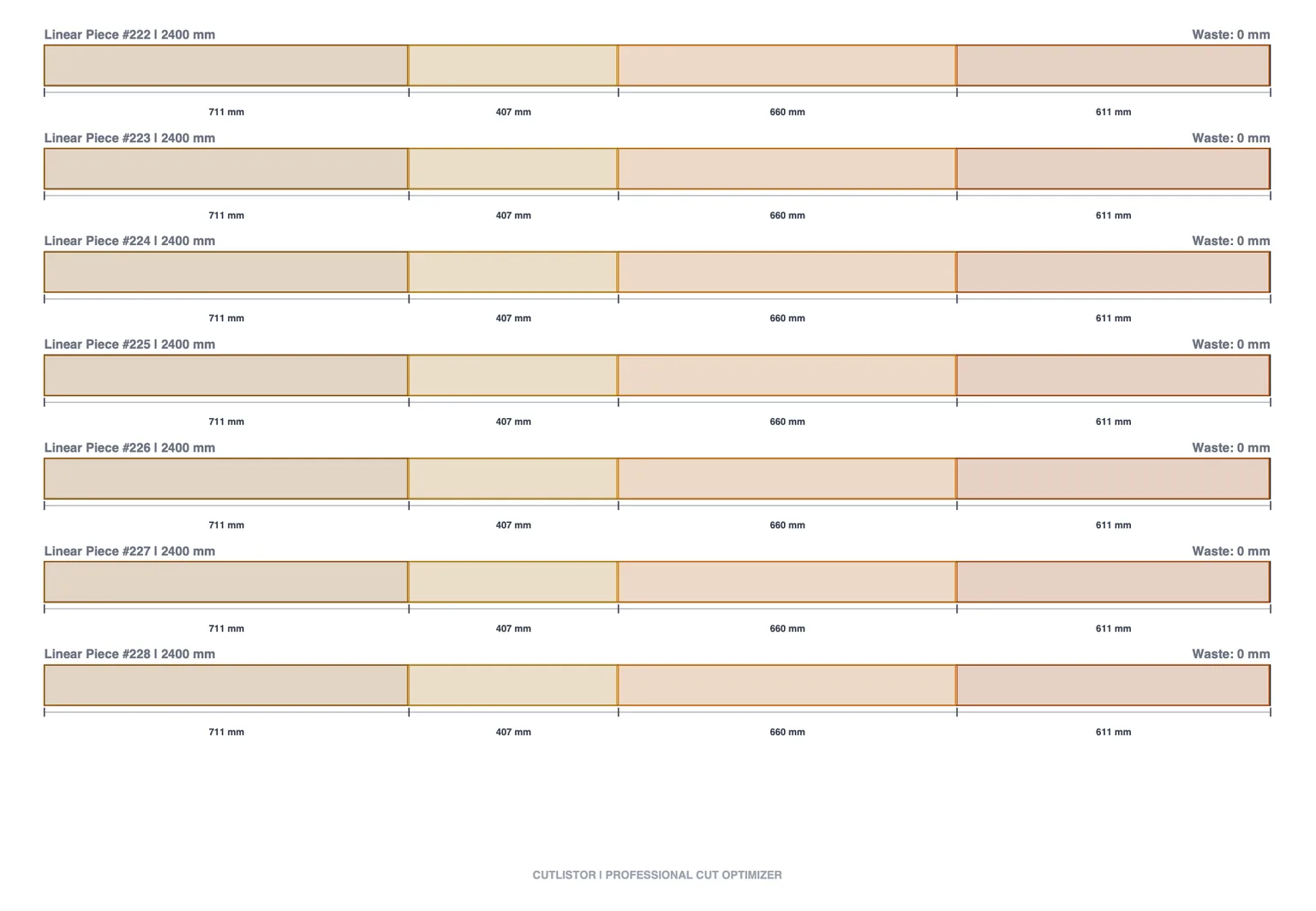
- Mitered ends on linear cuts, with the miter angle affecting the length consumed on the stock - a 45-degree return does not cost the same as a square cut, and pretending otherwise is how trim runs come up short.
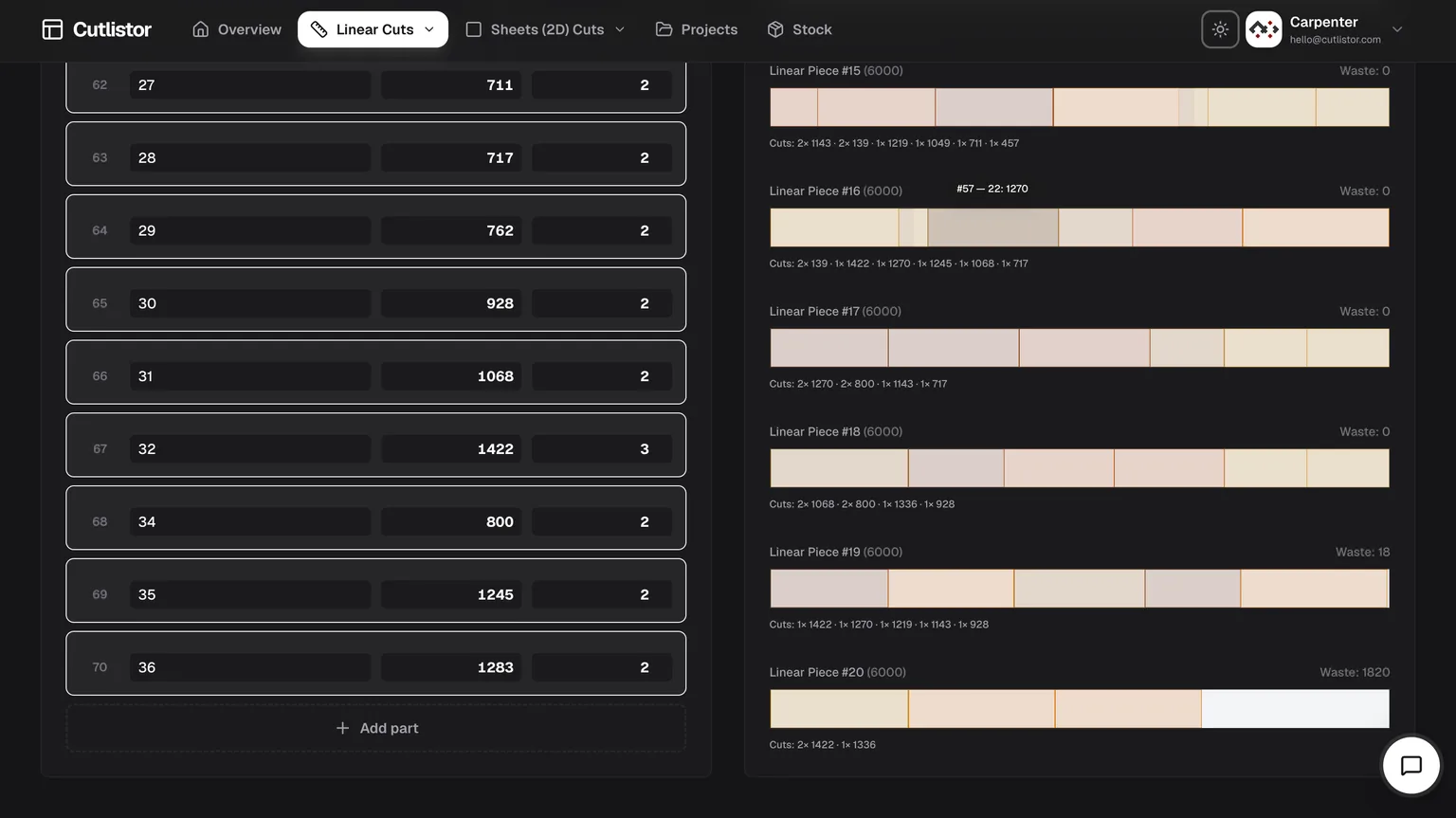
- Cross-section aware linear stock for pipe, tube, bar and angle, so the material is not treated as an abstract line.
- Grain direction locking on visible faces, honoured through nesting rather than applied as an afterthought.
- DXF export from both sheet and linear layouts, with the miter geometry preserved for a CNC.
Where OptiCutter wins
Language coverage is the big one. OptiCutter's interface is available in a long list of languages; Cutlistor is English-only. If your shop floor does not work in English, that is not a preference, it is a requirement, and it settles the comparison.
The API is the second. OptiCutter markets a documented Enterprise API you can call from your own quoting or ERP system. Cutlistor has no public API. If your plan is to generate cut plans programmatically rather than through a UI, OptiCutter is the only one of the two that can do it.
It is also simply older and more established, with years of accumulated tutorials and forum answers behind it.
Which should you choose
- Shop working in a language other than English: OptiCutter.
- Generating cut plans from your own software: OptiCutter, for the API.
- Parts arriving as SketchUp or Fusion models: Cutlistor, for mesh import.
- Parts arriving as emailed PDF elevations or photographed sketches: Cutlistor, for AI scanning.
- CNC requiring DXF geometry: Cutlistor.
- Frequent dimension changes mid-design: Cutlistor, for the live layout refresh.
Testing them against each other
Import the same bill of materials into both, match the kerf exactly, and lock grain wherever the job needs it. Run both, then nudge two part widths by 2 mm and re-run.
Compare on three things: how long the edit-to-updated-plan loop takes, how readable each PDF is when printed and carried into a workshop, and whether you can get usable DXF out of each. If you need an API or a non-English UI, verify those against OptiCutter's own documentation rather than any comparison page - including this one.
If it does not do what your shop needs, ask
Cutlistor is small enough that feature requests reach the person who writes the code. Several of the features above - laminate handling, miter-aware linear cuts, cross-section stock - exist because someone cutting material asked for them and explained why the workaround was costing them time.
If your workflow needs something that is not here, describe it and we will look at building it. That is a genuinely different proposition from filing a ticket against a twenty-year-old desktop product or a tool maintained as a side project, and it is worth weighing alongside a feature table.
FAQ
- Which is cheaper, Cutlistor or OptiCutter?
- Cutlistor's entry plan is $12 per month in US dollars; OptiCutter's Professional plan is around €19 per month, so the comparison depends on the exchange rate at the time. Both have free tiers, and both discount annual billing. On Cutlistor's free tier, 3 pdf exports (or new projects) per day; unlimited editing and re-optimizing; OptiCutter throttles stock and parts instead.
- Does Cutlistor have an API?
- No. If you need to generate cut plans programmatically from your own quoting or ERP system, OptiCutter's Enterprise API plan is the right tool and Cutlistor is not a candidate.
- Is Cutlistor available in other languages?
- Not currently - the interface is English only. OptiCutter supports many languages, which is decisive for shops that do not work in English.
- Do both handle linear as well as sheet cutting?
- Yes, and this puts them both ahead of panel-only tools. Cutlistor's linear optimizer additionally understands cross-sections for pipe, tube, bar and angle stock, and exports DXF from linear layouts as well as sheet layouts.
- Which is better for a CNC shop?
- Cutlistor, primarily because DXF export from both sheet and linear layouts is a standard feature rather than something to verify per plan. Confirm against OptiCutter's current documentation if DXF is your deciding factor.