
Article
How to Start a Woodworking Business in 2026: Complete Guide to Building a Profitable Shop
Cutlistor Team15 min read
Introduction
Starting a woodworking business has never been more accessible. Custom furniture, built-ins, and cabinetry are in steady demand, tools are better and more affordable than a decade ago, and social media makes it easier to find customers in your local market. A woodworking business can be a profitable small business when you pair craft with basic business discipline.
Common mistakes new woodworking businesses make include underpricing jobs, buying too many tools before landing clients, skipping a written business plan, and ignoring material waste. Many beginners focus on selling more projects while losing margin on every sheet of plywood they over-order or cut inefficiently.
This guide walks through choosing a niche, naming your business, writing a woodworking business plan, setting up a home shop, pricing projects, marketing, legal basics, and the profit lever most new shops overlook: cut list optimization before the first cut.
Is a Woodworking Business Profitable?
Yes, a woodworking business can be profitable, but margins depend heavily on niche, pricing discipline, and shop efficiency. Custom work typically earns higher margins than commodity products, and shops that control material costs outperform shops that only chase volume.
- Popular niches: custom cabinets, furniture, built-ins, closets, CNC signs, and home décor each have different price points and competition levels
- Average profit margins: custom cabinet and furniture shops often target 25–40% gross margin after materials; net profit depends on overhead and how efficiently you run the shop
- Demand: homeowners, contractors, and designers consistently need custom casework, shelving, and one-off furniture pieces that big-box stores do not supply
- Efficiency over volume: a shop that wastes one fewer sheet per job often beats a shop that takes on two extra jobs per month with sloppy material planning
Step 1: Choose Your Woodworking Niche
Your niche defines your tools, pricing, customer base, and marketing message. Start narrow: it is easier to become known for kitchen cabinets or live-edge tables than for everything made of wood.
- Custom cabinets and kitchen cabinetry: high ticket, repeat local demand, requires accurate cut lists and sheet goods workflow
- Furniture: tables, desks, beds; strong portfolio and Instagram appeal
- Built-ins and closets: steady contractor and homeowner demand
- Shelving and storage: good entry point with lower tooling costs
- CNC cutting: signs, templates, and nested panel work at scale
- Cutting boards and home décor: lower price point, good for craft fairs and online sales
Step 2: Pick a Woodworking Business Name
Woodworking business names should be easy to say, spell, and remember. Check domain availability and whether another shop in your state already uses a similar name before printing business cards or registering an LLC.
When brainstorming woodworking business name ideas, think about the feeling you want customers to have: premium craftsmanship, rustic warmth, modern minimalism, or approachable humor. Names for woodworking business brands work best when they hint at quality without limiting your services too narrowly.
Tips for Choosing a Business Name
Keep it short: two to three words is ideal for signs, invoices, and Google Business Profile listings.
Avoid hard-to-spell words unless you are willing to repeat the name every time you answer the phone.
Say it out loud: what is a good name for a woodworking business? One that sounds professional when a contractor calls it in on a job site.
Check trademarks and state business registries before committing.
Secure the .com domain and matching social handles early, even if the website comes later.
Funny woodworking business names can work for craft brands and social media, but test whether the tone fits high-ticket custom work in your market.
Professional woodworking business name ideas
- Precision Woodworks
- Apex Woodcraft
- Summit Wood Studio
- Heritage Wood Co.
- Sterling Woodworks
- True Grain Woodshop
- Northwood Craft
- Artisan Timber Co.
- ProEdge Woodworks
- Craftline Wood Studio
- Benchmark Wood Co.
- Keystone Woodcraft
- Cornerstone Woodworks
- MasterGrain Studio
- Reliable Wood Co.
Rustic woodworking business name ideas
- Barnwood Craft Co.
- Rustic Root Woodworks
- Timber & Nail Studio
- Sawdust & Soul Woodshop
- Wild Oak Woodworks
- Hearthwood Craft
- Cedar Hollow Studio
- Backcountry Wood Co.
- Homestead Timber Works
- Reclaimed Grain Studio
- Whiskey Barrel Woodworks
- Frontier Wood Co.
Modern woodworking business name ideas
- Minimal Grain Studio
- Linear Wood Co.
- Form & Function Woodworks
- Clean Edge Wood Studio
- Urban Timber Works
- ModCraft Wood Co.
- Sleek Grain Studio
- Axis Woodworks
- Mono Timber Co.
- Gridline Wood Studio
- Pure Form Woodworks
- Nova Wood Co.
Funny woodworking business name ideas
- Knot Bad Woodworks
- Plane Awesome Wood Co.
- Saw It Coming Studio
- Board to Tears Woodshop
- Measure Twice Panic Woodworks
- Offcut Empire
- Splintered Dreams Studio
- Grain Expectations Wood Co.
- The Joint Venture Woodshop
- Bark & Laugh Woodworks
- Wood You Believe It Studio
- Clamped Up Wood Co.
CNC woodworking business name ideas
- CNC Grain Works
- Digital Timber Studio
- Precision Path Woodworks
- Code & Grain Co.
- Router Ready Studio
- Bit & Board Woodworks
- Vector Wood Co.
- Smart Cut Studio
- AutoNest Woodworks
- CNC Craft Co.
Cabinet making business name ideas
- CabinetCraft Studio
- Box & Door Woodworks
- Casework Pro Co.
- Kitchen Box Studio
- Panel Perfect Woodworks
- Door & Drawer Co.
- Casework Solutions Studio
- Cabinet Core Woodworks
- Built-In Box Co.
- Millwork Masters Studio
- CaseLine Woodworks
- Shaker & Rail Co.
Furniture woodworking business name ideas
- Furniture Foundry Studio
- Chair & Table Woodworks
- Living Grain Furniture Co.
- Handcrafted Home Studio
- Solid Form Furniture Works
- Table Leg Wood Co.
- Seat & Surface Studio
- Home Form Woodworks
- Frame & Finish Furniture Co.
- Living Room Grain Studio
- Bespoke Home Woodworks
- Comfort Craft Furniture Co.
- Oak & Iron Woodworks
- Pine Street Studio
- Grain Theory Wood Co.
- Wood Logic Studio
Step 3: Create a Business Plan
| Section | What to include |
|---|---|
| Services | Niche, typical project sizes, what you will not do |
| Target customers | Homeowners, contractors, designers, commercial clients |
| Pricing | Hourly shop rate, material markup, minimum job size |
| Startup costs | Tools, insurance, LLC fees, initial material stock, website |
| Marketing plan | Google Business Profile, portfolio site, social, referrals |
| Revenue goals | Monthly project count and average ticket for year one |
Include material efficiency in your plan. Shops that budget a cut list optimizer and accurate sheet counts from day one quote jobs more confidently and lose less margin to waste. Track sheet usage per job so you can see whether pricing assumptions hold up after six months.
Step 4: What Tools Do You Need?
Buy tools for the niche you chose in step one, not every tool you might ever need. A furniture shop and a cabinet shop overlap, but their priority tool lists differ.
Essential tools
Most home woodworking businesses can launch with a core set of power tools and add specialty equipment as revenue grows.
- Table saw: ripping sheet goods and solid lumber accurately
- Miter saw: crosscuts, trim, and stick stock for face frames and cleats
- Router: edge profiles, dados, and hinge mortises
- Track saw: breaking down full sheets without a panel saw
- Drill/driver: hardware, assembly, and job-site tasks
- Sander: finish prep on visible surfaces
Professional equipment
As volume grows, dedicated equipment reduces labor time and improves repeatability.
- CNC router: nested cabinet parts, signs, and complex profiles at scale
- Panel saw: high-volume sheet breakdown in casework shops
- Edge bander: finished melamine and plywood edges on cabinet runs
- Dust collection: health, cleanup time, and fire safety in enclosed shops
Step 5: Start From Home
Starting a woodworking business from home is common and often the lowest-risk way to test demand. A home woodworking business keeps overhead low while you build a portfolio and referral base.
- Garage workshops: the most common starting point; plan workflow from sheet storage to assembly bench to finish area
- Space requirements: allow at least 8 ft clearance in front of major tools and a full sheet breakdown zone
- Noise: schedule loud cuts for daytime hours and check local noise ordinances
- Local regulations: HOAs, zoning, and business-use rules vary; confirm before taking paid work
- Storage: lumber, sheet goods, and finished projects need dry, accessible space separate from living areas
Can you run a woodworking business from home?
In most areas, yes, with limits. Many municipalities allow home-based businesses if you do not create excessive traffic, noise, or hazardous conditions. Some zones restrict commercial delivery trucks or customer walk-ins. A pickup-only or delivery model often fits residential zoning better than a retail showroom.
Step 6: Price Your Projects Correctly
| Cost component | How to calculate | Common mistake |
|---|---|---|
| Materials | Sheet count × unit price + hardware + finish | Guessing sheets instead of optimizing cut lists |
| Labor | Shop hours × hourly rate | Forgetting setup, finishing, and install time |
| Overhead | Rent, utilities, insurance, tool depreciation | Treating overhead as zero because you work from home |
| Profit margin | 15–30% on top of direct costs | Matching the lowest bidder instead of your true cost |
Run a cut list before you send the quote. Knowing exact sheet count lets you price materials accurately instead of padding blindly. That precision protects margin and makes you look professional to contractors who compare bids line by line.
The Biggest Profit Killer: Material Waste
| Scenario | Sheets wasted per month | Cost per sheet | Annual loss |
|---|---|---|---|
| Small shop, 4 jobs/month | 4 | $80 | $3,840 |
| Cabinet shop, 8 jobs/month | 8 | $100 | $9,600 |
| Busy shop, 12 jobs/month | 12 | $120 | $17,280 |
Why Every Woodworking Business Should Use a Cut List Optimizer
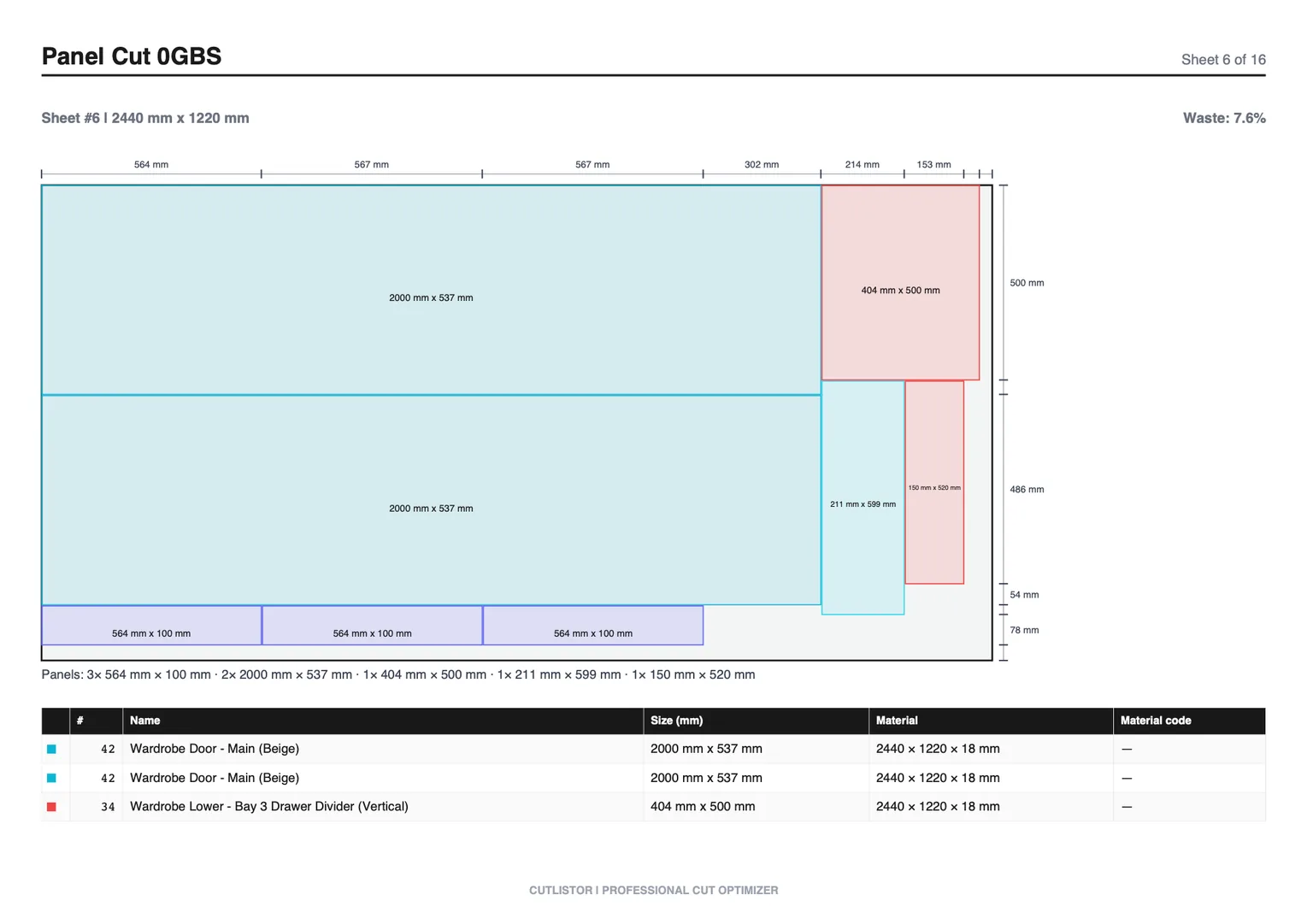
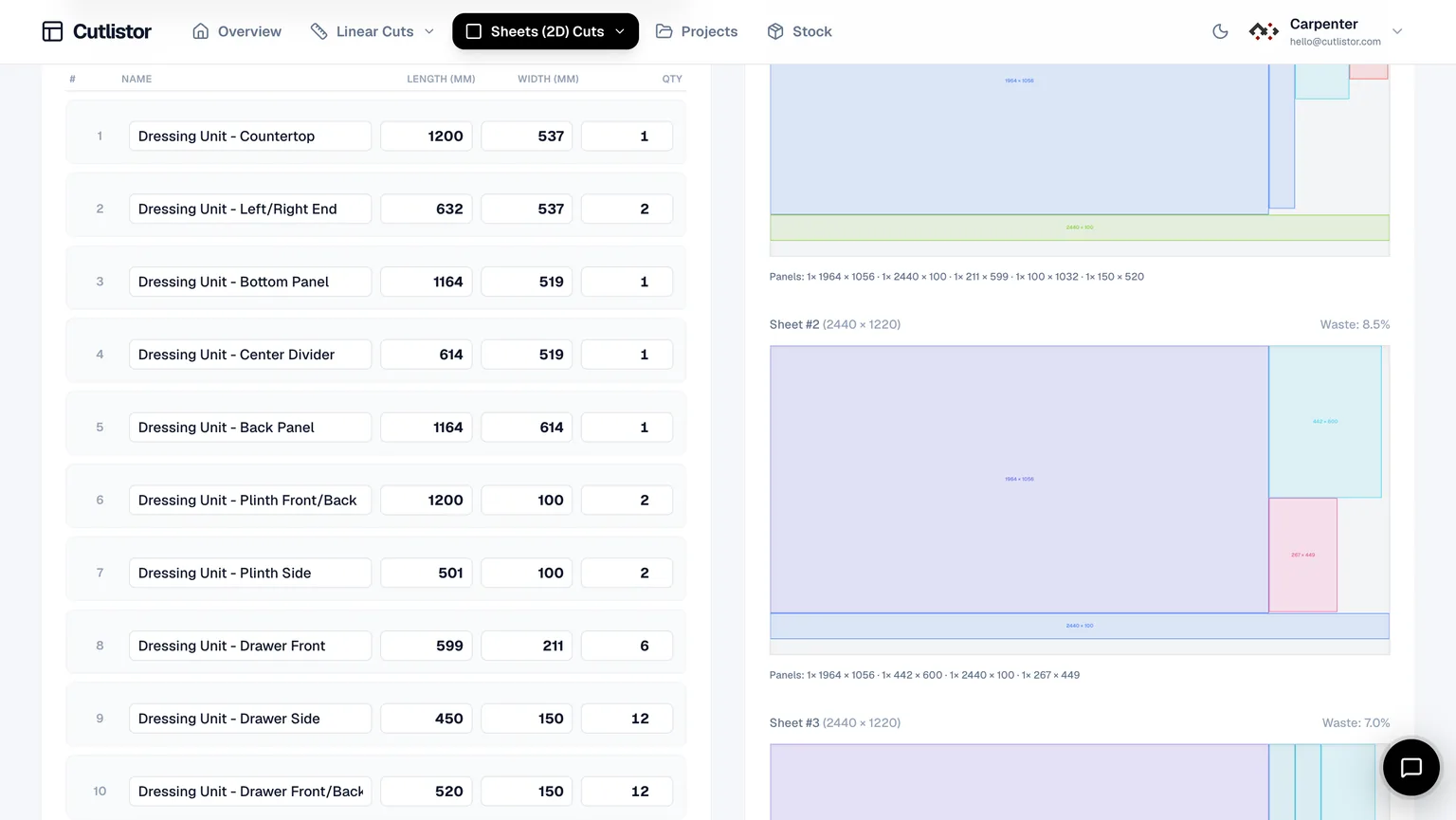
A cut list optimizer turns your part list into nested sheet layouts with kerf deducted and sheet count calculated. For any woodworking business that buys plywood, MDF, or melamine, it is one of the highest-return tools you can adopt early.
Better material utilization
Algorithms pack rectangles in two dimensions so more parts fit on each sheet. Small parts nest into gaps left by larger panels instead of each getting their own offcut zone.
Lower material costs
Fewer sheets per job means lower material line items on every quote. Savings repeat on every project without requiring you to work faster or charge less.
Faster project planning
Layouts generate in seconds after you enter stock sizes and parts. Revision when a client changes a dimension is a data edit, not a redrawing session.
More accurate quotes
Sheet count times unit price gives a defensible material number for estimates. Contractors and homeowners trust bids backed by clear material math.
Reduce human error
Labeled PDF cut plans reduce wrong-size rips and missed parts. The floor crew follows one diagram instead of interpreting spreadsheet rows.
Save hours on every project
Manual nesting on graph paper or in Excel does not scale. An optimizer frees shop time for building, finishing, and selling the next job.
How Cut List Optimization Increases Profit Margins
| Without optimizer | With Cutlistor | |
|---|---|---|
| Sheets per kitchen run | 22 | 20 |
| Material cost ($80/sheet) | $1,760 | $1,600 |
| Savings per job | $160 |
| Timeframe | Jobs | Savings at $160/job |
|---|---|---|
| One project | 1 | $160 |
| One month (4 kitchens) | 4 | $640 |
| One year (48 kitchens) | 48 | $7,680 |
That is material savings alone. Add avoided remakes from mis-cut panels, faster quoting, and less time drawing layouts, and the return on a cut list optimizer often exceeds accounting software or project management tools in the first month of active use.
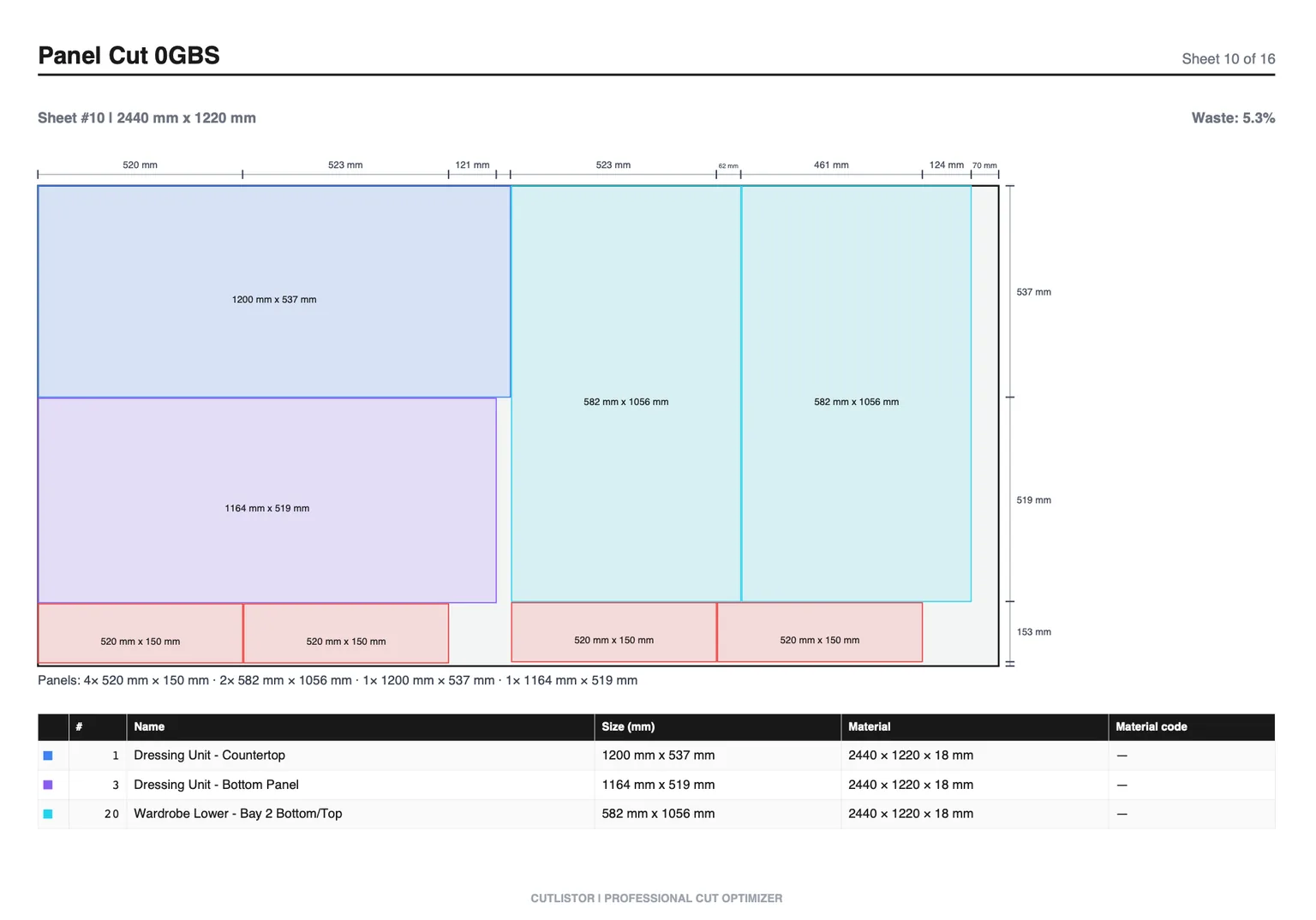
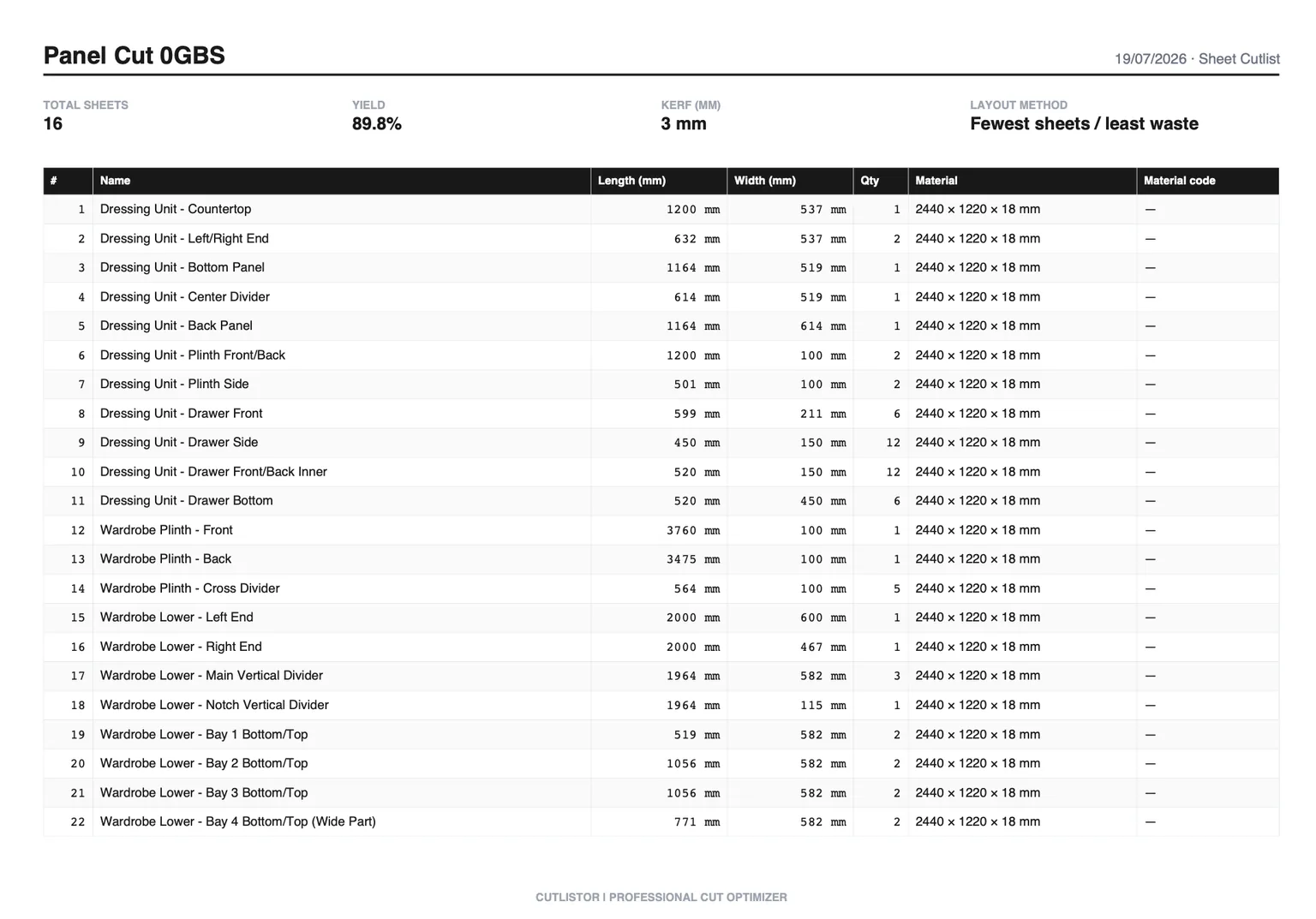
Real-World Example: Custom Kitchen Cabinets
How to Market Your Woodworking Business
Craft quality gets you referrals; marketing gets you found before the referral network kicks in. Focus on channels where homeowners and contractors search for local custom work.
- Google Business Profile: essential for local search; post project photos monthly
- Website: portfolio, services, contact form, and one clear call to action
- Instagram: before/after reels and shop process content build trust fast
- Facebook: local community groups and targeted ads for kitchen and built-in leads
- Pinterest: strong for cabinetry, closets, and furniture inspiration searches
- YouTube: shop tours and build videos establish authority for higher-ticket work
- Local networking: builders, designers, and real estate stagers refer steady work
- Referrals: ask satisfied clients explicitly; offer a small thank-you for introductions
Business Cards and Branding
Woodworking business cards still matter on job sites and at supply houses. Woodworking business card ideas that work keep the design clean and the contact info legible at arm's length.
- Logo: simple wordmark or monogram that reads at small sizes
- Contact details: phone, email, website, and city or service area
- QR code: link to portfolio or Google reviews
- Portfolio link: one URL that shows your best three to five projects
- Material: thick stock or a subtle texture suggests quality without gimmicks
Insurance and Legal Requirements
Treat the woodworking business as a real business from day one. Liability exposure exists the moment you install work in a client's home or on a job site.
- Liability insurance: general liability covers property damage and injury claims
- Business registration: LLC or sole proprietorship depending on state and risk tolerance
- Taxes: track income and expenses; set aside quarterly estimated payments
- Licenses: some jurisdictions require contractor or home-improvement licenses above certain job sizes
Common Mistakes New Woodworkers Make
- Underpricing jobs to win the first client
- Buying too many tools before validating the niche
- Not tracking material, labor, and overhead costs per project
- Wasting plywood through manual layouts and over-ordering
- Poor material planning with no cut lists before cutting
- Quoting without knowing sheet count or stick lengths
- Skipping a estimating process that can be repeated job after job
Recommended Software for a Modern Woodworking Business
| Category | Purpose | When to adopt |
|---|---|---|
| Accounting | Track income, expenses, and taxes | From first paid invoice |
| Invoicing | Send professional bills and accept payments | When you have repeat clients |
| CAD / design | Drawings, elevations, and client approvals | When selling custom casework or furniture |
| Project management | Job schedules, tasks, and client communication | When running multiple jobs at once |
| Cut list optimization | Nest parts, count sheets, export cut plans | Before your second sheet-goods job |
Cut list optimization has one of the fastest returns on investment because it reduces material waste on every project. Unlike a tool that helps one job type, an optimizer improves every cabinet run, closet, built-in, and sheet-goods furniture piece you build.
Optimize Every Sheet Before You Make the First Cut
Every sheet of plywood you waste comes directly out of your profit. Whether you're building cabinets, closets, furniture, or shelving, optimizing your cut list before cutting can save time, reduce waste, and increase your margins.
With Cutlistor you can:
- Optimize plywood, MDF, melamine, and lumber
- Generate professional cutting layouts in seconds
- Reduce material waste on every job
- Calculate exactly how many sheets to buy
- Estimate material costs before quoting clients
- Import cut lists from Excel or CSV
- Print and share optimized cutting diagrams with your team
Frequently Asked Questions
How do I start a woodworking business?
Choose a niche, register your business, set up a shop space, build a portfolio piece, price with real material and labor math, and market locally through Google Business Profile and referrals. Run a cut list optimizer on sheet-goods jobs from the start so quotes and material orders stay accurate.
Can I start a woodworking business from home?
Yes. Many profitable shops begin in a garage. Confirm zoning, HOA rules, noise limits, and insurance requirements in your area before taking paid work.
How much does it cost to start a woodworking business?
A basic home shop can start under $5,000 with used tools and minimal material stock. A cabinet-focused startup with new tools, dust collection, and initial insurance often runs $15,000 to $40,000 depending on equipment choices.
Is a woodworking business profitable?
It can be. Custom work with disciplined pricing and efficient material use often achieves 25–40% gross margins. Shops that waste less material and quote accurately keep more of each job as profit.
What tools do I need to start a woodworking business?
At minimum: table saw, miter saw, drill, sander, and measuring tools. Add a track saw or panel saw for sheet goods, a router for joinery, and CNC or edge banding as your niche and volume justify them.
How do I price woodworking projects?
Sum materials (with optimized sheet counts), labor hours at your shop rate, overhead allocation, and profit margin. Never copy a competitor's price without knowing your own costs.
How can I promote my woodworking business?
Claim Google Business Profile, post project photos on Instagram, ask every happy client for referrals, and network with local builders and designers. A simple portfolio website with contact info supports every other channel.
What's the best software for woodworking businesses?
Depends on stage: accounting and invoicing first, then CAD if you sell custom design-build work. For sheet goods, a cut list optimizer like Cutlistor delivers fast ROI by reducing waste on every job.
How can I reduce plywood waste?
Build a complete part list, set kerf to your blade, group materials by thickness, and run a sheet optimizer before ordering. Nest small parts into offcuts and export labeled PDF layouts for the shop floor.
What is a cut list optimizer?
A cut list optimizer arranges rectangular parts on sheet stock or lengths on lumber to minimize waste. It calculates how many sheets or sticks to buy and produces cutting diagrams for the shop. Cutlistor runs in the browser with CSV import and PDF export.
Conclusion
Success in woodworking is not just about craftsmanship. It is about running an efficient business. The shops with the healthiest profit margins do not simply sell more; they control costs on every job.
One of the easiest ways to do that is optimizing every sheet of material before cutting. A cut list optimizer like Cutlistor helps reduce waste, improve quoting accuracy, speed up project planning, and keep more profit from every cabinet run, built-in, or furniture piece you build.
Start with a clear niche, a simple business plan, honest pricing, and tools that protect margin from day one. Then open the free cut list optimizer on your next sheet-goods project and compare the sheet count to your old guess.