Article
Baltic Birch for Cabinets: Drawers, Edges & Shop Yield
Cutlistor Team4 min read
Introduction
Baltic birch earns its keep in cabinet shops as drawer-box stock and exposed-edge specialty work, not as the default for every kitchen carcass. Dense multi-ply birch, clean edges, and strong screw holding make it a premium SKU. Wasted strips hurt because the sheet price is high and sizes are often 5×5 ft instead of 4×8.
This guide is the cabinet-shop angle. For grades, ply counts, and general plywood context, see the Baltic birch plywood guide. Here we focus on drawer standards, when full carcasses make sense, nesting on non-4×8 sheets, and approximate 2026 cost bands.
Where Baltic Birch Wins in Cabinetry
| Cabinet use | Baltic birch fit | Shop note |
|---|---|---|
| Drawer boxes | Excellent | House standard for many custom shops |
| Exposed-edge open shelves | Excellent | Sand and finish edges |
| Full kitchen carcasses | Premium specialty | Cost and sheet size planning |
| Paint-grade doors | Usually poor choice | Use MDF instead |
| Melamine replacement | Different product | Not a TFL substitute |
Sheet Sizes and Thickness for Drawer Programs
| Part | Common thickness | Nesting tip |
|---|---|---|
| Drawer sides / fronts / backs | 1/2 in or 5/8 in | Separate stock row from 3/4 in carcass |
| Drawer bottoms | 1/4–1/2 in | Often different SKU |
| Jigs / templates | 1/2–3/4 in | Save remnants intentionally |
| Open shelf tops | 3/4 in | Grain and edge finish plan |
Cost and Yield: Treat It Like Premium Stock
Per square foot, Baltic birch often costs more than standard cabinet birch. Approximate mid-2026 shop pricing varies hard by thickness and region; plan for a premium over commodity 4×8 birch and re-bid every quarter. Remnant tracking matters: a usable 5×5 offcut can build several drawer sides.
Yield improves when drawer parts share a dedicated nest and when you standardize drawer heights so blanks repeat.
Shop Workflow: Separate from Carcass Ply
Keep Baltic birch on its own material code in the BOM and cut list. Do not mix with melamine or MDF door blanks. Many shops cut drawers on a dedicated day once carcasses are assembled.
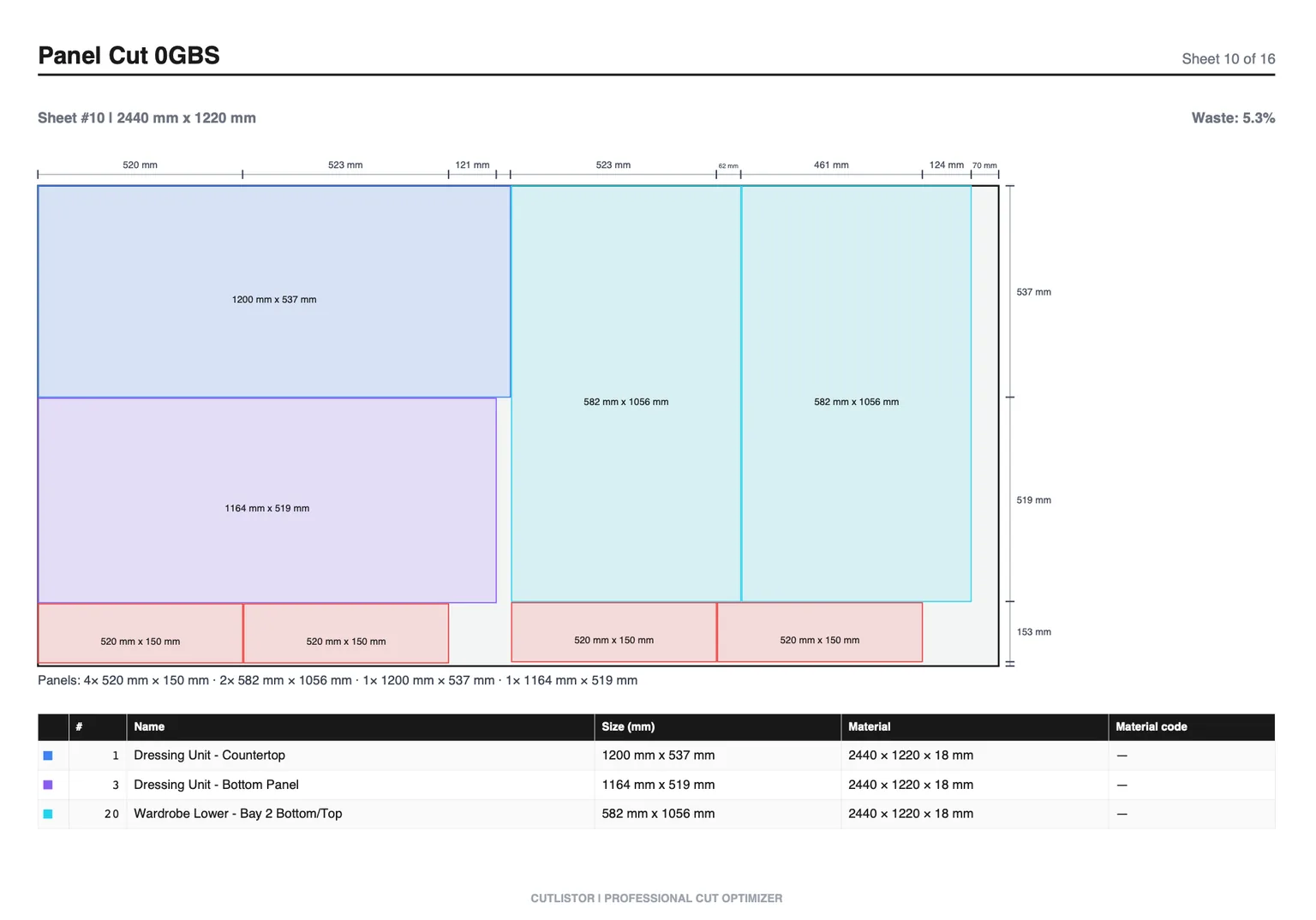
Cutlistor can nest Baltic birch on true sheet dimensions with kerf and PDF plans. Use the sheet optimizer for panels and the linear tool if you also cut hardwood edges or cleats. It is not a design suite.
Read the free tier this way: iteration is free, delivery is budgeted. Editing parts and re-optimizing the sheet cost nothing and are unlimited, while PDF export and starting a fresh project draw on 3 per day. The row cap is 20 per list, spreadsheet import is 5 rows per file, and projects are not saved.
Pro is $12/mo for saved projects and DXF export.
FAQ
Is Baltic birch the same as birch plywood?
Not always. Many “birch plywood” sheets are birch faces over mixed cores. True Baltic-style multi-ply birch uses birch throughout. Spec the product you want for exposed edges.
Should an entire kitchen be Baltic birch?
Only when the client pays for the look and your nest accounts for sheet size. Most commercial kitchens use standard carcass materials plus Baltic birch drawers.
Dimension Discipline on Cabinet Jobs
Drawer boxes make this concrete. A listed side height may be the finished dimension or the blank before the bottom groove is cut, and on 13-ply birch that difference is not something the assembler can correct later.
Standardize drawer heights across the job and the blanks repeat, which is what makes a premium sheet worth nesting carefully. Four drawer heights across a kitchen nest far better than eleven near-misses.
On stock this expensive, re-nest after any change rather than cutting from a superseded plan. A single wasted 5×5 sheet of Baltic birch costs more than the time it takes to re-run the layout.
Write the Baltic birch rules into your shop standard — its own stock row, its own nest — so it never lands on a 4×8 out of habit.
- One source of truth for openings vs carcase blanks
- Job number and revision date on every printed plan
- Separate sheet goods from linear face-frame stock
- Re-nest after any size change that touches a bought sheet
Conclusion
Baltic birch is a cabinet-shop premium tool: drawer boxes, exposed edges, and specialty parts. Nest on real sheet sizes, separate it from carcass SKUs, and track remnants so the premium stock keeps earning.