
Article
How Saw Kerf Affects Cabinet Cutting
Cutlistor Team4 min read
Introduction
Kerf is the material removed by the blade or bit. On a cabinet cut list with dozens of rips, that thin strip compounds into short parts, extra sheets, or both. This article focuses on cabinet shop impact: melamine and plywood nests, door blanks, and quoting. For definitions and general measurement methods, see the full kerf guide.
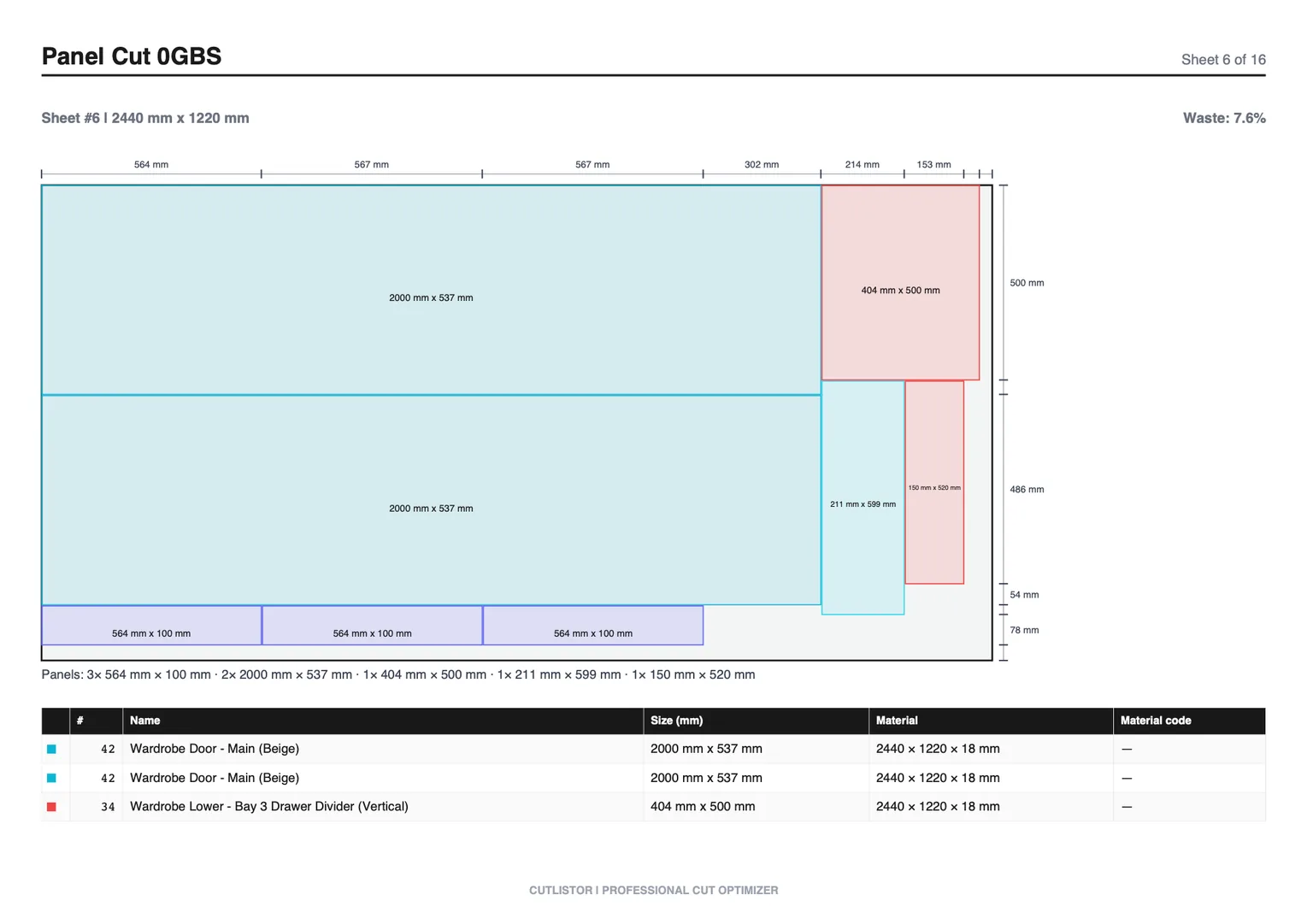
Read kerf explained for the core concept, then use the cabinet examples below when you set Cutlistor or any nest before a sheet PO.
Why kerf hits cabinet work hard
Casework nests pack many similar rectangles. Each shared cut between parts consumes kerf. Ignore it and the last part on a rip comes up small, or the nest claims a sheet count the floor cannot achieve without undersize panels.
- Panel saws: typical kerf around 2.8 to 3.5 mm depending on blade
- CNC routers: effective kerf near bit diameter (plus any finishing pass strategy)
- Score blades: still count full kerf on the cut that separates parts
- Multiple material groups: set kerf per machine that will cut that group
Part size accuracy and reveals
Doors and drawer fronts fail visually when blanks are short by a kerf. Carcass sides that shrink throw off backs and toe kicks. Measuring kerf on scrap of the same thickness as the job is cheaper than remaking a painted door set.
How kerf changes sheet count
| Nest setting | Sheets (example kitchen pack) | Floor result |
|---|---|---|
| 0 mm kerf | 11 | Parts short; remakes or forced re-layout |
| 3.2 mm kerf (measured) | 12 | Parts land on size; PO matches cut |
| Wrong 1 mm guess | 11 | Cumulative error across long rips |
Paying for the twelfth sheet in purchasing is cheaper than discovering the shortage after edge banding and hinging.
Worked yield sketch
On a 2440 × 1220 mm sheet, a 3 mm kerf between every part in a dense nest can remove well over a full percent of sheet area in kerf alone, before remnant waste. Cabinet estimators who bake kerf into the nest stop arguing with the sawyer about who shorted the shelf.
Cabinet shop practice
Tape a kerf coupon when you change blades or bits. Store the number by machine. Enter it on every nest. Re-check after a blade swap mid-week. Different machines on carcass versus doors can mean two kerf values on one kitchen.
- Coupon cut on the same material thickness as production
- Update Cutlistor or nest presets when the number changes
- Do not copy a competitor’s kerf; measure yours
- Train estimators that zero kerf nests are not valid POs
Setting kerf in Cutlistor
Most free optimizers meter the optimizing. Cutlistor does not — you can tweak parts and re-run the layout as often as a job needs. The daily ceiling of 3 applies to PDF exports and new projects only. Expect a 20-row cut list limit, a 5-row ceiling on each CSV or XLSX import, and no saved projects.
FAQ
Does a scoring blade change how I enter kerf?
Enter the kerf of the cut that separates the finished parts (usually the main blade). Scoring reduces chip-out; it does not remove the need for a kerf value in the nest.
Does kerf matter on edge banding sticks?
Yes for sawn solid stock. Banding rolls are different. Use the linear optimizer with kerf when you cut stick goods to length.
Where can I learn kerf basics?
See the dedicated kerf article for definitions, measurement, and general examples beyond cabinets.
Floor Practice That Protects Yield
Kerf is the smallest number in the cut list and the one most often wrong. An eighth-inch assumption running against a 3.2 mm blade compounds across every rip in the sheet.
Cut a test piece, measure the removed width with calipers, and use that number. Blade brand, tooth count, and stock all move it, and a saved kerf value from a different blade is worse than no value at all.
Accurate kerf tends to consolidate waste into fewer, larger drops. Capture that gain: label the useful ones with size and material so the next job pulls from the rack before opening a fresh sheet.
Record the measured kerf for each blade in the shop standard so nobody defaults back to guessing an eighth of an inch.
- Kerf from a test cut on the same material family
- Grain lock on doors, gables, and show shelves
- Trim allowances decided before nesting, not at the saw
- Offcut shelf with minimum size rules your shop respects
Conclusion
Saw kerf is a cabinet purchasing and quality input, not a footnote. Measure it, enter it, and accept the sheet count the nest reports. That habit protects reveals, schedules, and margin.