Article
Material Yield Explained: Percentages, Waste, and Worked Examples
Cutlistor Team5 min read
Introduction
Material yield is the share of purchased stock that becomes finished, billable parts. Everything else is waste: kerf dust, trim strips, and drops too small to reuse. Yield is how fabricators compare layouts, quote jobs, and judge whether a nest is worth running.
This guide defines yield in plain numbers, splits waste into components you can control, works examples on sheet and bar, and shows how Cutlistor reports yield on rectangular nests and linear cut lists. For the wider metal workflow, start from our metal fabrication hub.
What is material yield?
Yield is usually expressed as a percentage: part area (or length) divided by stock area (or length) used, times 100. A 85% yield on a plate nest means 85% of the sheet you cut became paid parts and 15% left as kerf, trim, or scrap.
Higher yield means lower material cost per part. Two layouts with the same part list can differ by five to fifteen yield points depending on kerf, stock size, rotation, and whether remnants are reusable.
- Sheet yield: sum of part areas ÷ total sheet area consumed
- Linear yield: sum of cut lengths ÷ total bar length opened (including kerf)
- Quote yield: include waste you cannot reuse in the cost model
Components of waste
| Component | What it is | Typical fix |
|---|---|---|
| Kerf loss | Material removed by blade, torch, or bit | Measure kerf; thin kerf tooling |
| Trim | Mill edge or grip margin you never nest into | Enter usable nest window |
| Inter-part gutter | Required spacing between nested parts | Already in optimizer kerf settings |
| Unusable remnant | Drop below reuse threshold | Smaller stock SKU or combine jobs |
| Damage / rework | Handling or wrong cut | Process control, not nesting |
Worked example: sheet yield on plate
| Item | Calculation | Value |
|---|---|---|
| One sheet gross area | 2.5 m × 1.25 m | 3.125 m² |
| Bracket part area each | 0.35 × 0.22 | 0.077 m² |
| Eight brackets total | 8 × 0.077 | 0.616 m² |
| Foot part area each | 0.10 × 0.08 | 0.008 m² |
| Four feet total | 4 × 0.008 | 0.032 m² |
| Total part area | 0.616 + 0.032 | 0.648 m² |
| Naive yield (ignores kerf) | 0.648 ÷ 3.125 | 20.7% |
| After nesting with kerf | Optimizer result | ~78-84% on one sheet if parts pack tightly |
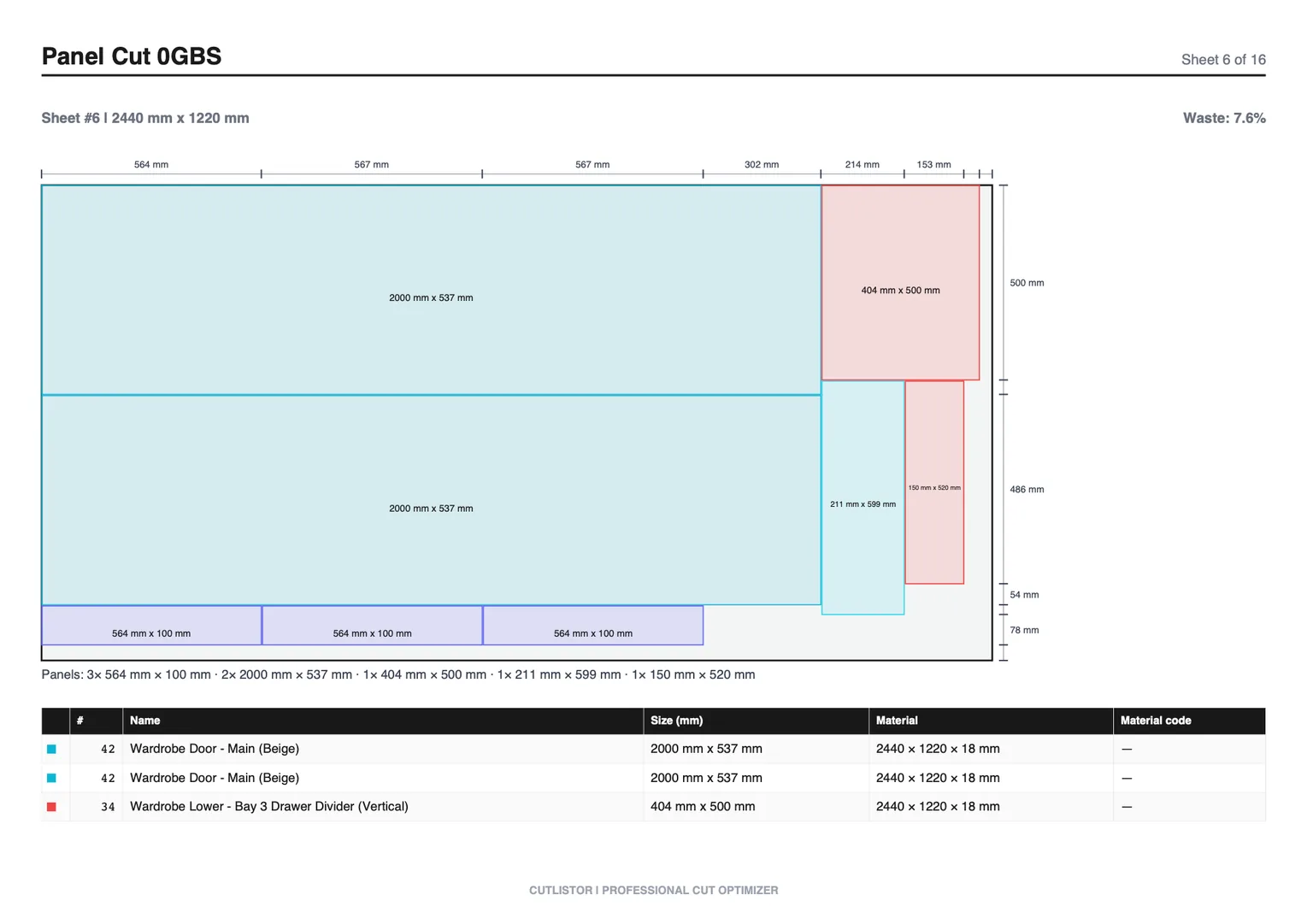
The naive 20.7% number is not how quoting works: you consume whole sheets. The optimizer packs parts, subtracts kerf on every cut, and reports true yield on the sheet area actually used. If the layout needs two sheets, divide part area by two sheet areas for job yield.
Worked example: linear yield on bar
Stick 1: cut 2400 + 3 kerf + 2400 + 3 kerf = 4806 mm used, 1194 mm drop. Stick 2: third and fourth parts use 4806 mm again, 1194 mm drop. Stick 3: fifth and sixth parts use 4806 mm, 1194 mm drop. Total bar opened: 18000 mm. Total part length: 14400 mm. Linear yield ≈ 14400 ÷ 18000 = 80%. Kerf consumed 18 mm (six cuts × 3 mm). Drops total 3582 mm: reusable if your minimum is 1000 mm, scrap if you never reuse 1194 mm tails.
| Scenario | Bar lengths offered | Sticks opened | Yield trend |
|---|---|---|---|
| 6 m only | 6000 mm | 3 | 80% in example above |
| 6 m + 12 m mix | 6000 and 12000 mm | Optimizer chooses | Often improves if 12 m packs pairs |
| With 2400 mm drop reused | Prior 1194 mm too short | Add shorter stock SKU | Next job yield rises |
How to improve yield
Yield gains come from better inputs and layout choice, not from hoping the saw gets sharper.
- Measure and enter correct kerf for each process
- Offer multiple stock sizes in linear runs so the algorithm picks cheaper totals
- Enter usable remnants as stock before buying new material
- Compare layout methods on sheet jobs (guillotine vs shelf vs maxrects-style)
- Lock grain only when required; unnecessary locks lower yield
- Batch small parts from the same grade onto one nest
- Nest before PO: re-run when BOM changes (free re-optimize in Cutlistor)
Yield in quoting and margin
Estimators often apply a flat scrap factor (5% or 10%) instead of nesting. Flat factors hide good and bad jobs alike. Nesting gives a yield number you can attach to the quote PDF.
When material price spikes, yield points translate directly to margin. A 5% yield improvement on a twelve-sheet stainless job can exceed a day of labour savings.
When a flat factor is still OK
Very small one-off cuts with no time to nest may use historical scrap rates. Repeat production should always nest.
How Cutlistor reports yield
The sheet optimizer shows yield per sheet and overall for rectangular nests with kerf gutters. The linear optimizer shows stick count and tail waste so you can judge linear yield before buying bar.
Cutlistor uses rectangular 2D packing, not true-shape nesting. Yield on irregular laser parts may differ once CAM nests the real outline. Use Cutlistor yield for rectangular blanks and stick planning; validate laser jobs in CAM when contours dominate scrap.
Conclusion
Material yield turns layout quality into a number estimators and buyers can trust. Split waste into kerf, trim, and remnants so you know what to fix. Work sheet and bar examples on real BOMs before you PO stock.
Cutlistor shows yield on rectangular sheet nests and linear stick plans in the browser, with unlimited re-optimization while you edit parts. Pair yield tracking with nest-before-buy discipline and metal waste drops without surprise.