
Article
Manual Cabinet Cut Lists vs Optimized Cut Lists
Cutlistor Team4 min read
Introduction
Manual cabinet cut lists still run many shops: spreadsheet quantities, a whiteboard rip plan, and a pad of extra sheets “for safety.” Optimized cut lists use the same BOM but pack parts with kerf and grain rules so the sheet PO matches the floor. The difference shows up in material cost, remake rate, and how fast you can release a job.
This comparison is commercial. It is about margin and throughput, not novelty software.
What each approach actually is
| Dimension | Manual cut list | Optimized cut list |
|---|---|---|
| BOM accuracy | Can be excellent | Same BOM, plus nest |
| Sheet count | Pad factor or whiteboard guess | Kerf-aware nest result |
| Grain / kerf | Easy to forget | Forced as inputs |
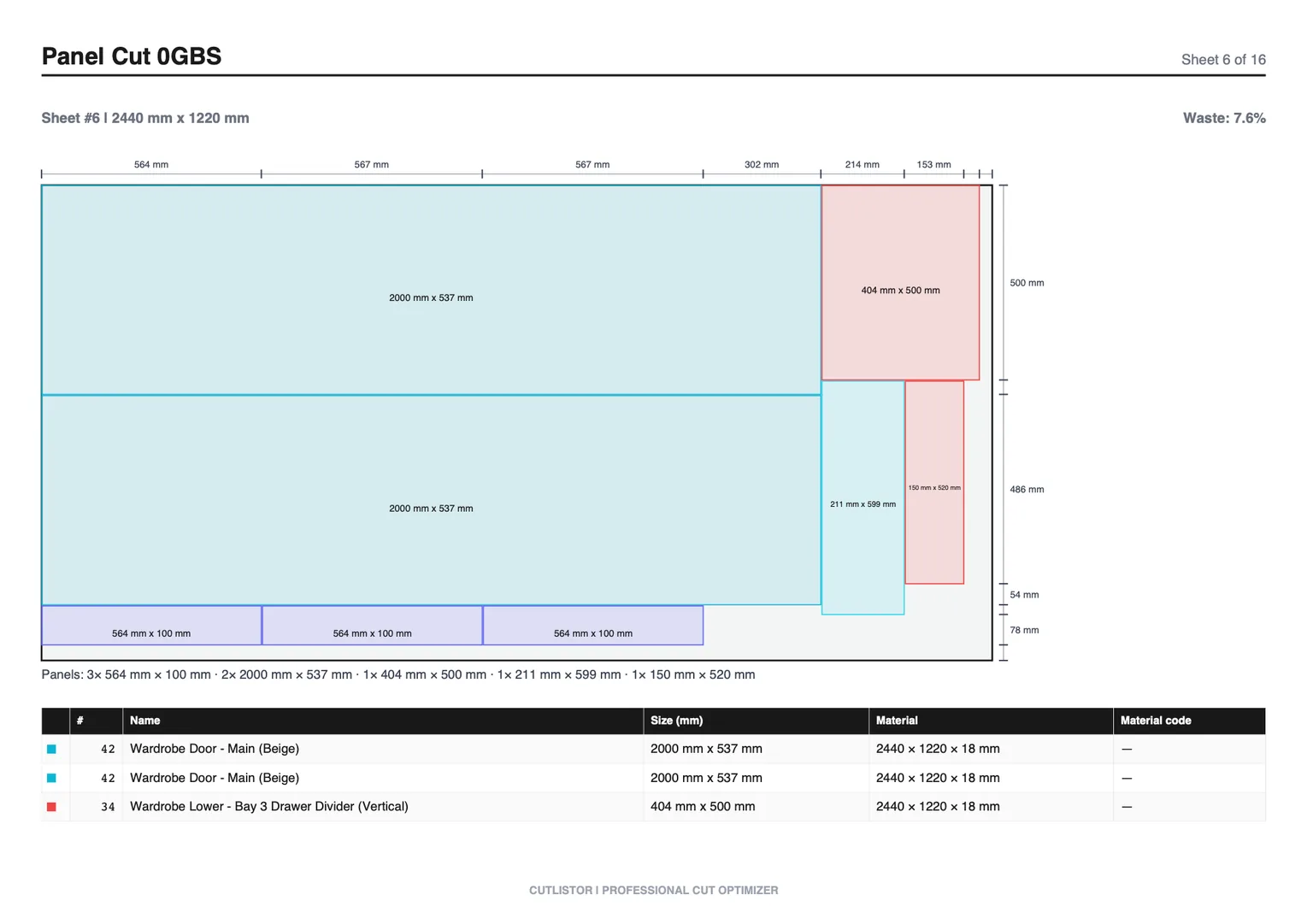
| Floor handoff | Notes and memory | PDF cut plans |
| Re-quote after change | Slow redraw | Re-optimize in minutes |
| Learning curve | Low | Low for rectangular casework |
Sheet count comparison (worked)
| Method | Sheets | Yield | Material at $88/sheet | Estimator time |
|---|---|---|---|---|
| Spreadsheet area × 1.20 | 15 | ~70% | $1,320 | 20 min + hope |
| Whiteboard layout | 14 | ~73% | $1,232 | 45 to 90 min |
| Optimized nest (Cutlistor) | 12 | ~82% | $1,056 | 15 to 25 min |
Three sheets versus the padded spreadsheet is $264 on one kitchen. Across ten kitchens a month, that is material alone before counting whiteboard hours returned to billable work.
Quoting accuracy
Manual pads either overcharge material (and lose bids) or undercharge (and lose margin). Optimized nests give a defendable sheet count by material. When the client adds a pantry, you re-nest and update the number instead of arguing about contingency.
When a manual list is still fine
One-off repairs with three parts, or a single sheet job you can see by eye, do not need a full nest. The break-even is low: as soon as sheet count is uncertain or grain rules apply, optimization pays.
- Manual OK: tiny lists, clear single-sheet fits
- Optimize: kitchens, multi-box runs, door packs, batched jobs
- Always measure kerf even on manual layouts
- Never skip grain decisions on woodgrain or veneer show faces
Shop throughput
Optimized PDFs reduce saw setup debates and miscuts. Batching multiple jobs into one nest is impractical on a whiteboard and natural in software. That is how offcuts shrink and weekly sheet buys drop.
Trying optimized lists with Cutlistor
The free tier's limits sit around the edges of the work rather than in the middle of it. Editing and re-optimizing are unlimited; PDF exports and new projects share a daily budget of 3. A single session carries up to 20 part rows, each CSV or XLSX import up to 5 rows, and nothing is stored after you close it.
FAQ
Does optimization replace cabinet design software?
No. Design software produces sizes and hardware. Optimization purchases and lays out sheet goods from those sizes.
Will my experienced sawyer hate PDFs?
Most prefer a clear plan over a rushed whiteboard. Invite them to validate kerf and grain inputs so the nest matches how they already cut.
Does optimized always mean fewer sheets?
Usually versus padded manuals. Versus a careful whiteboard, gains vary. You still win on speed, repeatability, and re-nesting after changes.
Dimension Discipline on Cabinet Jobs
Hand-written lists tend to carry the convention in the writer's head; optimized lists have to make it explicit. That is an advantage, not a burden — but only if someone actually names the convention on the sheet.
This is where optimized lists pull decisively ahead. Quantities are consolidated automatically and mirrored pairs stay flagged, whereas a hand list tends to repeat near-identical rows that a tired sawyer reads as identical.
Revision handling is the clearest practical argument for a digital list. Changing one part and re-nesting takes a minute; finding every consequence of that change on a hand-drawn layout takes an afternoon and usually misses one.
Record which jobs still justify nesting by hand, so the exception stays an exception rather than a habit.
- One source of truth for openings vs carcase blanks
- Job number and revision date on every printed plan
- Separate sheet goods from linear face-frame stock
- Re-nest after any size change that touches a bought sheet
Conclusion
Manual cabinet cut lists track parts. Optimized cut lists turn those parts into purchasable sheet counts with kerf and grain baked in. For shops running weekly kitchens, the optimized path protects margin and frees estimator hours.