
Article
Pre-Finished Plywood for Cabinets: Speed, Specs & Nesting
Cutlistor Team4 min read
Introduction
Pre-finished plywood (factory UV-cured clear or tinted finish on hardwood plywood) lets cabinet shops build wood-look interiors without spraying every carcass side. It sits between raw cabinet plywood and melamine: plywood core strength with a finished face.
Purchasing leads care about lot matching, banding color, face protection, and sheet yield. This guide covers when pre-finished ply wins the bid, how to cut and nest it, and approximate 2026 price context with regional caveats.
When Pre-Finished Plywood Wins
Use it when the client wants a clear wood interior, your spray booth is the bottleneck, and you still want plywood screw holding. It is popular for custom kitchens and vanities where melamine feels too commercial but raw plywood finishing would blow the schedule.
- Custom boxes with maple or birch clear interiors
- Shops selling plywood carcass upgrades without full finishing labor
- Jobs where booth capacity, not saw capacity, is the constraint
- Remodels that need fast install with finished interiors
Vs Raw Plywood and Melamine
| Factor | Pre-finished plywood | Raw cabinet plywood | Melamine |
|---|---|---|---|
| Face finish | Factory UV | Shop or site finish | TFL laminate |
| Core | Plywood | Plywood | Usually particle |
| Look | Wood grain | Wood grain (after finish) | Solid color or print |
| Touch-up | Needs matching kits | Easier before topcoat | Hard on chips |
| Speed | Fast assembly | Slower if finishing | Fastest production |
| Approx. sheet cost* | Higher than raw | Mid | Often lowest |
*Approximate relative cost only. Mid-2026 prefinished maple/birch often lands roughly $90–$180 per common 4×8 sheet in many U.S. markets; confirm locally.
Handling, Edges, and Lot Matching
Protect faces from the first cut. Pad saw tables, keep parts labeled show-face down or up per shop rule, and order banding that matches the factory tone. Buy enough sheets from the same lot for a visible run; mixing dye lots shows on large elevations.
Cut edges need banding or solid edge. Factor banding scrap into yield. Drill carefully so chip-out on the show face stays minimal.
Nesting Rules That Protect Expensive Faces
Lock grain on show sides and doors cut from prefinished stock. Separate prefinished nests from raw MDF door blanks and from white melamine. Remnants are valuable: label species, finish, and dimensions for the next job.
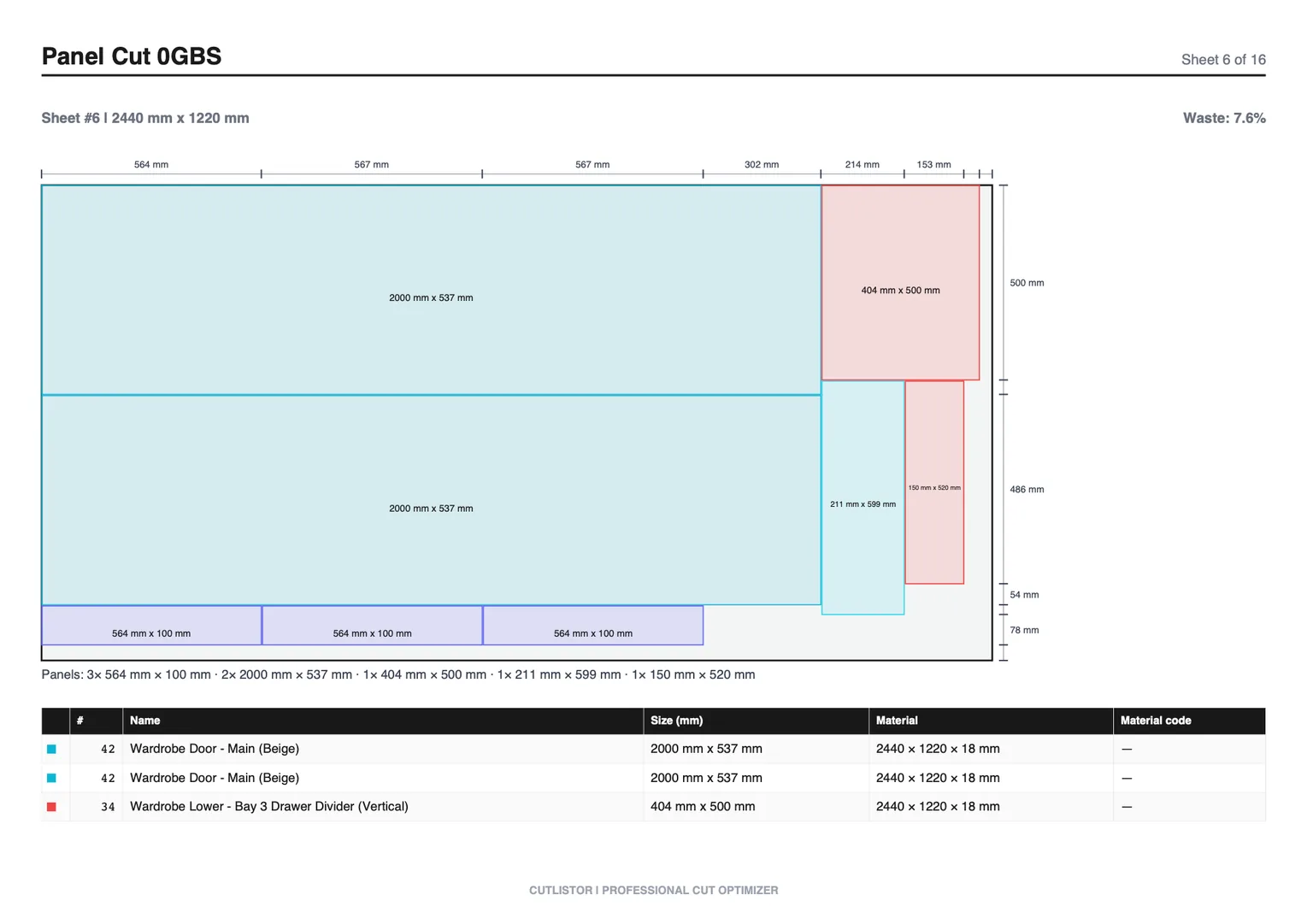
Cutlistor nests rectangular parts on purchased sheet sizes with kerf and PDF plans. It is a sheet and linear optimizer, not a kitchen design suite.
Free use is genuinely unmetered where it matters for cutting: change a dimension, re-nest, change it again, at no cost. The 3-per-day allowance covers PDF exports and new projects. Cut lists stop at 20 rows, imported CSV or XLSX files at 5 rows, and there is no persistence between visits.
Pro is $12/mo for saved projects and DXF when you send rectangles to CNC.
Quoting Pre-Finished Upgrades
Sell prefinished plywood as a package: material premium, reduced finishing labor, and schedule certainty. Show the client a sample door/box corner with banding. When plywood prices rise, re-nest and re-bid; do not assume last quarter’s sheet count still holds if part sizes changed.
FAQ
Should doors also be prefinished plywood?
Sometimes for slab wood doors. Painted doors usually stay MDF. Mixed specs (prefinished boxes + painted MDF doors) are common and profitable.
Is prefinished plywood better than melamine?
Different jobs. Prefinished ply wins wood aesthetics and core strength. Melamine wins lowest production cost and wipe-clean solids. Choose by client and margin, not ideology.
Floor Practice That Protects Yield
Prefinished stock changes the arithmetic of a mistake. You are no longer scrapping plywood; you are scrapping plywood plus the finishing you have already paid for.
On prefinished panels the blade matters twice: kerf accuracy for yield, and tooth geometry for tear-out on a face you cannot sand. Measure the first, test-cut for the second, and lock grain on every exposed part.
Prefinished offcuts are worth real money, so treat the rack accordingly: label size, species, and which faces are finished. An unmarked prefinished drop usually ends up cut into shop fixtures.
Write the prefinished handling rules down. Scratch and tear-out losses are avoidable, but only when the rules are explicit.
- Kerf from a test cut on the same material family
- Grain lock on doors, gables, and show shelves
- Trim allowances decided before nesting, not at the saw
- Offcut shelf with minimum size rules your shop respects
Conclusion
Pre-finished plywood is the commercial bridge between raw custom plywood and melamine production. Spec lots carefully, protect faces, band edges, and nest with grain lock so expensive sheets do not become scrap.