Article
Cabinet Parts Explained: Box, Gables, Nailers, Fillers, and More
Cutlistor Team5 min read
Introduction
Cabinet shops speak in parts: gables, bottoms, stretchers, nailers, fillers, and toe kicks. Each name maps to a cut list row, a material choice, and a place in the nest. Mislabel a left gable as a shelf blank and you waste a sheet of pre-finished melamine before assembly starts.
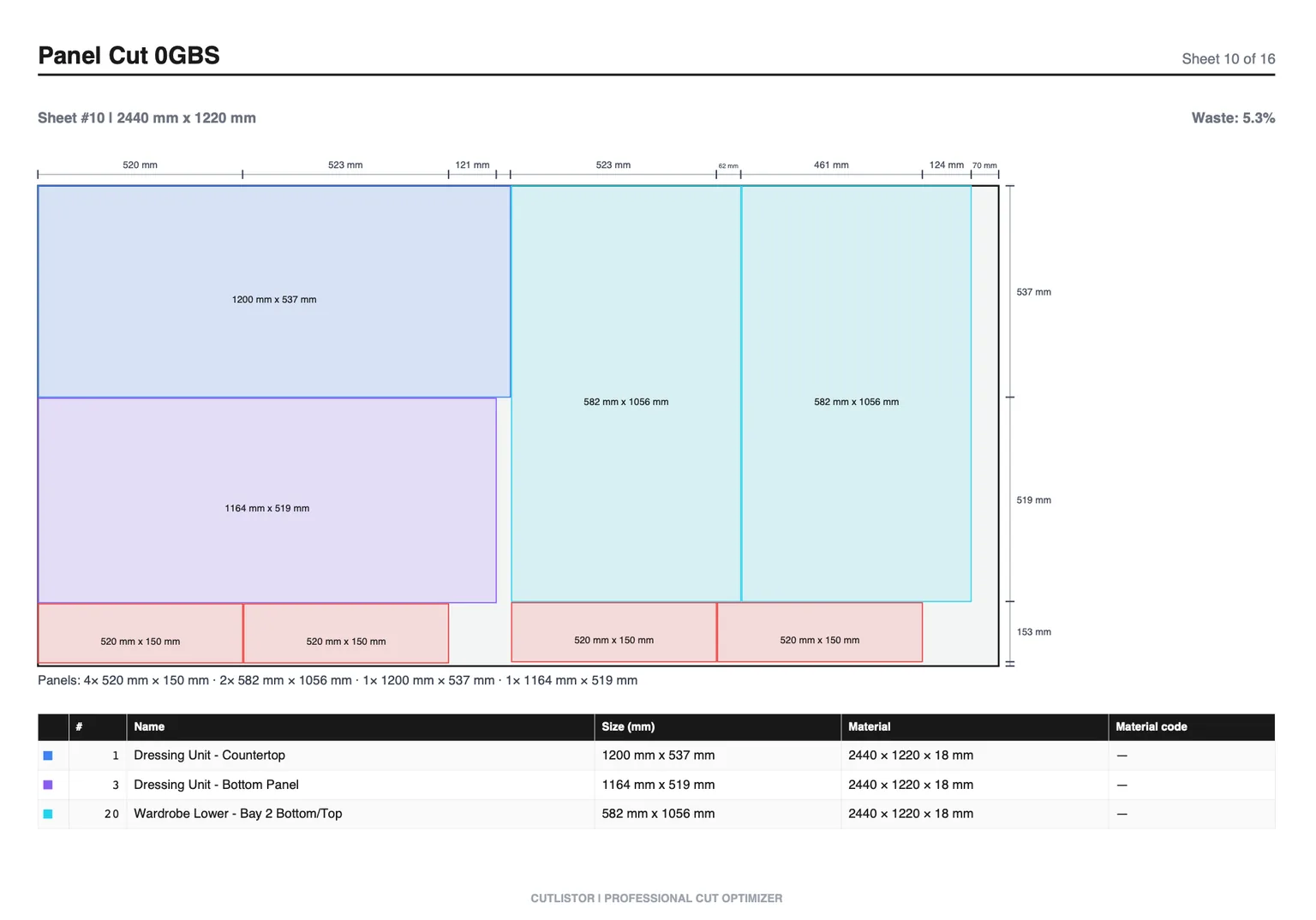
This guide explains the major cabinet parts professional makers cut and assemble, how they differ between face-frame and frameless construction, and which optimizer mode each family uses. Use it as a floor and estimating reference alongside the full terminology guide.
For a dictionary-style index, see the cabinet terminology guide. For nesting those parts, start from the cabinet making hub.
The Carcase: Box Parts That Form the Case
The carcase (or cabinet box) is the structural shell. Doors, drawers, and hardware dress it. On a cut list, carcase parts dominate sheet nesting because they are large rectangles cut from melamine, plywood, or MDF.
Typical sheet parts: left and right gables (sides), bottom, top or stretchers, fixed and adjustable shelves, back, and nailers or hanging rails. Construction method changes which of those are full panels versus strips.
Gables (Sides)
Gables are the vertical side panels of the box. In North American shop language, left and right gables define box height and depth. They are often the largest sheet parts on a base or tall cabinet and usually carry grain vertically on show ends.
Frameless gables often become the finished side when exposed. Face-frame gables may sit behind the frame and accept dados for bottoms and shelves. Either way, each box needs a matched left/right pair on the cut list.
- Base gable height commonly 34.5 in (876 mm) before countertop in NA kitchens
- Base gable depth commonly about 23.25 to 24 in depending on whether depth is finished outside or to face
- Wall gables often 12 in (305 mm) deep and 30 or 42 in high depending on the run
- Grain lock on exposed ends; nest carefully to protect yield
Bottoms, Tops, Stretchers, and Shelves
| Part | Role | Cut list notes |
|---|---|---|
| Bottom | Floor of the box | Often dadoed; check finished width vs gable dados |
| Full top | Closes upper or tall boxes | May need cutouts for vents or lights |
| Stretchers | Front/rear strips on bases | Narrow rectangles; good nest fillers |
| Fixed shelf | Structural divider | Often thicker or edged for stiffness |
| Adjustable shelf | User shelves | Batch identical sizes across boxes |
Backs
Backs square the box and provide a fastening surface to the wall. Full backs are common in frameless and higher-grade work. Partial backs or nailer-only systems appear in some face-frame shops to save sheet goods, at the cost of racking resistance if not detailed carefully.
Back material is often thinner (1/4 in or 1/2 in / 6 to 12 mm) than the 3/4 in (19 mm) carcase. Keep backs on their own material group in the cut list so they never nest onto 3/4 in stock by mistake.
Nailers and Hanging Rails
Nailers (also called hanging rails or cleats) are horizontal strips at the top, and sometimes bottom, of the box. They catch screws into wall studs and stiffen the opening. On wall cabinets they are structural; on bases they may support the countertop or tie the stretchers.
Cut list treatment: short, wide rectangles from the same thickness as the carcase, or solid strips optimized linearly. Label them clearly so they are not confused with stretchers.
Toe Kick
The toe kick is the recessed plinth at the front of base cabinets that lets someone stand close to the counter. Typical NA recess is about 3 in (76 mm) high and 3 in deep, though shops vary. The kick can be integral to the box, a separate platform, or a continuous run of kick faces across multiple cabinets.
Cut list impact: either notches/recesses in gables and a kick face strip, or a separate ladder/platform with its own sheet and linear parts. See the dedicated toe kick article for construction options.
Fillers and Scribe Strips
Fillers close gaps between cabinets and walls, appliances, or inside corners. They absorb out-of-square rooms so the boxes stay modular. On the cut list they are usually linear parts: width set by field measure, length matching cabinet height.
Never cut fillers to final width until the install measure is confirmed. Nest or rip oversized blanks if the shop prefabricates, then scribe on site.
Face Frames, Doors, and Drawer Parts
Face-frame stiles and rails are linear hardwood (or sheet strips) that attach to the front of the box. Doors and drawer fronts may be slab sheet goods or five-piece frames; either way they need their own material group and often grain-matched nesting.
Drawer boxes add another sheet family (sides, fronts, backs, bottoms) when the shop builds them in-house. Many shops buy drawer boxes and keep only fronts on the cut list.
How Parts Map to Nesting Modes
| Part family | Typical stock | Optimizer |
|---|---|---|
| Gables, bottoms, shelves, stretchers | 3/4 in sheet | 2D sheet |
| Backs | 1/4 or 1/2 in sheet | 2D sheet (separate SKU) |
| Nailers from sheet | 3/4 in sheet strips | 2D sheet |
| Face-frame stock | Hardwood sticks | 1D linear |
| Fillers / scribe | Matching face material | 1D linear |
| Toe-kick faces | Sheet or solid | 2D or 1D by method |
FAQ
Is a gable the same as an end panel?
Often yes in shop speech. Some shops reserve 'end panel' or 'finished end' for a decorative skin applied over a gable. Confirm local usage on drawings so the cut list does not double-count.
What is the difference between a stretcher and a nailer?
Stretchers typically span front or rear at the top of a base to stiffen the opening and support the countertop zone. Nailers / hanging rails are fastening strips for wall attachment. Overlap exists in slang; label by function on the cut list.
Can every cabinet part nest on sheet goods?
Carcase panels yes. Face frames, many fillers, and some kick wraps are more efficient as linear stock. Mixed jobs should run both the sheet and linear optimizers.
Conclusion
Continue with the cabinet making pillar or nest a sample box BOM in the free sheet optimizer.