Article
Plywood vs MDF for Cabinets: Boxes, Doors, Shelves, Yield & Cost
Cutlistor Team4 min read
Introduction
In a commercial cabinet shop, plywood vs MDF is not a hobby debate. It is a purchasing and quoting decision that shows up on every PO: which SKU for carcasses, which for paint-grade doors, which for adjustable shelves, and how many sheets you actually need after kerf and grain lock.
This article is written for shops that build boxes, hang doors, and quote kitchens by the sheet. For a general woodworking comparison, see our broader plywood vs MDF guide. Here the focus is carcass strength, door machining, shelf span, yield on 4×8 and metric panels, and approximate 2026 material cost ranges (regional variation is large; treat numbers as planning bands, not quotes).
If you are planning a full kitchen or remodel cut list, start from the cabinet making hub and nest parts before you buy stock.
How Cabinet Shops Decide: Role, Not Brand Loyalty
| Cabinet part | Usually plywood | Usually MDF | Shop note |
|---|---|---|---|
| Base/wall box sides & decks | Yes (veneer or prefinished) | Rare for premium custom | Screw holding and racking resistance |
| Adjustable shelves | Preferred for long spans | Only short spans or thick stock | Sag risk drives callbacks |
| Paint-grade slab doors | Possible, more grain telegraph | Preferred | Flatness and CNC profiling |
| Shaker rails/stiles (paint) | Solid or ply options | MDF common | Match door system to finish |
| Toe kicks / skins | Either | Either | Often cheapest stable sheet |
| Sink base / wet zones | Sealed plywood preferred | Avoid raw MDF | Moisture risk |
Cabinet Boxes: Strength, Screws, and Install Reality
Carcasses take pocket screws, confirmat screws, European hinges, drawer slides, and racking loads during delivery. Veneer-core plywood generally holds fasteners better than MDF and recovers better from a slightly overdriven screw. Prefinished plywood and melamine boxes are also common; pure MDF boxes are uncommon in mid-to-premium custom work because weight and moisture risk climb fast.
If a client wants paint-grade interiors, many shops still build plywood boxes and paint or use prefinished panels rather than switching the entire box to MDF.
- Hinge plates and slide screws: plywood cores tolerate re-drills better than dense fiberboard
- Racking in transit: plywood carcasses usually stay squarer with less blocking
- Weight: MDF boxes raise trucking and install crew fatigue
- Hybrid shops: plywood sides + MDF doors is a standard profitable mix
Doors: Where MDF Often Wins the Quote
Paint-grade doors are where MDF earns its place. It machines cleanly for shaker profiles, stays flatter than many plywood slabs under paint, and takes primer well. Hardwood plywood doors make sense for clear or stained faces, not as a default paint substrate.
Do not nest door blanks on the same sheet as carcass parts unless thickness, finish, and process truly match. Separate material groups keep yield honest and avoid contaminating a prefinished nest with raw door stock.
Shelves and Sag: Thickness Beats Marketing Claims
| Shelf scenario | Safer default | Why |
|---|---|---|
| ≤24 in span, painted, light load | 3/4 in MDF or ply | Either works if supported |
| 24–36 in span, books/dishes | 3/4 in plywood | Less creep under load |
| Pantry / open long run | Plywood + mid support | Callbacks cost more than a sheet |
| Closet adjustable shelves | Plywood or melamine ply | Screw cups and pins need grip |
Cost and Yield: Approximate 2026 Shop Ranges
| Material (approx. 4×8, 3/4 in) | Approx. 2026 shop range* | Cabinet use |
|---|---|---|
| Paint-grade MDF | $35–$70 / sheet | Doors, panels, skins |
| Cabinet-grade birch plywood | $70–$140 / sheet | Boxes, shelves, clear faces |
| Prefinished maple/birch ply | $90–$180 / sheet | Fast custom interiors |
| Shop-grade / utility plywood | $45–$90 / sheet | Utility / garage (not show) |
*Ranges vary widely by city, mill, and grade. Coastal metros and specialty cores run higher. Confirm with your distributor.
Nesting Plywood and MDF on the Same Job
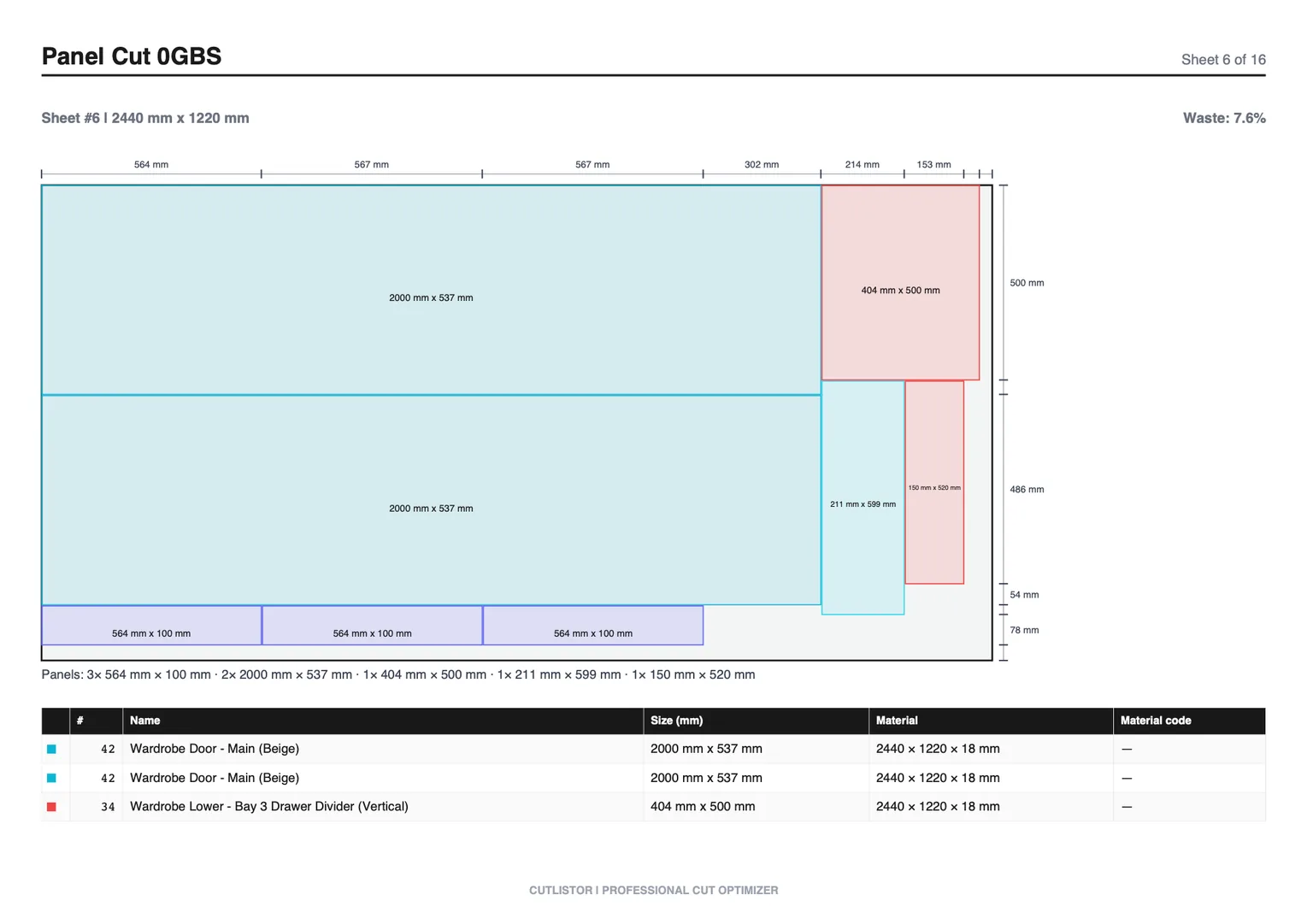
Run separate optimizer jobs (or separate stock rows) for plywood carcasses and MDF doors. Lock grain on visible plywood faces. MDF doors can often rotate freely, which improves yield. Set kerf to your panel saw or CNC tooling, not a spreadsheet guess.
Cutlistor is a browser-based sheet and linear cut list optimizer for rectangular nesting and PDF plans. It is not a cabinet design suite. Use it to answer purchasing questions before the saw runs.
The distinction that matters on the free plan is between reworking a layout and shipping one. Rework is unlimited. Shipping — a PDF export, or opening a new project — comes out of 3 per day. Alongside that sit a 20-row list cap, a 5-row limit per CSV or XLSX import, and no saved state.
Pro is $12/mo and adds saved projects, higher import quotas, and DXF export for CNC handoff when you need more than PDF plans.
FAQ
Can I build entire cabinets from MDF?
You can for paint-grade built-ins in dry interiors, but commercial shops usually keep plywood or melamine for boxes and reserve MDF for doors and panels. Moisture, weight, and fastener holding push boxes away from all-MDF in kitchens.
Where does melamine fit vs plywood and MDF?
Melamine (TFL) is the production box workhorse: prefinished faces, fast banding, lower cost. Plywood wins custom strength and clear finishes. MDF wins paint doors. See our melamine vs plywood cabinets comparison for that tradeoff.
Conclusion
Nest your next kitchen on the free sheet optimizer or jump into the cabinet calculator with real part sizes.