Article
How to Order Kitchen Cabinets: Lead Times, Confirmations & Delivery
Cutlistor Team5 min read
Introduction
Ordering kitchen cabinets is where renovation timelines usually slip. Cabinets are often 30–40% of the budget and the longest-lead finish item. A wrong width, hinge side, or finish on the PO can add weeks—and a second freight bill.
This guide covers realistic 2026 lead times, the confirmation package you need before depositing money, measuring sign-off, delivery and site readiness, and what to verify on the truck. Custom shops get a parallel checklist: freeze the cut list before the sheet-goods PO.
Lead Times in 2026 (Plan Backward from Install)
| Cabinet path | Typical order-to-delivery | Notes for 2026 planning |
|---|---|---|
| In-stock / RTA | 3–14 days | Limited sizes; confirm freight damage policy |
| Semi-custom (dealer) | 4–10 weeks | Common mid-range path; approval drawings required |
| Custom shop (local) | 6–14 weeks | Depends on shop backlog and material availability |
| Fully custom + specialty finishes | 10–20+ weeks | Paint matches, exotic veneers, inset doors add time |
| Hardware / inserts | 1–6 weeks | Order with boxes; late soft-close upgrades stall install |
Backward schedule example: target install week 18 → receive cabinets week 16–17 → factory ship week 15 → final drawing approval week 8–10 → deposit and PO week 7–9 → field measure week 6–8. Order appliances and stone templates on a parallel track so cutouts and panel-ready sizes stay honest.
Confirmations Before You Sign the PO
| Document | Who owns it | Freeze meaning |
|---|---|---|
| Quote / estimate | Dealer or shop | Pricing only—not build authority |
| Field measure sheet | Installer / designer | Site truth for fillers and heights |
| Confirmation drawings | Dealer / shop | What will be built if you sign |
| Finish sample approval | Homeowner | Color/sheen locked |
| PO / contract | Both | Money + legal freeze; changes cost time |
Measuring Sign-Off (Do This Before Production)
Many dealers measure after contract. Treat that visit as a hard gate: no “release to production” until you (or your GC) sign the measure. Floors, drywall, and window trim that are not final yet should be called out as assumptions.
- Measure each elevation wall-to-wall at counter height and at wall-cabinet height
- Note out-of-square corners and bowed walls—drive filler strategy
- Confirm ceiling height for tall units and stacked wall cabinets
- Mark plumbing centerlines, gas lines, electrical boxes, and HVAC returns
- State whether cabinets install before or after finished flooring (affects toe-kick and tall heights)
- Photograph every wall with a tape in frame; keep with the job file
Custom Shop Path: Finalize the Cut List Before the Material PO
| Step | Output | Gate |
|---|---|---|
| Layout freeze | Appliance + elevation schedule | No more model swaps |
| Part takeoff | Cabinet cut list by material/SKU | Every part labeled |
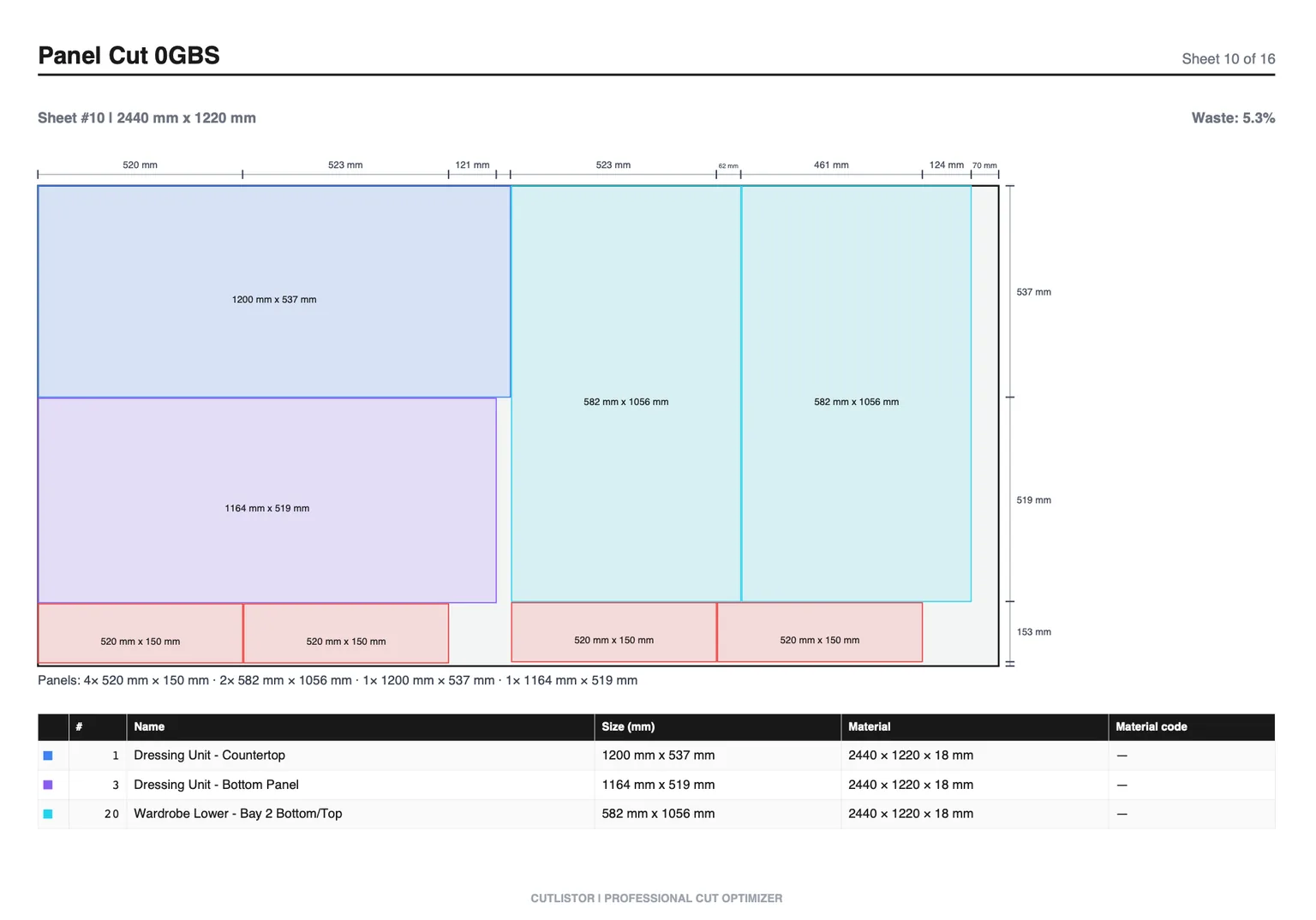
| Nest / optimize | Sheet count + offcut plan | Kerf and grain locked |
| Material PO | Sheets, edgeband, hardware | Matches nest revision |
| Production | Labeled parts → boxes → install | PDF/DXF matches BOM |
Shops running multiple kitchens should batch shared SKUs (for example 3/4 in white melamine) across jobs when lead times align. Nesting before the PO is how you avoid a mid-job lumberyard run that blows the schedule.
Delivery and Site Readiness
Cabinets hate weather, unfinished floors that will be ground later, and chaotic sites. Schedule delivery when you have a clean, dry staging room and a path wide enough for tall boxes.
- Confirm truck access, elevator reservations, and stair carries in writing
- Stage on level sleepers or original cartons—not damp concrete
- Keep finish doors away from paint overspray and drywall sanding
- Have the packing list and elevation drawings on site the morning of delivery
- Coordinate install start within a few days when humidity is stable
What to Verify on Delivery
| Check | Pass | Fail action |
|---|---|---|
| Piece count | Matches packing list / PO | Note shortage on BOL; call dealer same day |
| Visible freight damage | No crushed corners / wet cartons | Photos + refuse or exception notation |
| Finish / door style | Matches sample approval | Do not install; quarantine boxes |
| Box widths / labels | Labels match elevation IDs | Stop install on that run until resolved |
| Hardware kits | Hinges, slides, pulls present | Reorder immediately—do not assume “in another box” |
| Appliance panels | Correct height/width/grain direction | Hold fridge/DW install |
Install sequence tip: set tall units and bases that define the room first, then fillers, then doors/drawers for final reveals. Do not drill for hardware until you confirm overlay and reveal standards from the shop drawings.
FAQ
Should I order cabinets before demolition?
Often yes for semi-custom and custom—if measurements can be trusted from the existing kitchen or a locked architectural plan. Ordering before demo protects the schedule. Re-measure after walls are opened if you are moving plumbing or changing flooring thickness.
What changes are expensive after the PO?
Finish changes, door style swaps, and appliance width changes. Filler tweaks after field measure are normal; redesigning an elevation after production starts is not.
Who should do the final measure?
Whoever is contractually responsible for fit: dealer installer, GC, or custom shop. Homeowners should still walk the measure and initial the sheets.
When do I use a cut list optimizer if I am buying finished cabinets?
If you are buying finished boxes from a dealer, you may not nest sheet goods yourself. If you are a shop—or a homeowner building face frames / DIY boxes—nest before the material PO. Cutlistor is built for that sheet-planning step.
Conclusion
Ordering kitchen cabinets cleanly means planning lead time backward from install, freezing confirmation drawings, signing a real field measure, and inspecting the delivery against the packing list. Custom shops add one non-negotiable step: nested cut list before the material PO.
For layout and renovation context, use the kitchen renovation hub. For shop production, build the cabinet cut list and nest sheets in Cutlistor before you spend on plywood or melamine.