Article
How to Calculate Square Feet of Plywood (Sheets, Parts & Waste)
Cutlistor Team3 min read
Introduction
Square feet tells you how much plywood area you are talking about. Sheet count tells you what to buy. Yield tells you whether your nest is efficient. Shops that only sum part areas and divide by 32 sq ft (a full 4x8) usually under-order, because kerf, grain, and odd part shapes leave usable area on the floor as scrap.
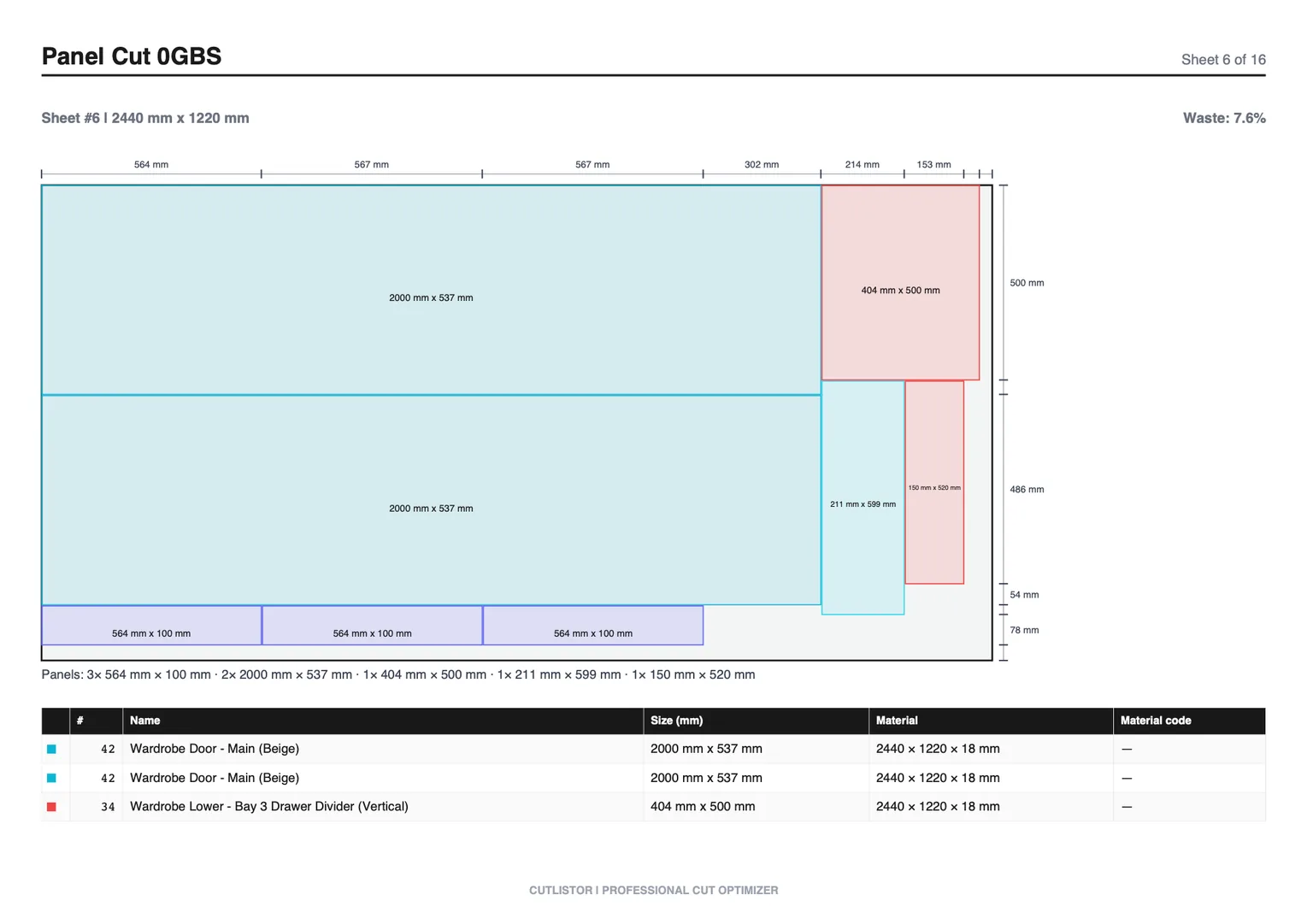
This guide covers sheet area for common sizes, summing part areas from a cut list, and how to turn those numbers into a realistic sheet count with waste.
Square Feet of a Full Sheet
| Sheet size | Area (sq ft) | Area (m²) | Notes |
|---|---|---|---|
| 4 x 8 ft (48 x 96 in) | 32 | 2.97 | Most common NA plywood |
| 5 x 5 ft (60 x 60 in) | 25 | 2.32 | Common Baltic birch |
| 4 x 10 ft | 40 | 3.72 | Fewer seams on long runs |
| 5 x 10 ft | 50 | 4.65 | Shop and trailer floors |
| 2440 x 1220 mm | ≈31.9 | 2.98 | Metric near-equivalent to 4x8 |
| 2500 x 1250 mm | ≈33.6 | 3.13 | Common EU sheet |
| 1525 x 1525 mm | ≈25.1 | 2.33 | Metric 5x5 class |
Summing Part Areas from the Cut List
Gables: 0.72 x 0.56 = 0.4032 m² each x 12 = 4.838 m² (≈52.1 sq ft). Bottoms: 0.56 x 0.56 = 0.3136 m² x 6 = 1.882 m² (≈20.3 sq ft). Part total ≈ 6.72 m² or about 72.4 sq ft.
On 2440 x 1220 mm sheets (≈31.9 sq ft each), 72.4 / 31.9 ≈ 2.27 sheets of pure part area. That is a lower bound, not a buy quantity.
From Square Feet to Sheet Count (Waste and Yield)
| Method | Sheet estimate | When to use |
|---|---|---|
| Part area / 32 sq ft | 2.3 → round to 3 | Quick sanity check only |
| Part area / (32 x 0.75) | ≈3.0 | Planning without a nest |
| Optimizer nest + kerf | Exact count + remnants | Before purchasing |
Metric Sheets and Mixed Units
If parts are in mm and sheets are in mm, stay in m²: area_m2 = (L_mm x W_mm x qty) / 1_000_000. Divide by sheet m² for the same lower-bound sheet count. Do not convert to inches mid-list.
When a North American yard sells 4x8 but your drawings are metric, convert sheet size once (2440 x 1220 mm is the usual stand-in) and nest in one unit system.
Counting Offcuts and Remnants
Square feet of waste is not all useless. A 400 x 600 mm offcut may cover the next job's drawer bottoms. Label remnants after the nest if you warehouse them. Do not assume waste sq ft returns as free material on the current job — only reusable pieces larger than your smallest part count.
Square Feet for Quotes vs Square Feet for Cutting
Estimators sometimes price plywood by sheet and report coverage in sq ft for clients (for example, 96 sq ft of panels across three 4x8 sheets). That client-facing number is sheet area purchased, not part area. Keep both figures: part sq ft for design scope, sheet sq ft (and sheet count) for purchasing.
If a client asks for cost per sq ft of finished cabinet face, do not divide material cost by part area alone — yield and hardware still sit in the real number. For buying stock, trust the nest sheet count over any per-sq-ft shortcut.
Faster Path: Calculators and Optimizers
For a quick sheet estimate from parts, use the plywood cut calculator. For a purchase-ready count with kerf and grain, run the free sheet cut list optimizer or the dedicated plywood cut list workflow. Baltic birch on 5x5 sheets has its own calculator because sheet area and nesting behavior differ from 4x8.
Cutlistor nests in the browser: enter parts, set stock size and kerf, lock grain, export PDF cut plans (free tier: 3 PDF exports/day, 20 part rows). That replaces guesswork on yield.
Summary
Know the sheet's sq ft, sum part areas, then inflate for yield — or skip the guess and nest. Square footage is a planning unit; the cutting diagram is the buying document.