Article
Melamine vs Plywood: Cabinets, Durability & Cut Planning
Cutlistor Team4 min read
Introduction
Melamine (thermally fused laminate on particle board or MDF) and plywood are the two workhorses of cabinet shops. One arrives prefinished and ready for banding; the other is stronger, lighter for its stiffness, and takes paint, veneer, or clear finish. The right choice depends on budget, site moisture, and how the cabinets will be used.
Below: durability, edges, hardware, when hybrids make sense, and how to plan cut lists so expensive sheets are not wasted.
What melamine and plywood actually are
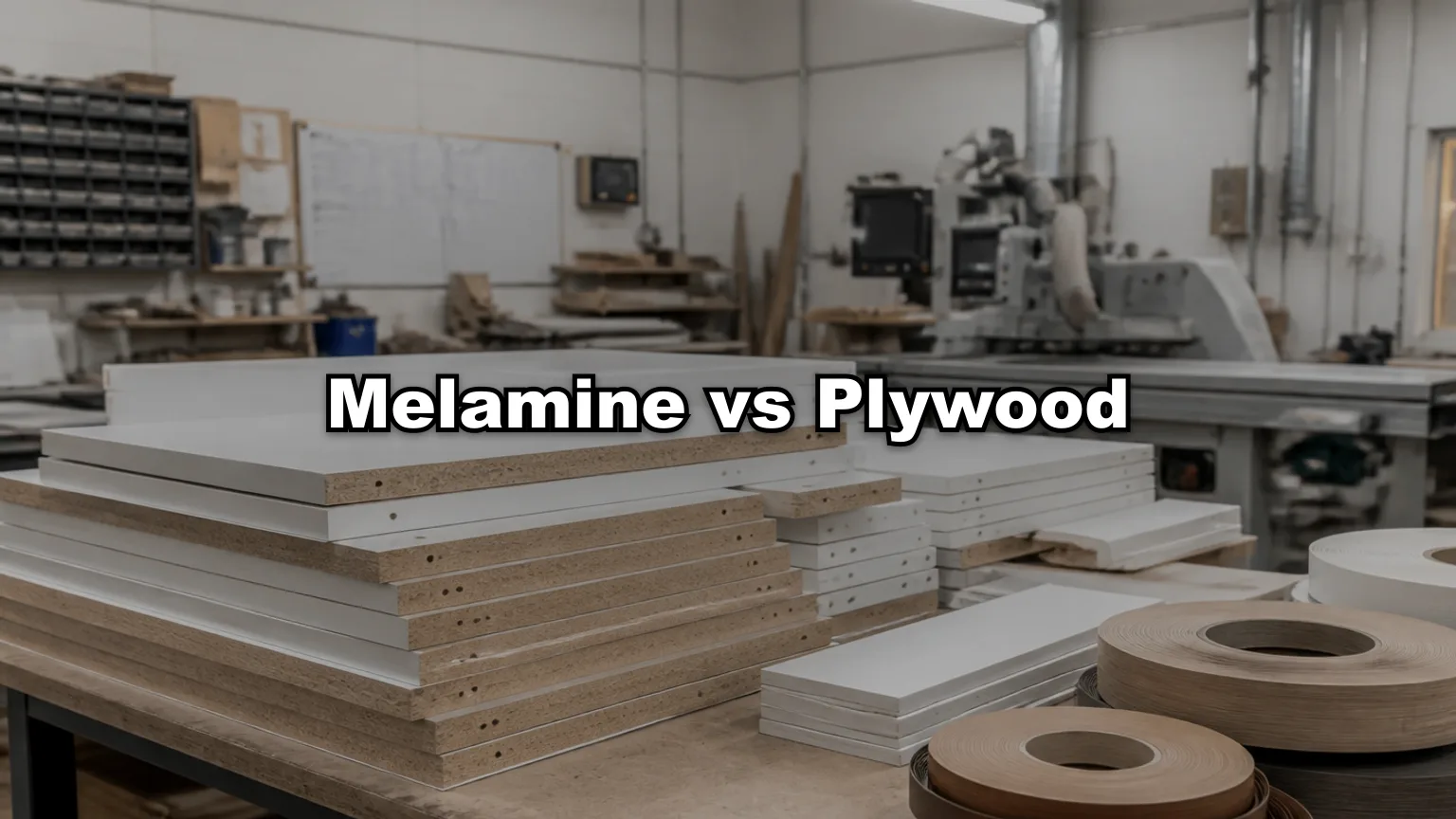
Melamine panels are usually particle board (sometimes MDF) with a resin-saturated paper fused to both faces. The surface is wipeable and consistent — white, colors, or woodgrain prints. Edges are raw core until you apply banding.
Cabinet plywood is veneer-core or specialty multi-ply with sanded wood faces (or prefinished plywood in some lines). It is structural sheet stock, not a finished laminate system, unless you buy prefinished plywood.
Side-by-side comparison
| Factor | Melamine (TFL) | Plywood |
|---|---|---|
| Surface | Finished laminate | Wood face; finish yourself or buy prefinished |
| Core strength | Particle/MDF — weaker screws & span | Stronger spanning and screw holding |
| Weight | Moderate–heavy | Often lighter for same stiffness |
| Edges | Must band | Band, solid lip, or show plies |
| Moisture | Poor if core wets; wipeable face | Better with exterior/marine grades |
| Repair | Hard to touch up chips | Can sand/refinish wood faces |
| Shop speed | Fast — less finishing | More finishing time unless prefinished |
| Look | Uniform commercial | Natural wood or paint/veneer options |
Durability in real kitchens
Melamine faces resist stains and wipe clean — ideal for rental kitchens and high-volume production. Chips at corners expose dark core and are hard to hide. Hinges and slides need correct fasteners; oversize holes strip particle core fast.
Plywood carcasses survive moves, heavier shelves, and humid swings better when you choose an appropriate grade. Prefinished plywood gives some of melamine’s speed with better structure. For sink bases and laundry rooms, sealed plywood or marine-adjacent grades beat raw melamine chipboard if water is likely.
Abuse testing in the real world is simple: watch delivery crews and the first year of kids and pets. Melamine interiors that never take a standing puddle look new for years. The same material after a dishwasher leak may swell at the toe-kick. Detail water zones deliberately — trays, sealed edges, or plywood wet zones — instead of hoping the laminate face alone is waterproof.
Hybrid builds shops actually use
You do not have to pick one material for the whole kitchen.
- Melamine boxes + MDF or solid doors
- Plywood boxes + melamine interiors for wipe-clean shelves
- Plywood boxes + painted MDF doors (common custom look)
- Baltic birch drawers inside melamine or plywood cases
Cost tradeoffs (2026)
Melamine sheets often cost less than furniture-grade plywood of the same size in 2026, especially in commodity white. Labor savings from skipping finish coats can outweigh a higher plywood sticker on small custom jobs — or the reverse on large runs where material dominates. Prices vary by region, core, and laminate grade; see our plywood price guide for market ranges and treat local quotes as authoritative.
Cut planning for melamine and plywood
Both nest as sheets. Differences that matter in the optimizer are easy to miss on the first kitchen and expensive on the third.
- Grain / pattern lock: woodgrain melamine needs direction locking like plywood face grain.
- Edge banding allowance: add banding thickness to finished sizes or cut oversized then trim — be consistent in the cut list.
- Kerf: measure the blade; chip-out on melamine means a sharp, high-tooth blade and proper scoring if you have it.
- Material groups: never nest 18 mm white melamine with 6 mm backs or raw plywood on one sheet.
- Sheet size reality: some melamine arrives as 49×97 or metric specialty sizes — enter the true stock, not a generic 4×8 assumption.
Choosing Melamine vs Plywood for the Job
Default to melamine for painted-look casework interiors and high-volume boxes where a durable finished face matters more than structural spanning. Default to plywood when you need screw-holding for hinges on thin walls, veneer aesthetics, or wetter service conditions the board is rated for.
Many shops hybridize: melamine boxes, plywood or solid doors, and plywood where hardware density is high. That hybrid only works if the cut list keeps material groups separate so nests do not pretend one sheet serves both.
Price the full system—sheet cost, edge banding, scrap rate, and remake risk—not just the sticker on the panel. Prefinished faces raise the cost of every wrong cut.
- Interior boxes vs show faces decided up front
- Hardware zones that need plywood called out
- Separate nests per material group
- Edge-banding and remake risk in the cost model
Nest both materials in Cutlistor
Cutlistor handles melamine, plywood, MDF, particle board, and Baltic birch as sheet nesting jobs with kerf, grain direction locking, and material grouping. Use the cabinet cut list calculator or free sheet optimizer to preview yield before you buy. Free tier: 3 PDF exports per day, 20 part rows. Face frames and solid lumber rails go through the linear optimizer.