Calculator page · 4 min read
Cabinet cut list calculator
Cabinet shops live in cut lists. Enter every finished part below and this calculator nests those rectangles on the melamine, ply, or composite sheets you keep in inventory — no spreadsheet required.
How Cutlistor nests cabinet panels
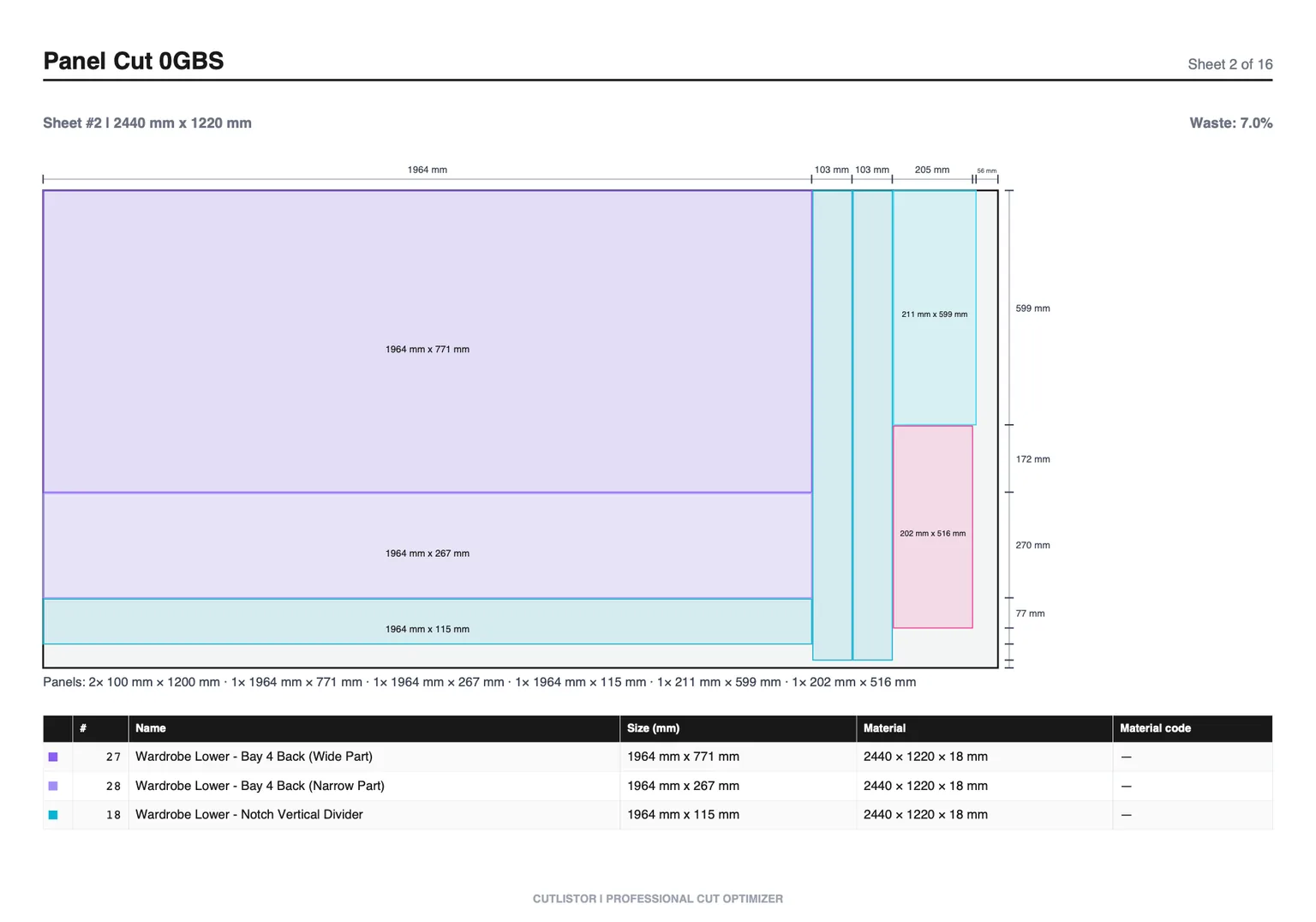
Use the free sheet cut list optimizer to enter cabinet panels stock sizes, parts, kerf, and optional grain or edge-banding notes. You will see nested layouts and can export a PDF for the shop.
Frameless vs face frame
Both systems need accurate side, top, bottom, and back sizes. The optimizer does not replace engineering, but it keeps purchased sheet counts honest once sizes are final.
Cabinet parts checklist
Missing a back panel row is a common reason sheet count looks too optimistic.
- Sides, decks, stretchers, shelves, backs, toe kicks, fillers
- Drawer parts and door blanks as separate rows
- Material code per thickness and finish
Step-by-step cabinet panels sheet workflow
Start with the cabinet panels sheet SKU you actually purchase — melamine 2750×1830 mm or birch ply 2440×1220 mm. Add every finished part as width × height × quantity. Set kerf to 3.2 mm panel saw kerf so the optimizer subtracts realistic blade loss for cabinet panels.
Run the layout and read sheet count plus yield before buying. If yield looks low on cabinet panels, check grain locks, mixed thicknesses, or whether rips and rows for high-volume casework shops fits your crew better.
Export the PDF when the diagram matches shop habits. If a dimension changes, edit the row and recalculate — the cabinet panels nest refreshes immediately.
Layout methods for cabinet panels
Cutlistor offers multiple sheet strategies because no single algorithm wins every cabinet panels job. Rips and rows suits table-saw-first shops. Fewest sheets pushes yield when cabinet panels cost dominates. Router / CNC layout helps dense packs when spoilboard spacing is set.
Frameless and face-frame shops share the same nesting once engineering is done — sides, decks, shelves, backs, and toe parts are rectangles.
| Layout method | Best for cabinet panels |
|---|---|
| Rips & rows | Panel saw casework lines |
| Fewest sheets / least waste | Multi-room kitchen PO accuracy |
| Neat grid | Part labels aligned for assembly |
Worked example: three-wide base run
Three 610 mm bases: twelve sides/decks/shelves plus backs on 18 mm melamine — nest entire run, multiply quantities, export one PDF per room or elevation.
Import, export, and verification
Import CSV or XLSX from /samples/cutlist-import/ when your cabinet panels cut list already lives in a spreadsheet. Group rows with material codes when you buy multiple cabinet panels SKUs.
Export kerf-aware PDF cut plans for the floor. Paid plans add saved projects, stock inventory, AI plan scanning, and 3D CAD import (glTF, GLB, Collada).
Free anonymous use includes 3 calculations per day, up to 20 part rows per session, and CSV/XLSX imports of up to 5 rows.
Before you cut cabinet panels: checklist
Engineering method (frameless vs face frame) changes part list, not the optimizer workflow.
Run face-frame lumber in the linear optimizer separately.
FAQ
- How many sheets for a kitchen?
- Enter all parts for all cabinets, run the nest, read sheet count. Room-by-room imports work when using CSV.
- Is this cabinet panels calculator free?
- Yes. The sheet cut list optimizer runs in your browser with daily limits. Accounts unlock saved projects and higher caps.
- What sheet sizes work for cabinet panels?
- Enter any rectangle you purchase — melamine 2750×1830 mm or birch ply 2440×1220 mm. Match the delivery note, not a generic label.
- Does kerf matter on cabinet panels?
- Yes. Set kerf to 3.2 mm panel saw kerf. Underestimating kerf on dense cabinet panels nests can shift sheet count.
Related calculators
- Woodworking cut list calculatorWoodworking cut list calculator for furniture and casework: nest panels, track kerf, export PDFs with Cutlistor’s free sheet tool.
- Furniture cut list calculatorFurniture cut list calculator: plan case goods panels, reduce sheet waste, apply kerf and grain notes with Cutlistor.
- Panel cut list calculatorPanel cut list calculator for wall panels, built-ins, and sheet stock: nest rectangles, manage kerf, export documentation from Cutlistor.
- Cut sheet calculatorCut sheet calculator online: translate part lists into nested panel layouts and PDF cut plans using Cutlistor’s free optimizer.