Calculator page · 3 min read
Woodworking cut list calculator
Furniture builders juggle solid wood and sheet goods. When the sheet side of the job grows, a woodworking cut list calculator plus nesting keeps you from overbuying hardwood plywood or overspending on premium veneer core.
How Cutlistor nests woodworking panels
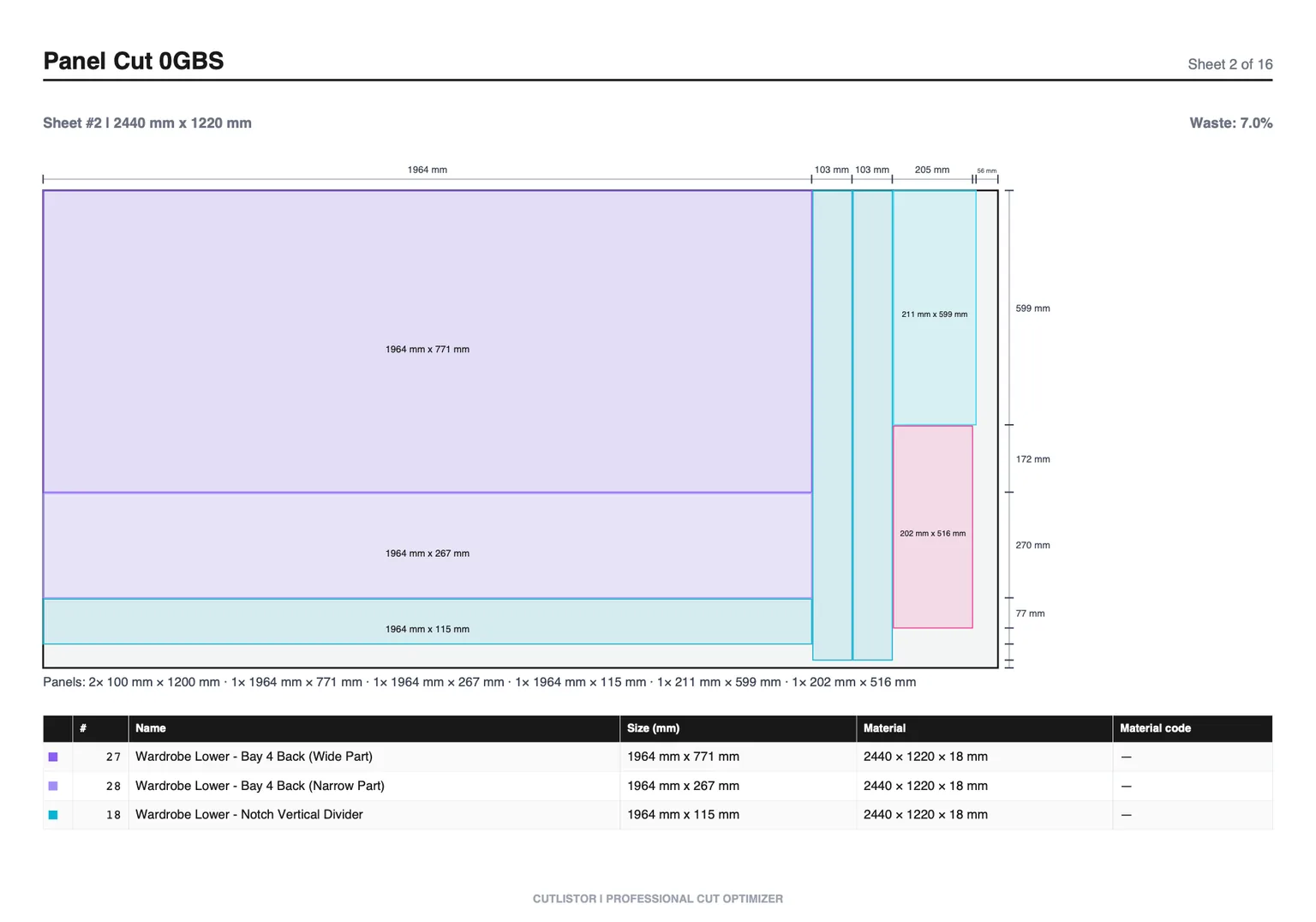
Use the free sheet cut list optimizer to enter woodworking panels stock sizes, parts, kerf, and optional grain or edge-banding notes. You will see nested layouts and can export a PDF for the shop.
Blend with solid stock
Use the sheet optimizer for panels and the linear optimizer for rails, stretchers, and solid components that come from dimensional lumber or S4S stock.
Solid wood vs sheet goods on one job
Panels in the sheet optimizer. Legs, aprons, and moulding in the linear optimizer. Link both PDFs in the project folder.
Step-by-step woodworking panels sheet workflow
Start with the woodworking panels sheet SKU you actually purchase — hardwood ply, veneer core, or MDF in shop standard sizes. Add every finished part as width × height × quantity. Set kerf to 3.2 mm rip blade or CNC bit diameter so the optimizer subtracts realistic blade loss for woodworking panels.
Run the layout and read sheet count plus yield before buying. If yield looks low on woodworking panels, check grain locks, mixed thicknesses, or whether fewest sheets on premium hardwood ply fits your crew better.
Export the PDF when the diagram matches shop habits. If a dimension changes, edit the row and recalculate — the woodworking panels nest refreshes immediately.
- Lock grain on tabletops and drawer fronts
- Batch identical furniture multiples via qty column
Layout methods for woodworking panels
Cutlistor offers multiple sheet strategies because no single algorithm wins every woodworking panels job. Rips and rows suits table-saw-first shops. Fewest sheets pushes yield when woodworking panels cost dominates. Router / CNC layout helps dense packs when spoilboard spacing is set.
Furniture builders mix solid wood and sheet goods — nest panels here, linear stock for rails and legs in the linear tool.
| Layout method | Best for woodworking panels |
|---|---|
| Fewest sheets / least waste | Premium plywood and veneer core |
| Rips & rows | Table saw furniture shops |
| Router / CNC layout | CNC furniture parts |
Worked example: dresser case in maple ply
Sides 1200×450 mm qty 2, shelves 420×420 mm qty 4, top 900×450 mm on 18 mm maple ply 2440×1220 mm with grain locked on show faces.
Import, export, and verification
Import CSV or XLSX from /samples/cutlist-import/ when your woodworking panels cut list already lives in a spreadsheet. Group rows with material codes when you buy multiple woodworking panels SKUs.
Export kerf-aware PDF cut plans for the floor. Paid plans add saved projects, stock inventory, AI plan scanning, and 3D CAD import (glTF, GLB, Collada).
Free anonymous use includes 3 calculations per day, up to 20 part rows per session, and CSV/XLSX imports of up to 5 rows.
Before you cut woodworking panels: checklist
Hardwood ply cost justifies spending time on layout method comparison.
Export PDF with part names your assembly bench already uses.
FAQ
- Is this woodworking panels calculator free?
- Yes. The sheet cut list optimizer runs in your browser with daily limits. Accounts unlock saved projects and higher caps.
- What sheet sizes work for woodworking panels?
- Enter any rectangle you purchase — hardwood ply, veneer core, or MDF in shop standard sizes. Match the delivery note, not a generic label.
- Does kerf matter on woodworking panels?
- Yes. Set kerf to 3.2 mm rip blade or CNC bit diameter. Underestimating kerf on dense woodworking panels nests can shift sheet count.
Related calculators
- Furniture cut list calculatorFurniture cut list calculator: plan case goods panels, reduce sheet waste, apply kerf and grain notes with Cutlistor.
- Panel cut list calculatorPanel cut list calculator for wall panels, built-ins, and sheet stock: nest rectangles, manage kerf, export documentation from Cutlistor.
- Cut sheet calculatorCut sheet calculator online: translate part lists into nested panel layouts and PDF cut plans using Cutlistor’s free optimizer.
- Linear cut list calculator (tool landing)Linear cut list calculator for bar stock: lengths, kerf, yield, PDF export. Use Cutlistor’s free linear cut list optimizer in your browser.