Article
Aluminium Extrusion Guide (2026): Process, Profiles, Applications & Cost Saving Tips
Cutlistor Team13 min read
Introduction
Aluminium extrusion turns heated billet into long profiles with a fixed cross-section: T-slot rails, window frames, angles, tubes, and thousands of custom shapes used in buildings, machines, and vehicles. It is one of the most efficient ways to produce complex metal sections in volume.
Fabricators choose aluminium for its strength-to-weight ratio, corrosion resistance, and the fact that one die can produce kilometres of profile. But extrusion is only half the job. Cutting, mitering, and assembling those lengths is where material cost and labour time actually land on the quote.
This guide covers what aluminium extrusion is, how the process works, common profile types, cutting methods, waste costs, and why linear cut list optimization matters as much as choosing the right alloy or supplier.
What Is Aluminium Extrusion?
Aluminium extrusion is a manufacturing process that forces heated aluminium alloy through a shaped opening in a steel die, producing a long profile with the same cross-section along its entire length. The result is an aluminium extrusion: a stick, bar, tube, or channel you cut to finished lengths on the shop floor.
What is an aluminium extrusion in practice? It is the stock you buy by the meter or by the full bar length (often 6 m or 6.5 m), then chop into frame rails, mullions, brackets, and machine guard panels.
- Light weight with usable structural strength in 6063-T5 and 6061-T6 alloys
- Corrosion resistance without painting (anodizing or powder coat optional)
- Complex cross-sections in one step, which would take multiple bends or welds in steel
- Recyclable scrap retains value compared with many composite alternatives
- Advantages over steel: lower density, no rust, often faster cutting on the saw
- Advantages over wood: dimensional stability, outdoor durability, consistent sections for automation frames
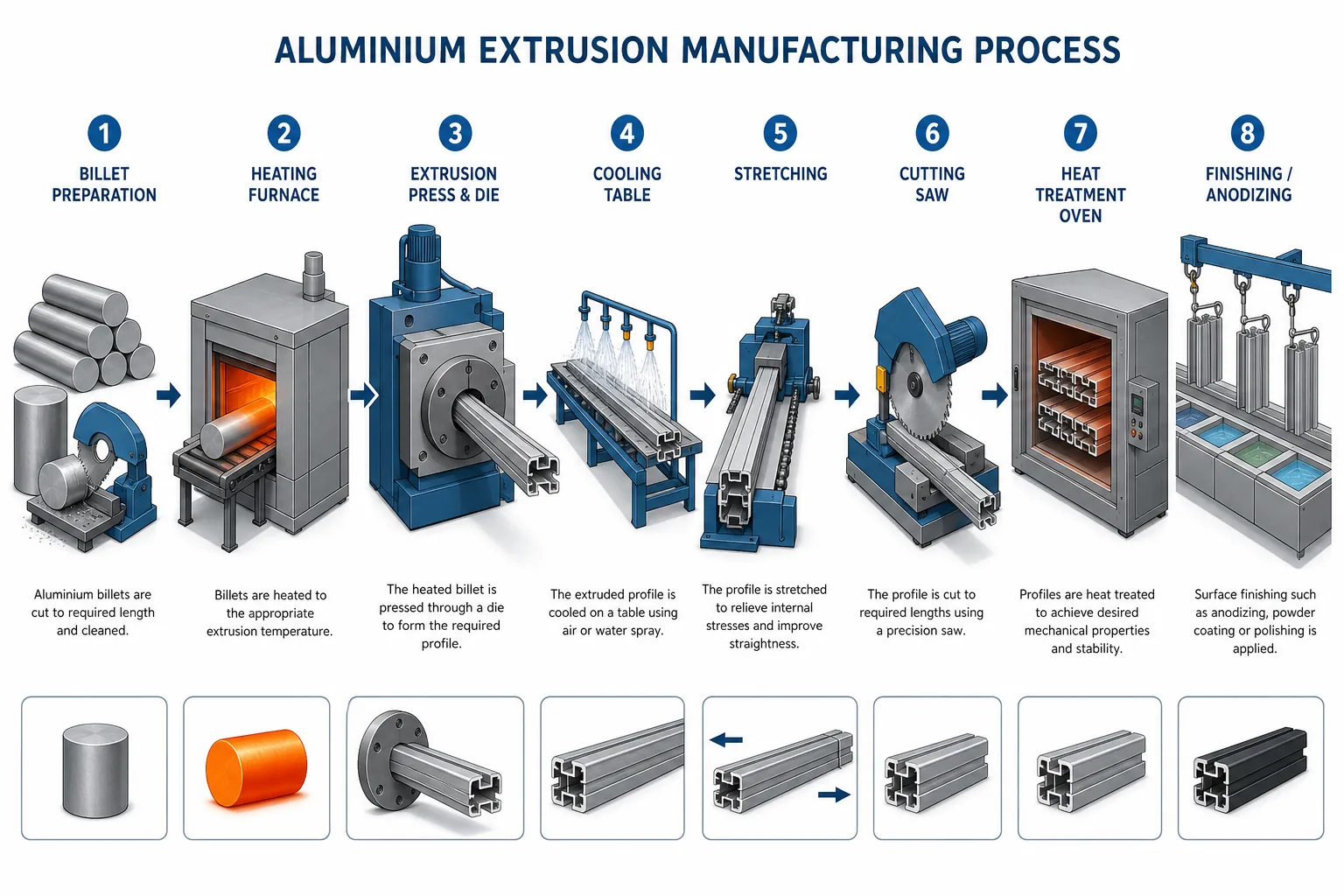
How the Aluminium Extrusion Process Works
- Billet preparation: log-shaped aluminium cylinders cut to length and inspected for alloy grade
- Heating: billet heated to roughly 400-500°C until soft enough to flow under pressure
- Extrusion die: billet pushed through a steel die that defines the profile cross-section
- Cooling: profile exits the press and passes through air or water quench to set shape
- Stretching: lengths stretched straight to relieve internal stress and hit dimensional tolerance
- Cutting: extrusion cut to commercial lengths (typically 3 m to 7 m depending on supplier)
- Heat treatment: age-hardening where required (T5/T6 tempers)
- Finishing: anodizing, powder coating, or mill finish before dispatch to fabricators
Aluminium Extrusion Dies
An extrusion die is the hardened steel tool that gives the profile its shape. Die complexity drives tooling cost and minimum order quantity (MOQ). Standard catalogue profiles use existing dies; custom aluminium extrusion requires a new die machined to your section drawing.
Solid dies
Used for solid profiles: flat bars, some angles, and simple shapes with no internal void. Lowest die cost and fastest to produce.
Hollow dies
Used for tubes and enclosed sections. A mandrel inside the die forms the internal void. More complex and more expensive than solid dies, but essential for square tubes, round tubes, and multi-chamber window profiles.
Semi-hollow dies
Used for channels, partial enclosures, and profiles with one open side. Common for U-channels and certain glazing beads.
Die costs and lead times
Catalogue die profiles: no tooling charge, order from stock. Custom die tooling: often $1,000 to $10,000+ depending on complexity, plus 4 to 8 weeks lead time before first production. MOQs for custom profiles often start at 500 kg to several tonnes per order.
Types of Aluminium Extrusion Profiles
Aluminium extrusion profiles are named by their cross-section. Most fabricators work from a mix of catalogue sections and occasional custom dies for proprietary window or machine-frame systems.
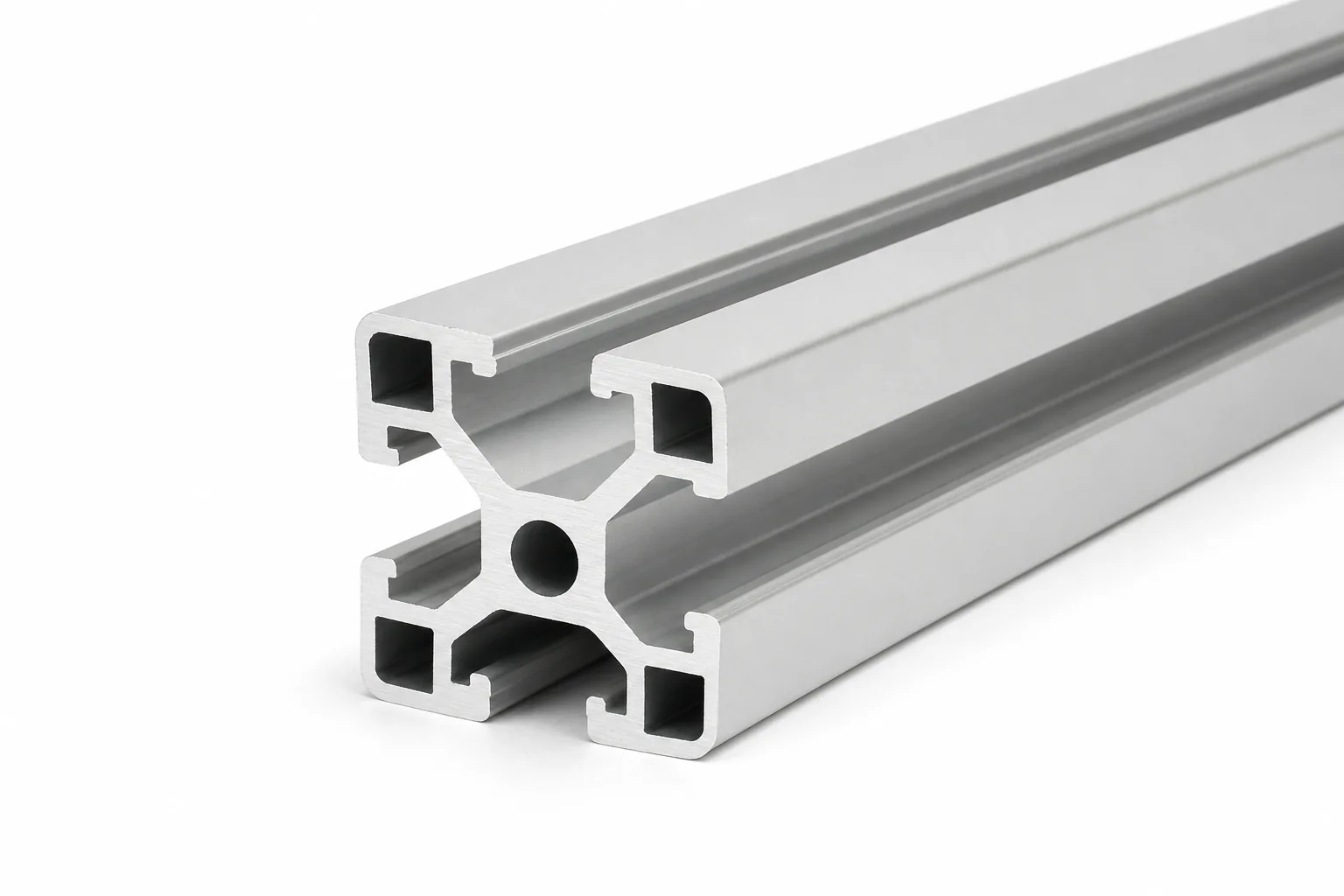
T-Slot Profiles
T-slot aluminium extrusion has a grooved channel that accepts nuts and bolts for modular framing. Used in CNC enclosures, automation guards, workstations, and exhibition stands. Common sizes include 20, 30, 40, and 45 series metric profiles.
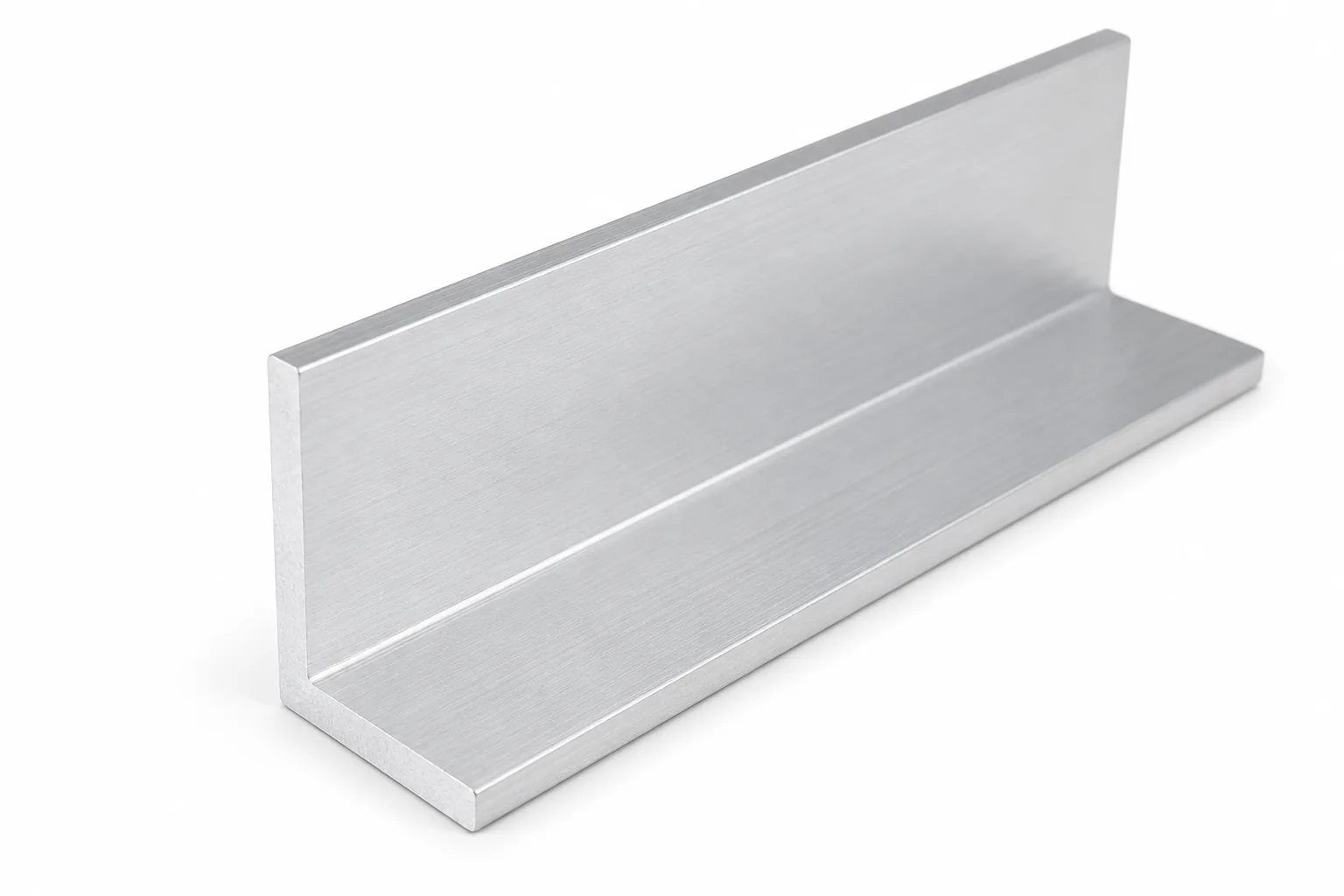
Angle Profiles
L-shaped equal or unequal leg angles for brackets, stiffeners, and corner reinforcement. Common in solar mounting, signage, and light structural work.
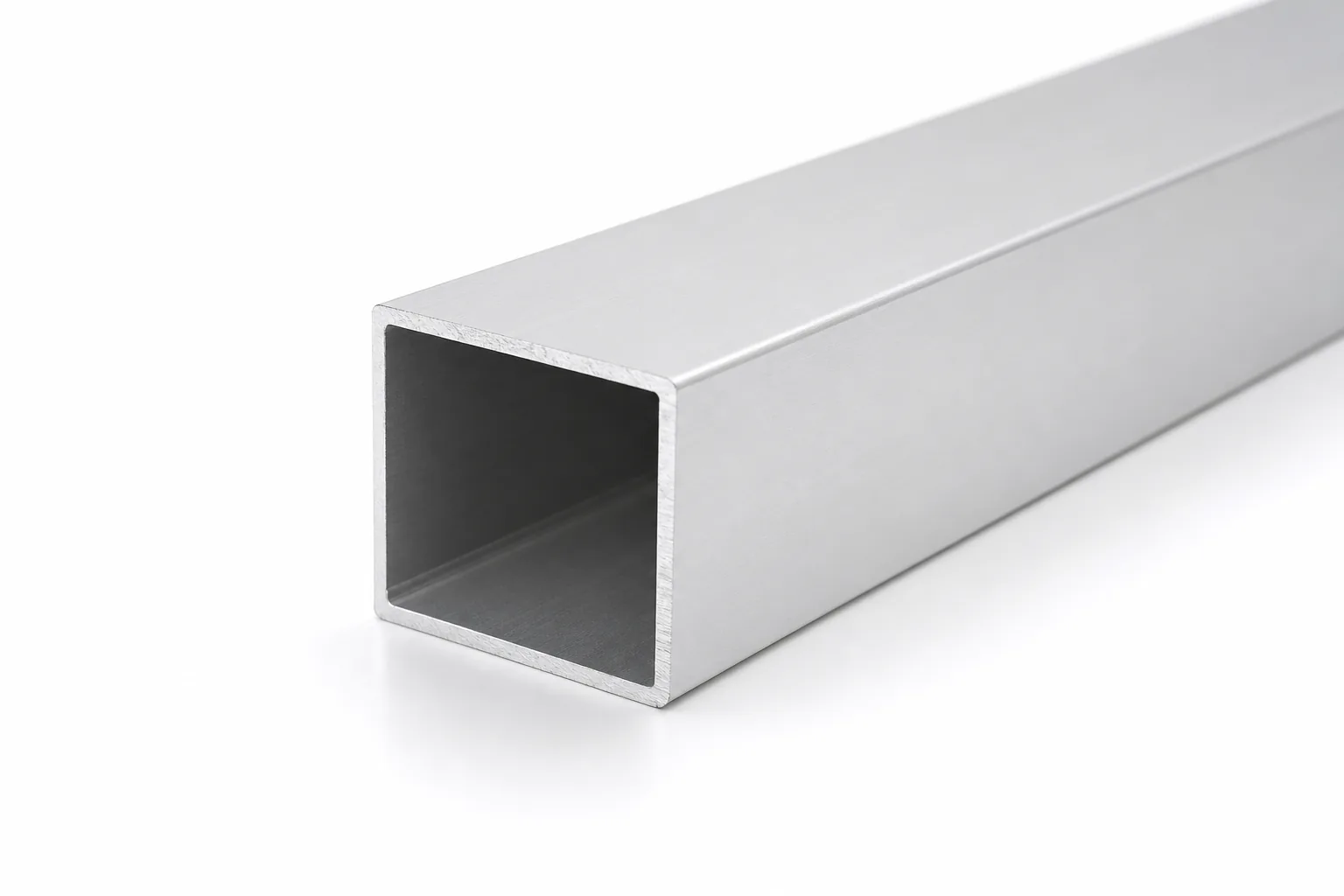
Square Tubes
Hollow square section tubing for frames, posts, and columns where torsion stiffness matters. Window and door manufacturers use larger square tubes for mullions; furniture makers use smaller sizes for legs.
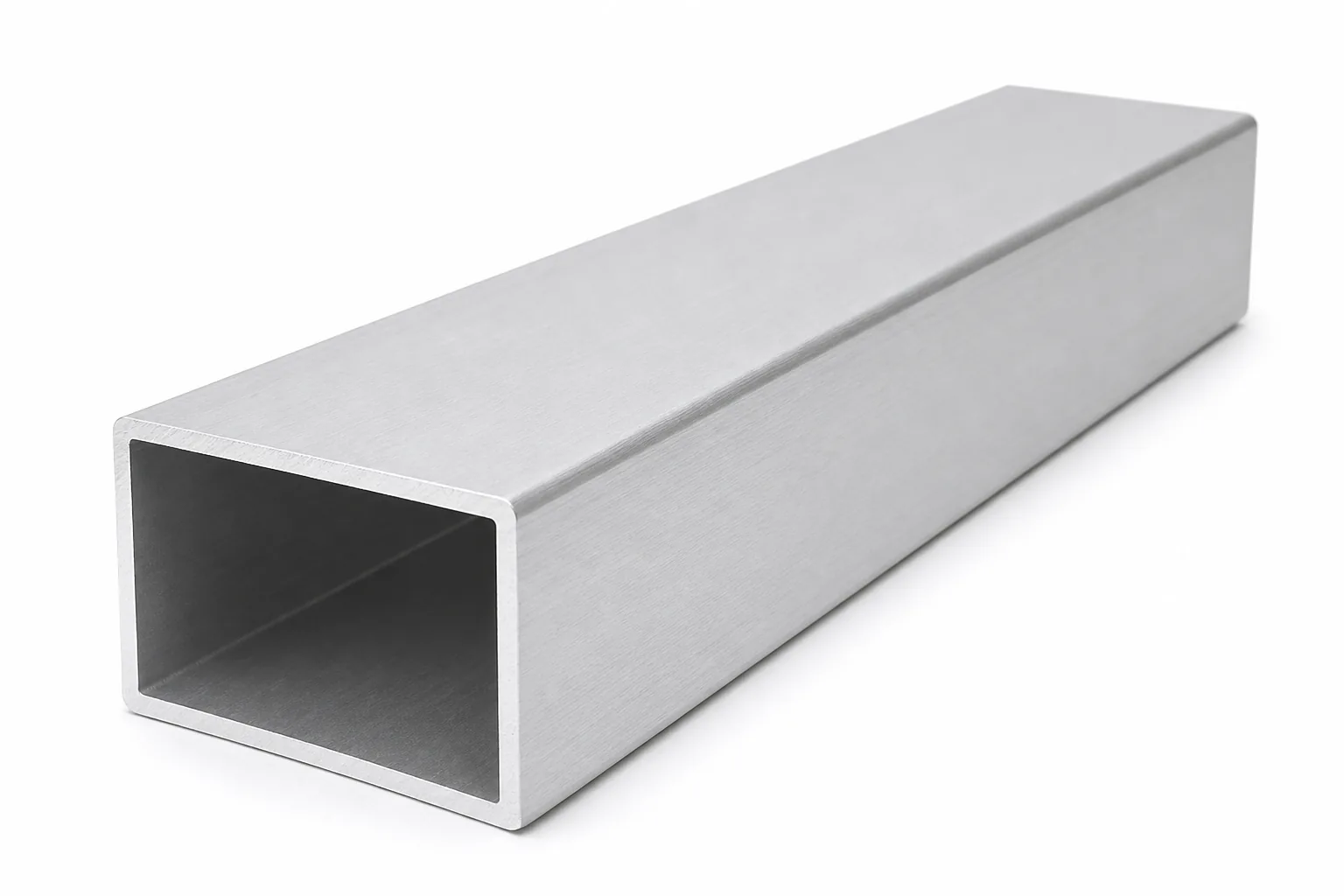
Rectangular Tubes
Hollow rectangular sections for door frames, curtain wall mullions, and structural rails. The asymmetric shape fits glazing pockets and screw channels in window systems.
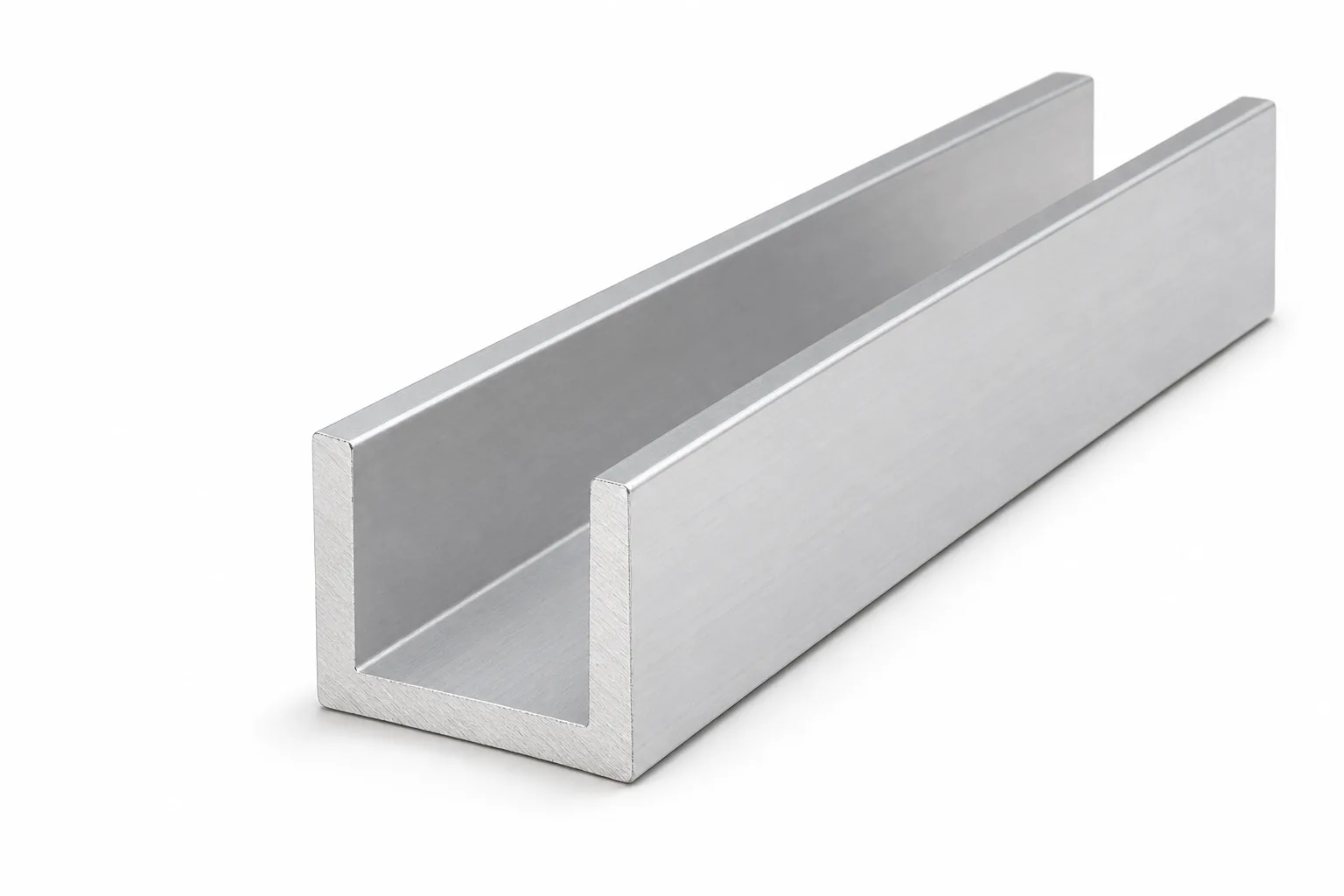
Channels
U-channel and C-channel profiles for glazing beads, trim, cable routes, and sliding track bases. Semi-hollow dies produce the open side that clips or receives infill panels.
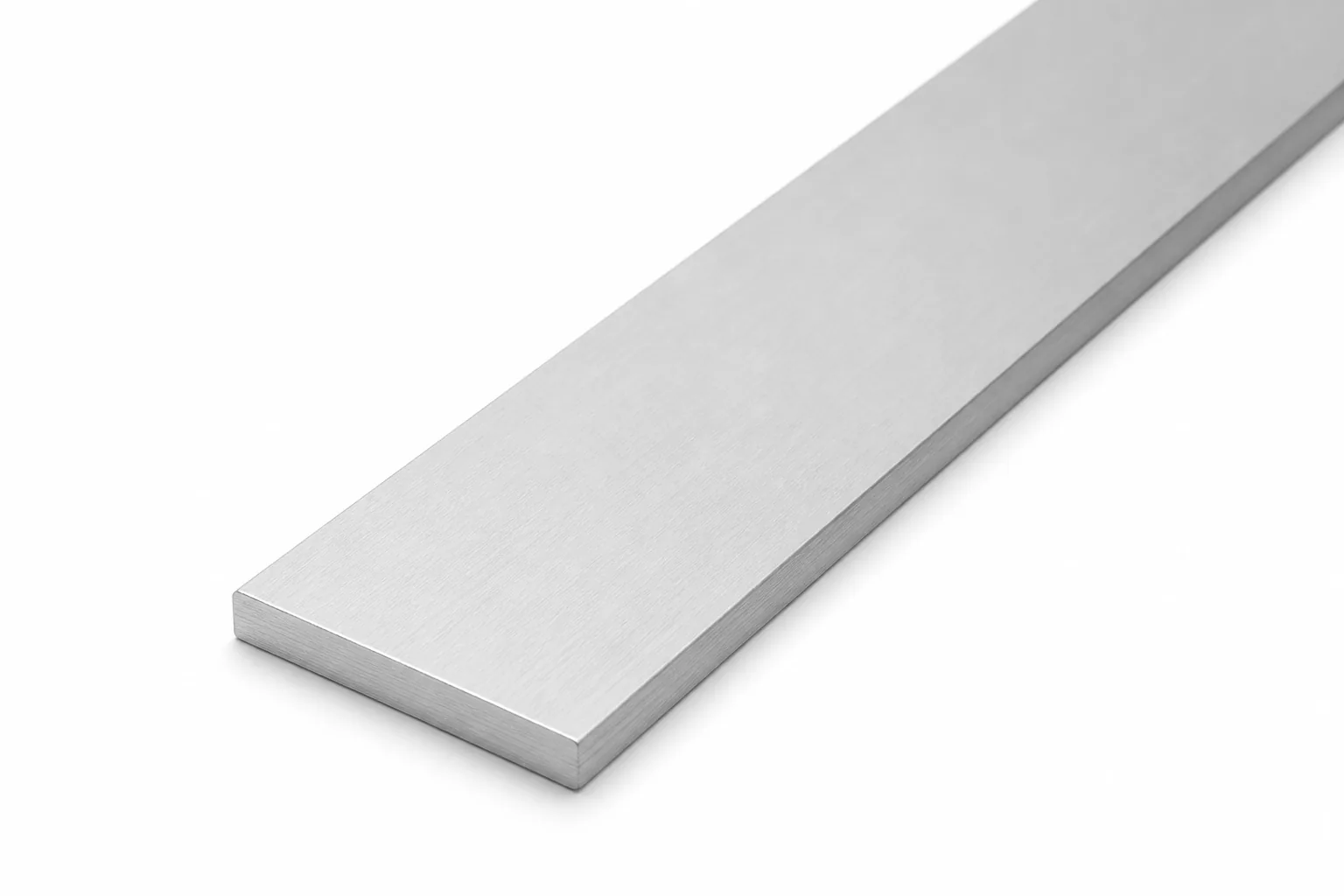
Flat Bars
Solid rectangular strip for stiffeners, cover plates, and simple brackets. Often the cheapest profile per kilogram and easy to cut on any mitre or cold saw.
Round Tubes
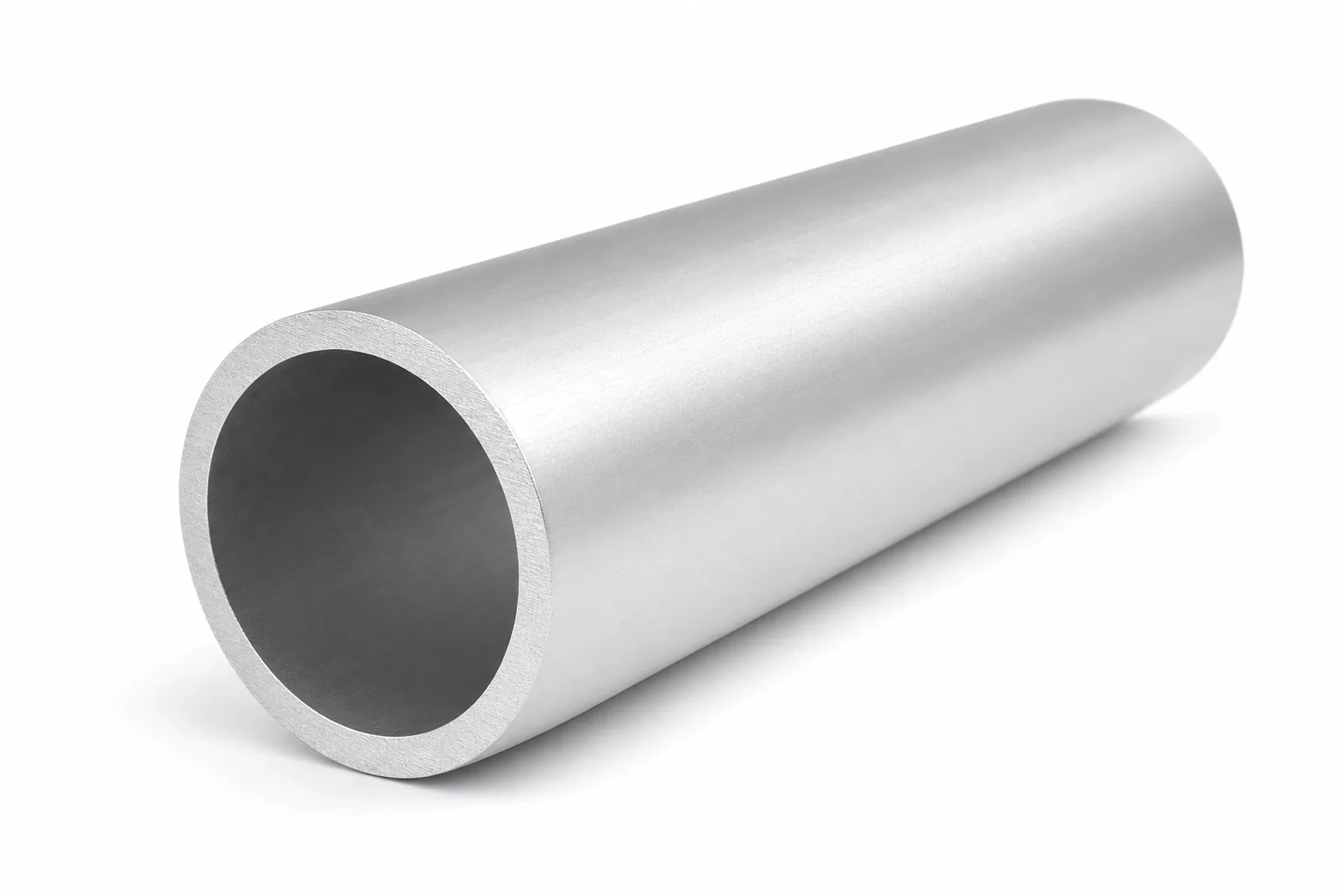
Hollow circular profiles for handrails, lightweight posts, and decorative elements. Round tube dies are common in catalogue ranges from 10 mm to 200 mm outer diameter.
Custom Profiles
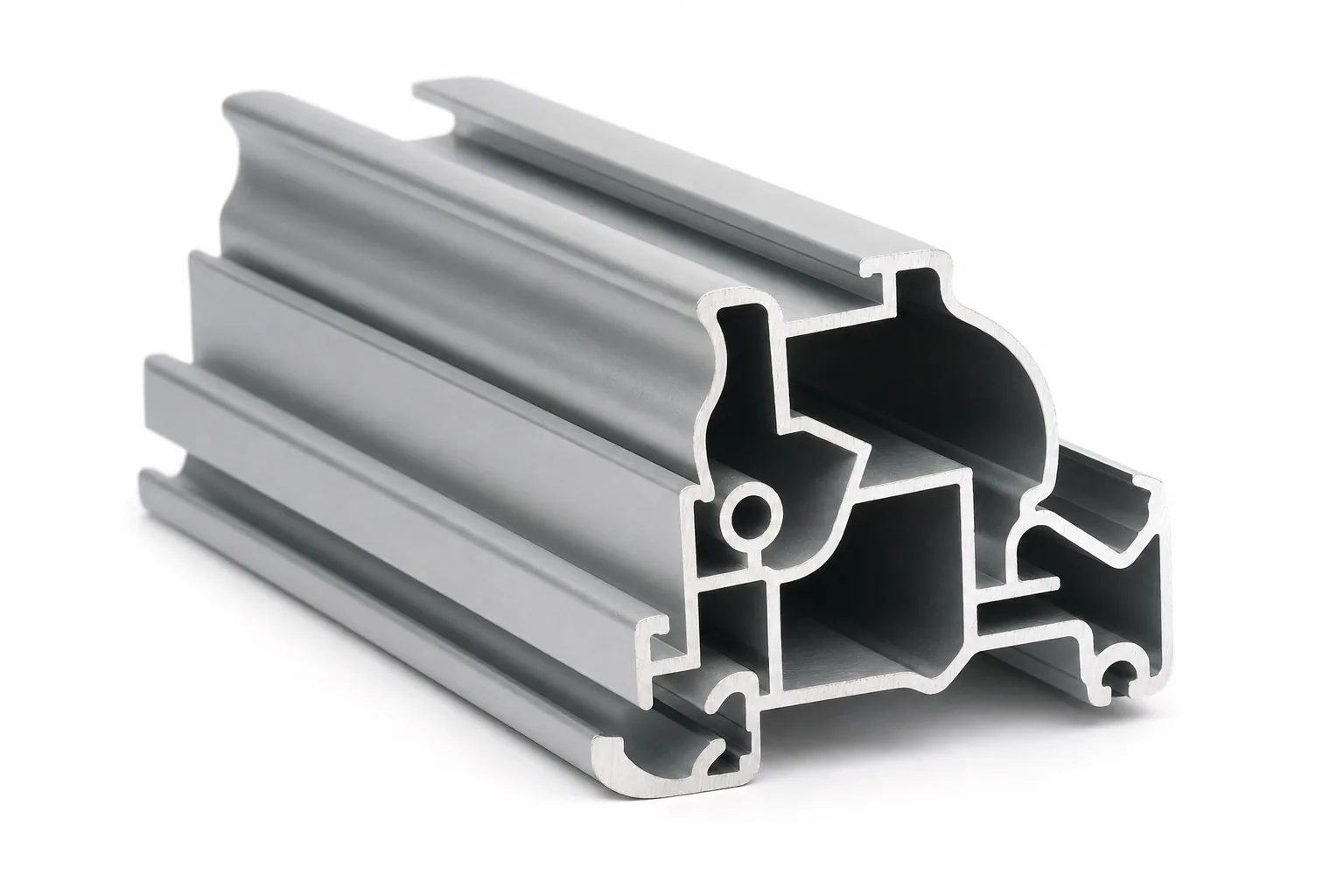
Proprietary window systems, automotive sections, and heat sinks use custom dies with complex multi-void shapes. Fabricators on custom profiles must match supplier drawings exactly because catalogue optimizers will not know the section weight or packing rules.
Custom Aluminium Extrusions
Custom aluminium extrusion (bespoke aluminium extrusion) makes sense when a catalogue profile cannot carry the glazing pocket, screw boss, or thermal break your product needs. The tradeoff is tooling cost, MOQ, and longer lead times.
- When custom profiles make sense: proprietary window systems, OEM product lines, heat sinks with fin geometry, unique machine guard sections
- Tooling costs: budget $1,000 to $10,000+ for the die depending on hollow complexity
- MOQ: often 500 kg to 2,000 kg minimum on first orders; repeat orders may be smaller
- Design considerations: wall thickness minimums (often 1 mm to 1.5 mm), symmetry for straight stretching, and avoiding sharp internal corners that crack during quench
Common Industries That Use Aluminium Extrusions
- Cabinet manufacturers: aluminium frames for commercial casework and display units
- Window and door manufacturers: mullions, sashes, and glazing profiles
- Industrial automation: T-slot machine guarding and conveyor supports
- CNC machine builders: modular frames and enclosure panels
- Solar panel mounting: rails, mid-clamps, and roof hooks
- Exhibition stands: reusable T-slot structures
- Retail fixtures: display frames and shelving uprights
- Furniture manufacturers: table legs and desk frames
- Automotive: trim, roof rails, and structural subframes
- Aerospace: lightweight structural sections (high-grade alloys, tight tolerances)
How to Cut Aluminium Extrusions
How to cut aluminium extrusion and how to cut aluminium profile both come down to the same shop question: which saw, which blade, and how you sequence lengths to minimize scrap. Aluminium is soft compared with steel but galls easily with the wrong blade or feed rate.
Miter saw
Pros: fast setup, good for 45° and 90° cuts on small to mid-size profiles, common on window shops. Cons: less precision on very large sections, dust control needed, not ideal for high-volume repetitive work without a stop system.
Cold saw
Pros: clean, square cuts with carbide-tipped blades; preferred for accurate length work on production lines. Cons: slower cycle time, higher blade cost, dedicated machine footprint.
Band saw
Pros: handles large or awkward sections, flexible for one-off cuts. Cons: slower, cut surface may need deburring, blade wander if guides are worn.
CNC saw / automated cutoff
Pros: repeatable lengths from an optimized cut list, automatic feeding, best for high-volume window and door plants. Cons: capital cost, requires accurate digital cut plans.
Angle grinder
Pros: field repairs and rough cuts. Cons: poor squareness, heavy burrs, safety and quality risks. Not recommended for production length work.
Cutting Aluminium Sheets
How to cut aluminium sheet is a separate workflow from extrusion. Sheet and plate are optimized in two dimensions (width and height), not along a single length. For 2 mm or 3 mm aluminium sheet, fabricators typically use:
- Circular saw with aluminium-grade blade and wax lubricant for straight rips
- Jigsaw with fine tooth blade for curves and openings
- CNC router with single-flute or polished cutters for nested panel work
- Waterjet for thick plate or intricate shapes without heat-affected zones
- Laser on thin sheet in dedicated aluminium-friendly shops
- Plasma on heavy plate where edge quality is less critical
Common Mistakes When Cutting Aluminium
- Wrong blade: steel-only blades gum up and overheat aluminium; use negative-hook carbide rated for non-ferrous metal
- Burrs: dull blades or too-fast feed leave burrs that foul glazing gaskets; deburr before assembly
- Heat buildup: stacked cuts without cooling can warp thin walls on hollow profiles
- Inaccurate measurements: not accounting for kerf or miter angle consumption on angled ends
- Poor cut planning: cutting long pieces first and leaving no room to nest shorts into remaining bar length
Why Aluminium Fabricators Use Cut List Optimizers
Example: Aluminium Window Manufacturer
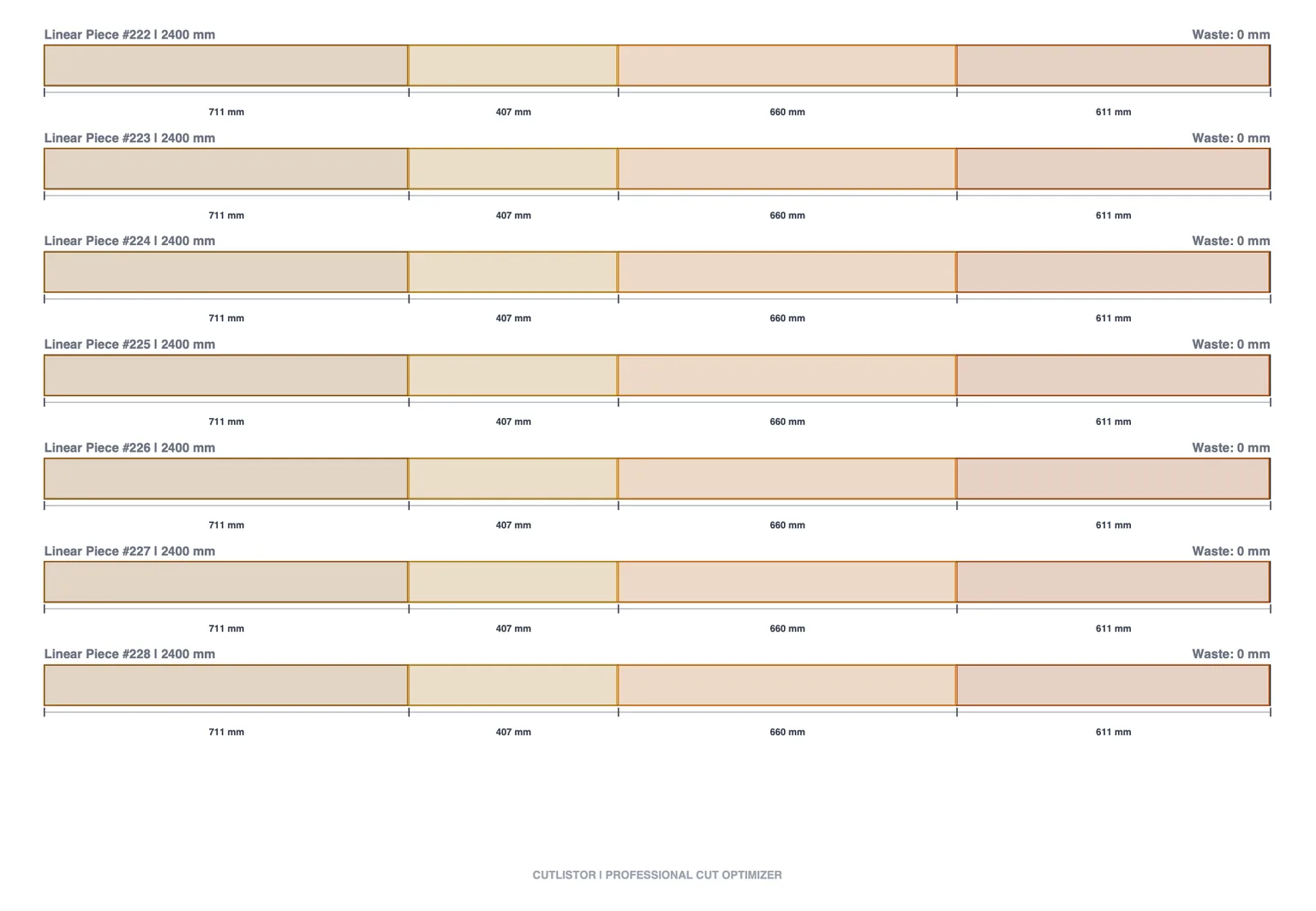
A window plant cutting frame rails, mullions, and transoms for a batch of 40 units might list 280 unique cut lengths across mixed profiles. Without optimization, purchasing rounds up to 120 stock bars of 6 m to be safe.
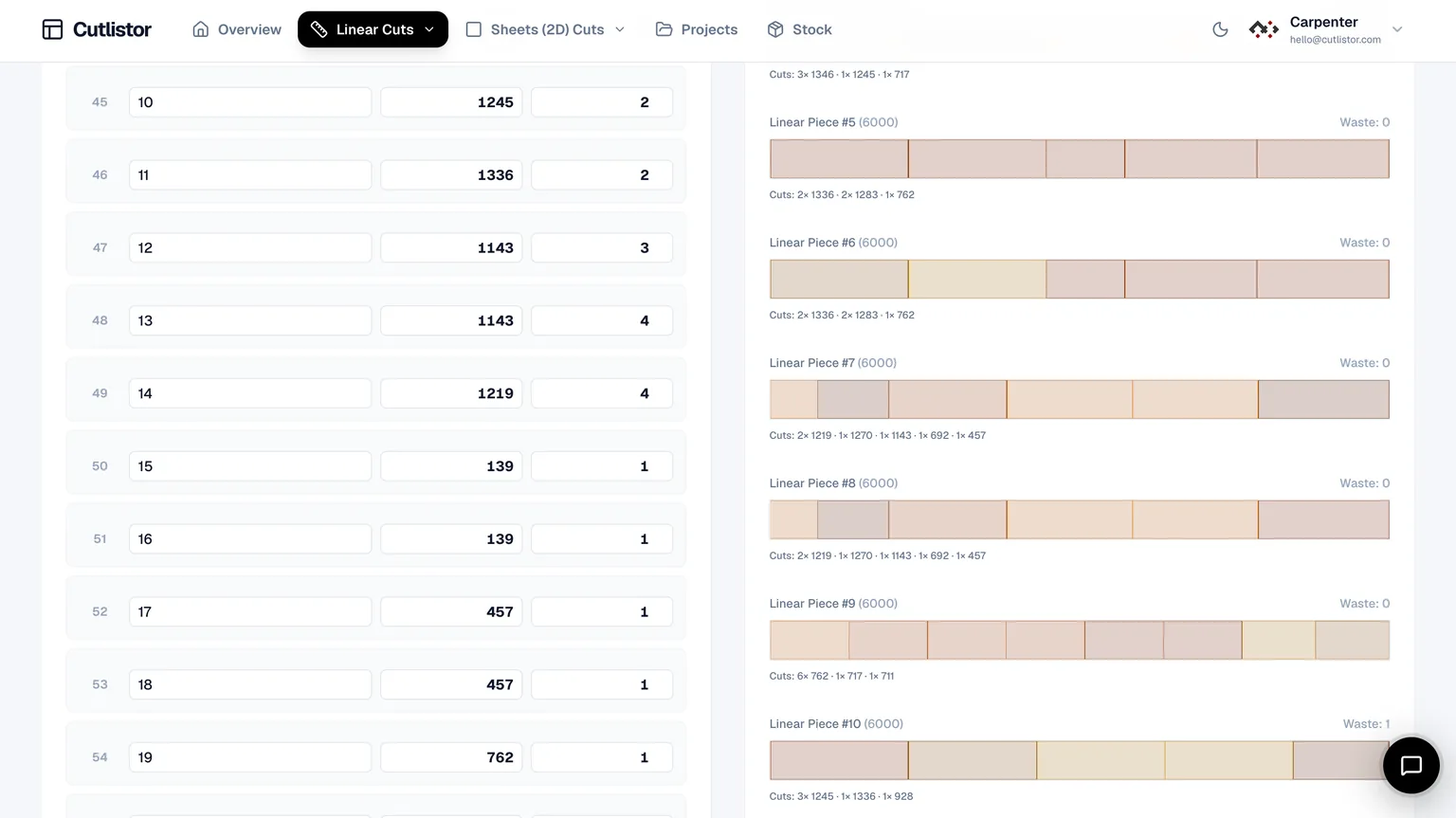
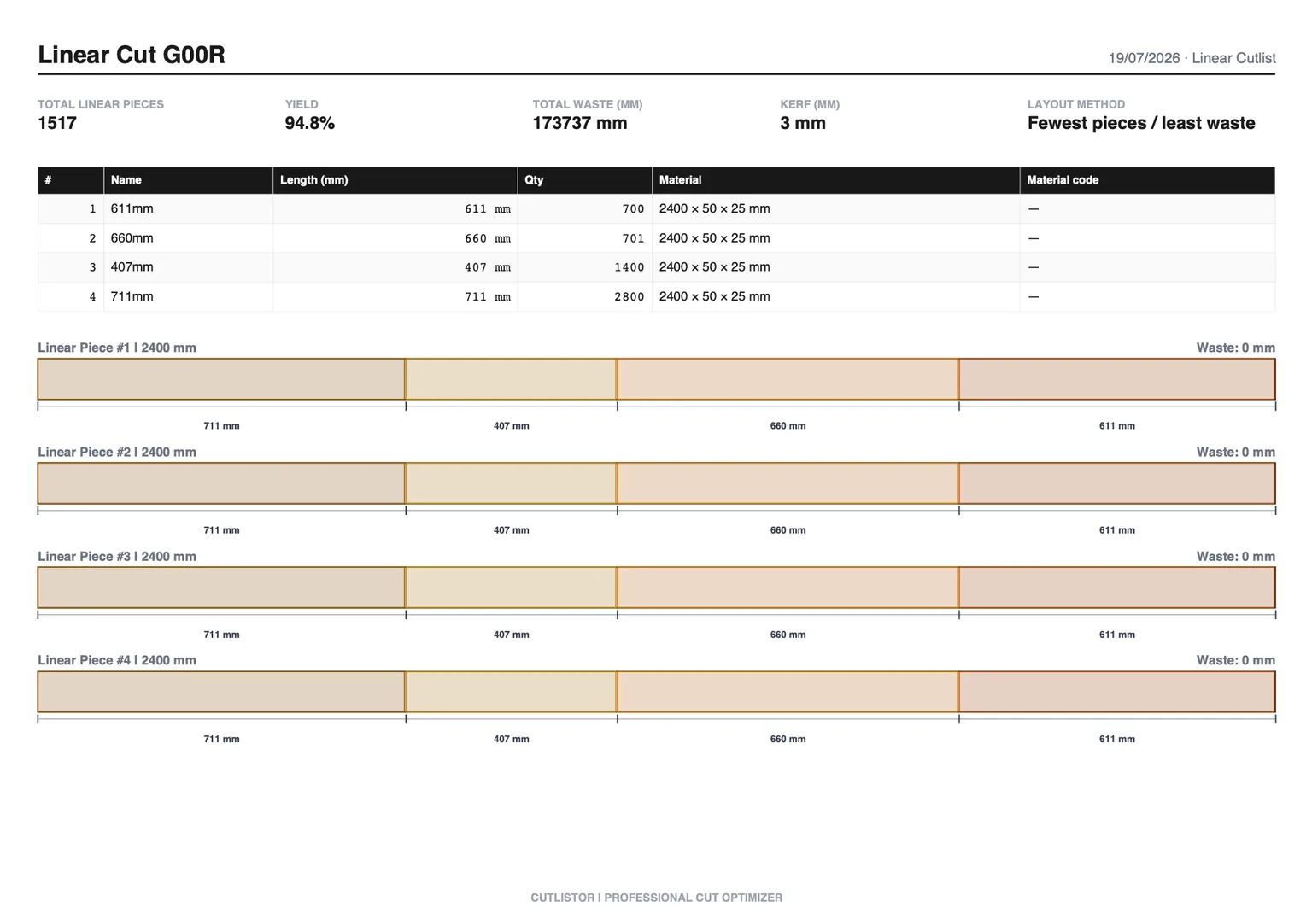
After importing the cut list into Cutlistor with kerf set to the cold saw blade (typically 3 to 4 mm), and entering both 6000 mm and 6500 mm stock options, the optimized plan fits the same parts on 114 bars. At $45 per bar delivered, six saved bars is $270 on one batch, plus less scrap handling and faster cutting because the sequence is pre-planned.
- Material: six fewer 6 m bars per batch at catalogue pricing
- Less waste: shorter total offcut length sent to recycling
- Faster cutting: saw operator follows PDF sequence bar by bar
- Better profitability: material savings drop straight to margin on fixed-price contracts
Linear Optimization for Aluminium Extrusions
Unlike plywood or aluminium sheet, extrusion is optimized by length, not sheet area. One dimension matters: how long each finished piece is, and how long each stock bar is in the rack.
Linear optimization applies to window frames, door frames, curtain wall mullions, railings, solar mounting rails, machine T-slot frames, and any job where you cut fixed lengths from bars, tubes, or channels.
How Cutlistor Helps Aluminium Fabricators
Free use is genuinely unmetered where it matters for cutting: change a dimension, re-nest, change it again, at no cost. The 3-per-day allowance covers PDF exports and new projects. Cut lists stop at 20 rows, imported CSV or XLSX files at 5 rows, and there is no persistence between visits.
Choosing an Aluminium Extrusion Supplier
Aluminium extrusion suppliers and aluminium extrusion manufacturers range from global mills to regional distributors stocking catalogue profiles. Choosing well affects lead time, MOQ, and finishing quality.
- Quality: consistent wall thickness and straightness; ask for mill test certificates on structural work
- Lead times: catalogue profiles often ship in days; custom dies need weeks
- MOQ: confirm minimum kg or length per order before quoting your customer
- Finishing options: mill finish, anodized, powder coat, wood-effect; match your customer's spec
- Certifications: ISO 9001, Qualicoat for powder, coastal-grade anodizing where required
Reduce Aluminium Waste Before You Make the First Cut
Every unnecessary cut and every unused offcut reduces your profit. Whether you're fabricating aluminium windows, doors, machine frames, railings, or T-slot assemblies, optimizing your stock lengths before cutting helps you buy less material, reduce scrap, and complete jobs faster.
With Cutlistor you can:
- Optimize aluminium extrusions and other linear materials
- Reuse offcuts by entering them as stock rows (track inventory across jobs on paid plans)
- Support multiple stock lengths in a single project
- Set miter angles on linear parts with paid plans for accurate frame and handrail work
- Generate optimized cutting lists in seconds
- Estimate material costs when price per stick is entered
- Import cut lists from Excel or CSV
- Print clear cutting diagrams for the workshop
Frequently Asked Questions
What is aluminium extrusion?
Aluminium extrusion is a process that pushes heated aluminium through a die to create a long profile with a fixed cross-section. The resulting lengths are cut to size for windows, frames, rails, and structural components.
How is aluminium extrusion made?
Billet is heated, forced through a die, cooled, stretched straight, cut to commercial lengths, heat-treated if required, and finished (anodized or powder coated) before shipping to fabricators.
What is the extrusion process?
The extrusion process converts solid aluminium billet into continuous profile lengths by applying pressure through a shaped die opening. It is the same fundamental method used for both simple flat bars and complex multi-chamber window sections.
What is an extrusion die?
An extrusion die is a hardened steel tool with an opening shaped like the profile cross-section. Aluminium flows through the die under heat and pressure to form the profile.
How do you cut aluminium extrusion?
Production shops use cold saws, mitre saws, band saws, or CNC cutoff saws with blades rated for non-ferrous metal. Measure carefully, account for kerf, and sequence cuts from an optimized cut list to minimize scrap.
What's the best saw blade for aluminium?
Carbide-tipped blades designed for non-ferrous metal with negative hook angle and appropriate tooth count for your profile wall thickness. Avoid steel-only blades that gum and overheat aluminium.
What industries use aluminium extrusion?
Construction (windows, curtain wall, solar mounting), industrial automation (T-slot framing), transport, furniture, retail fixtures, and aerospace all rely on extruded aluminium profiles.
How much material waste is normal?
Without optimization, 5 to 15% length waste on mixed cut lists is common. With linear optimization and offcut reuse, many shops hold waste under 5% on repeat profile work.
How can I reduce aluminium waste?
Build a complete cut list, enter all purchasable stock lengths including usable offcuts, set kerf to your blade, and run a linear optimizer before ordering. Track remnants on paid inventory tools so the next job consumes them first.
What is linear optimization?
Linear optimization (1D nesting) packs required cut lengths onto stock bars to minimize waste and stick count. It is the correct method for extrusions, unlike 2D sheet nesting used for plate and plywood.
What software is best for aluminium cut optimization?
Cutlistor's linear optimizer handles extrusions, tubes, angles, and T-slot with multiple stock lengths, kerf control, CSV import, PDF export, mitered ends on paid plans, and DXF for CNC saws on paid plans. Run the free browser tool on your next BOM to compare stick count with your current method.
Does Cutlistor support mitered cuts on aluminium frames?
Yes, on paid Cutlistor plans. Enter miter start and end angles on linear parts and the optimizer deducts the correct length along the bar, labels miters on PDF cut plans, and exports miter geometry in DXF. The free linear tool handles square cuts with kerf; upgrade when frame miters are part of daily work.
Conclusion
Aluminium extrusion delivers complex profiles efficiently at the mill, but fabricator profit is won or lost on the cutoff saw. Accurate cut lists, kerf-aware sequencing, and miter-aware planning on angled frame work separate shops that pad every PO from shops that buy exactly what the job needs.
Linear cut list optimization is the fastest way to reduce aluminium waste without changing suppliers or alloys. Try Cutlistor's free linear optimizer on your next window batch, T-slot frame, or railing job: import your lengths, set kerf, compare stick count to your usual estimate, and see how much margin returns when scrap drops.