Guide · 5 min read
Length nesting for linear stock
Length nesting (1D nesting) packs multiple cut lengths onto standard sticks, bars, or tubes you actually purchase. The optimizer decides cut order along each stick so kerf and offcuts stay under control before you commit to a lumber order or pipe pull. It is the same math whether you call it a lumber cut list, pipe nesting calculator, or bar stock optimizer. Only one dimension matters: how long each finished piece is, and how long each stock length is in the rack. Cutlistor’s free linear cut list optimizer runs this in the browser with multiple stock lengths, kerf, yield display, and PDF export. Dashboard projects add mitered ends on linear parts when trim geometry requires angles.
What length nesting means in practice
Imagine a 3048 mm (10 ft) stick and three parts: 2438 mm, 448 mm, and 812 mm. Length nesting chooses which parts share a stick and in what order, subtracting kerf after every blade pass.
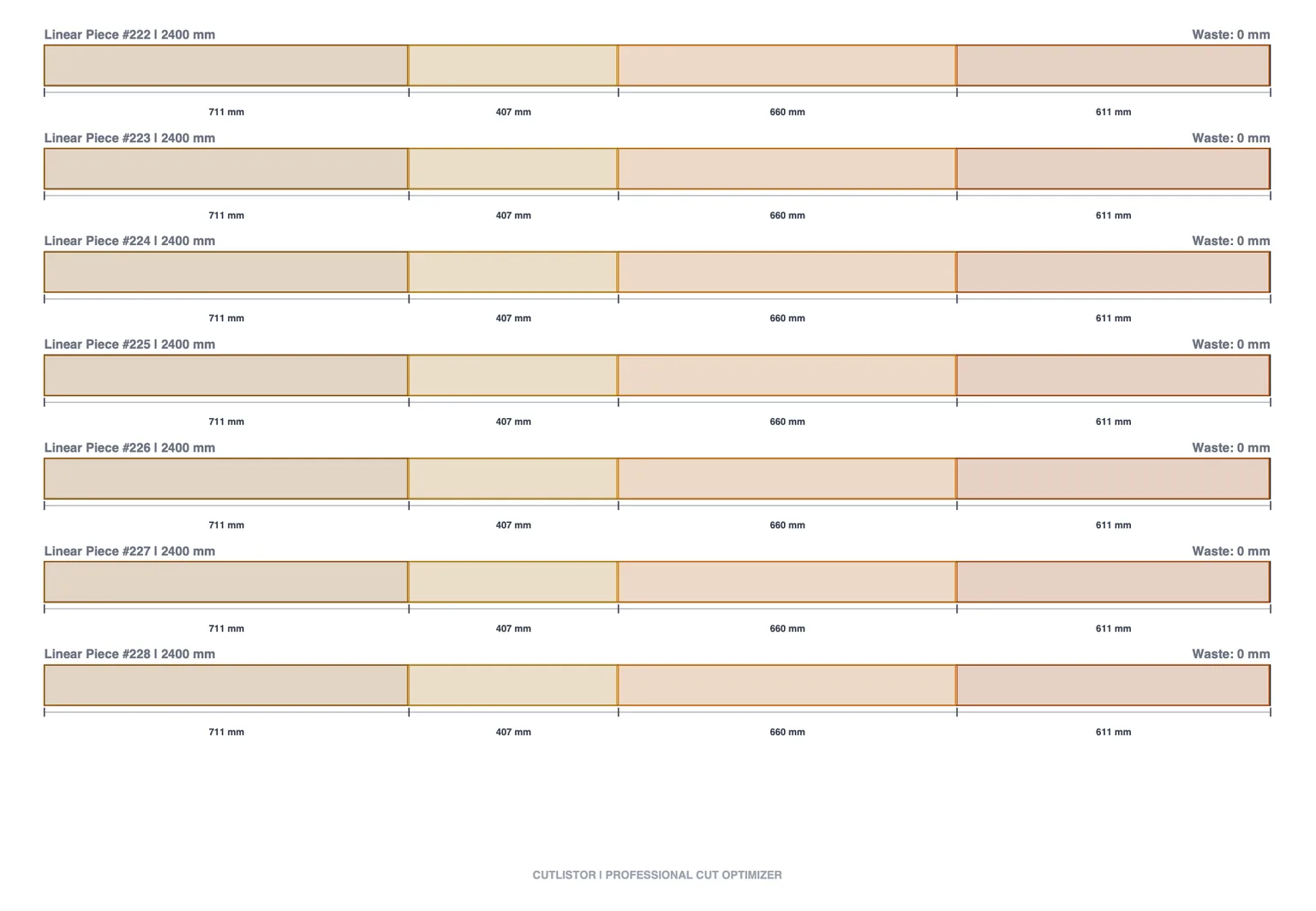
The output is a cut sequence per stick: start from one end, cut, advance kerf, cut again, until the stick is consumed or a labeled offcut remains.
Unlike sheet nesting, there is no rotation on a table. The decision space is smaller but still combinatorial when you have dozens of lengths and several stock sizes to choose from.
When to use length nesting instead of sheet nesting
Use length nesting when purchased stock is one-dimensional: dimensional lumber, trim bundles, conduit, copper tube, angle iron, rebar, and metal bar.
Use sheet nesting when parts have two meaningful face dimensions on panel stock: plywood, MDF, melamine, plate steel rectangles, or OSB sheathing patches.
Mixed jobs are normal. Cabinets nest panels on sheets and cut toe-kick cleats or face-frame stock on linear nesting. Run two optimizers rather than forcing everything into one model.
Stock lengths, kerf, and material codes
Enter every stock length you are willing to buy, not only the cheapest one. Framing yards might stock 2438 mm and 3658 mm sticks; metal service centers sell 6000 mm bars while you only need 4200 mm of parts.
Set kerf to the blade or wheel you will use today. A 2.4 mm kerf on a finish miter saw differs from a 3.2 mm framing circular saw.
Material codes group parts that must cut from the same SKU. Do not nest pressure-treated posts with interior SPF on the same stock row unless they truly share inventory.
| Trade | Typical stock lengths (examples) | Notes |
|---|---|---|
| Framing lumber | 2438 mm (8 ft), 3048 mm (10 ft), 3658 mm (12 ft) | Precut studs are often 2438 mm |
| Trim / moulding | 3660 mm, 4877 mm bundles | Watch exposed face waste |
| EMT conduit | 3048 mm (10 ft) sticks | Include bend allowances in part length |
| Steel bar | 6000 mm mill length | Kerf wider on abrasive cuts |
| Deck boards | 2438 mm, 3658 mm, 4877 mm | Mixed lengths common at retail |
Always enter the length printed on your supplier tag, not a generic label.
Worked example: interior wall framing sticks
Take a wall needing twelve studs at 2438 mm cut from 2438 mm precut studs (essentially one piece per stud) plus four plates at 3658 mm from 3658 mm stock. Kerf 3.2 mm.
If plates were 3048 mm instead, each plate might consume one 3048 mm stick with small offcuts unless you nest shorter blocking into those offcuts in the same run.
Import the linear sample CSV from /samples/cutlist-import/, replace lengths and quantities, set stock rows to match your yard, and read how many sticks the optimizer requests before pickup.
Multiple stock lengths in one optimization run
Real shops rarely buy only one length. Cutlistor accepts multiple stock rows per material so the algorithm can place short parts into offcuts from long pieces before opening a new stick.
When yield looks low, add the next longer stock length you actually keep in the rack and recalculate. Sometimes buying one 3658 mm stick saves two 2438 mm sticks even though unit price per foot is higher.
Compare results with yield percentage and stick count, not gut feel. A few recalculations in the browser beat an extra truck run.
PDF cut plans and handoff to the crew
After nesting, export a PDF linear cut plan with labeled parts and cut positions. Crews can work from the diagram at the miter saw or chop station without translating a spreadsheet.
Free tier sessions support 3 calculations per day and up to 20 part rows. Paid plans add saved projects, stock inventory, and miter metadata on linear parts in the dashboard when angles matter.
Pair PDF output with your material codes so the pull list and the saw diagram use the same names. Consistency reduces wrong-length recuts on busy Saturdays.
FAQ
- Is length nesting the same as sheet nesting?
- No. Length nesting is 1D along a stick. Sheet nesting places rectangles on panels. Cutlistor has a dedicated free tool for each.
- Can I nest pipe and conduit?
- Yes, if the job is defined by cut length along the stick. Enter conduit stick length (often 3048 mm for 10 ft EMT) and each run length with kerf.
- Does Cutlistor support metric and imperial?
- Yes. Enter stock and parts in the units you purchase. Stay consistent within a job.
- Are mitered cuts included in free length nesting?
- The free linear optimizer focuses on straight length cuts with kerf. Mitered ends are available on linear parts in saved dashboard projects.
- How do I import many parts quickly?
- Use linear-cutlist-sample.csv or .xlsx from /samples/cutlist-import/ with columns name, length, qty, material code, material name, and optional custom column.
Related guides
- Cut list software that runs in your browserCut list software comparison: browser-based sheet and linear optimizers, AI plan scan, 3D CAD import, PDF and DXF export. No PC download required.
- Cut list optimiser: free online (UK spelling)Free online cut list optimiser for sheet goods and linear stock. Kerf-aware cutting list optimisation with PDF export. Browser-based, no download.
- How many sheets of plywood do I need?How many sheets of plywood do you need? Why square-footage math under-counts, how kerf changes the answer, and how to get an exact 4×8 sheet count.
- What is a cut sheet?A cut sheet means two different documents depending on the trade: a cutting layout in the shop, a product spec sheet on site. What each contains, with examples.