Guide · 3 min read
Linear cut list calculator for 1D stock
A linear cut list calculator focuses on lengths: how many pieces of each size, which stock lengths you buy, and how blade kerf eats into every cut. It is the right mental model for dimensional lumber, trim bundles, pipe, tubes, and metal bars. Unlike sheet nesting, width and height are not part of the waste equation. Only stick length, part length, quantity, and kerf drive the plan.
When linear beats sheet optimization
If your parts do not have a meaningful width on panel stock, or you are cutting runs from long goods, use a linear cut list optimizer instead of a sheet nesting tool.
Framing walls, trimming rooms, cutting conduit sticks, and sawing bar stock are all 1D jobs. Trying to model them as fake rectangles on plywood wastes time and hides the real purchase question: how many sticks?
How Cutlistor handles linear jobs
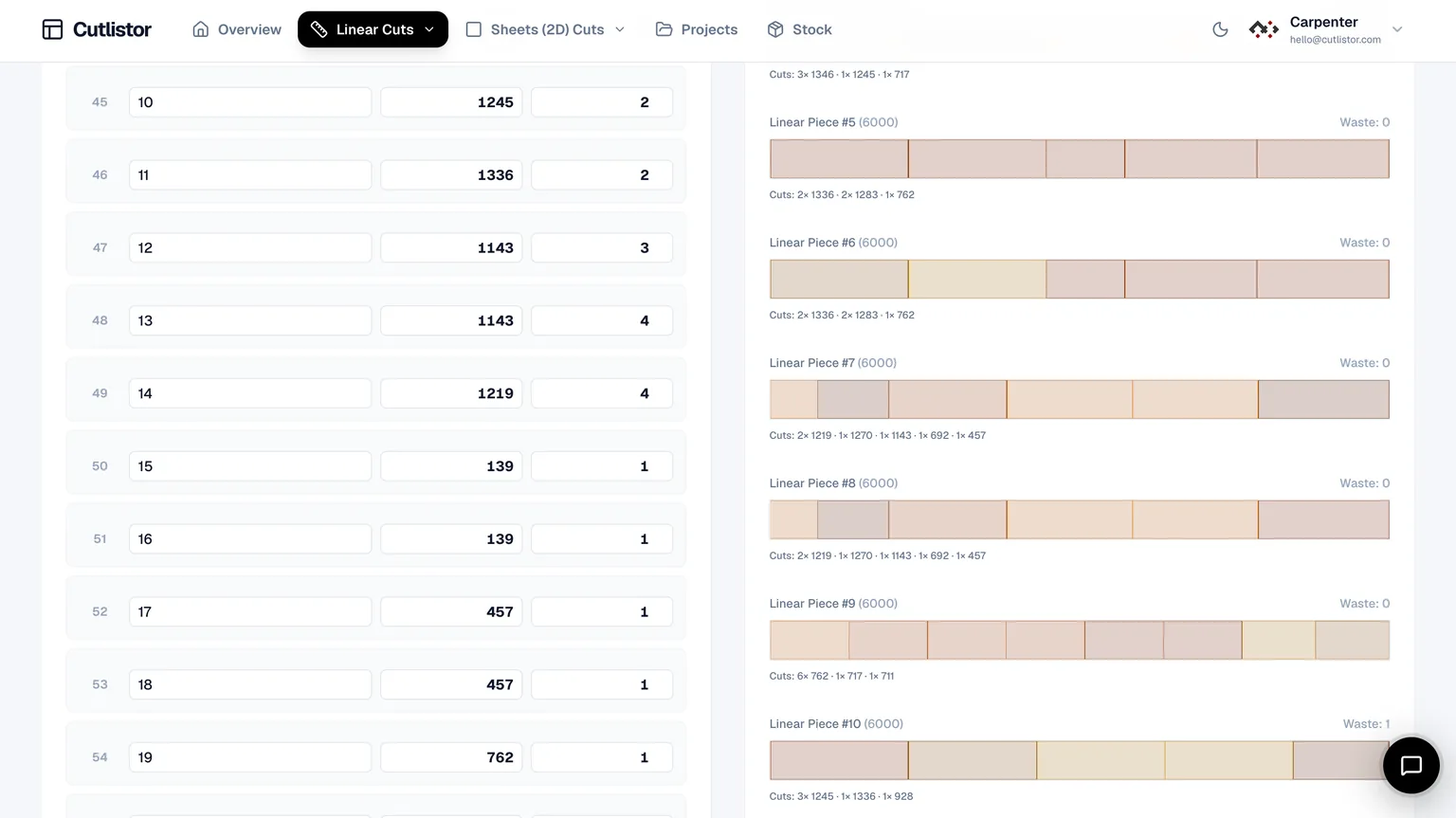
Enter stock bars and part lengths, set kerf, review yield, and export documentation. For mixed cabinet jobs, pair this with the sheet optimizer for panels.
Multiple stock lengths can coexist in one job. Enter 8 ft and 10 ft bundles if both are on the truck and let the optimizer pick efficient patterns.
Mitered ends are supported when your process needs angled cuts reflected in planning. Enter finished lengths after your shop allowances.
Stock length honesty
Precut studs at 92-5/8 in, 10 ft conduit sticks, 6 m pipe, and 20 ft bar stock are different SKUs. Enter what you purchase, not rounded textbook numbers.
When price per foot differs between lengths, run the same cut list against each bundle option and compare stick count plus leftover inventory value.
Kerf on linear cuts
Every cut removes blade width. Fine-tooth trim blades, framing blades, abrasive wheels, and cold saws differ. Measure kerf once per process and reuse until tooling changes.
Underestimating kerf produces parts that are slightly short in a long wall run. Overestimating kerf wastes stock. Both are fixable with a quick scrap test.
Worked example: wall framing
A 12 ft wall with 16 in on-center framing might need fourteen studs at 92-5/8 in plus top and bottom plates cut from 2×4×8 bundles. Enter stock 96 in and 92-5/8 in precuts if both are available.
Set kerf near 1/8 in for a typical framing blade, run the optimizer, and read how many bundles to pull before layout day.
Import and PDF export
Import linear CSV or XLSX from /samples/cutlist-import/ when Excel already lists lengths. Export PDF cut sequences for the crew. Paid plans add saved projects when the same stick sizes return every week.
FAQ
- What is a linear cut list calculator?
- A planning tool for length-only stock: lists parts, stock lengths, kerf, and stick count before cutting.
- Can it handle pipe and conduit?
- Yes. Any 1D stock with meaningful length fits the same workflow.
- Multiple stock lengths?
- Yes. Enter every length you buy and compare yield.
- Does it subtract kerf?
- Yes. Set kerf to your blade or wheel width.
- Mixed panel and stick jobs?
- Use the sheet optimizer for panels and this tool for sticks. Link both PDFs in job notes.
Related guides
- The cutting stock problem in workshopsPlain-language guide to the cutting stock problem in woodworking: 1D bar cutting vs 2D sheet nesting, heuristics, and practical tools including Cutlistor.
- 1D cutting optimizer explainedWhat a 1D cutting optimizer does for lumber, pipe, and bar stock, how kerf changes results, and how to try Cutlistor’s free linear optimizer online.
- 2D nesting optimizer for sheet goodsOverview of 2D nesting for sheet goods: rectangles, kerf, grain, yield, and Cutlistor’s free browser-based sheet cut list optimizer.
- Guillotine cutting on panel stockWhat guillotine-style cuts mean for nested panels, how they differ from freeform nesting, and how Cutlistor helps you plan practical shop cuts.