Guide · 3 min read
Guillotine cutting on panel stock
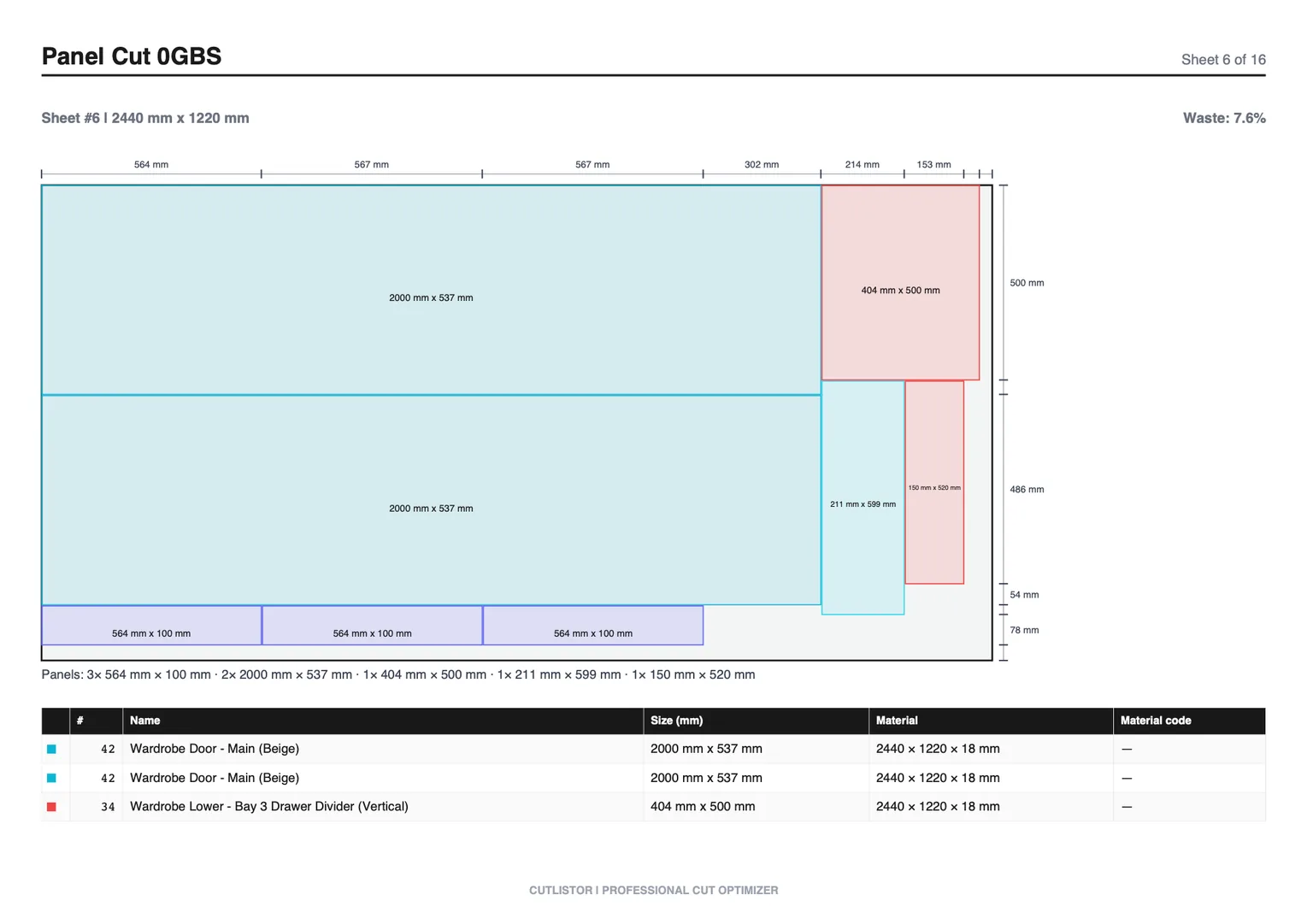
Guillotine cutting means every cut slices across the full remaining piece, like a series of straight shears. Many table-saw-first shops naturally prefer guillotine-friendly patterns because they are fast and repeatable even if they are not always mathematically perfect.
Why shops care
If you optimize only for theoretical minimum waste but the pattern needs dozens of turns, floor time suffers. Cutlistor focuses on practical documentation you can actually build from.
Rips and rows layout methods align with guillotine-style production on panel saws and table saws.
Guillotine vs freeform nesting
Freeform nests can squeeze extra parts into odd corners at the cost of complex cut sequences. Guillotine patterns trade a little yield for straight rip bands and predictable handling.
CNC routers sometimes accept denser freeform packs; panel saw crews often do not. Pick the layout method that matches who cuts the job.
Kerf still matters
Even straight rip patterns need accurate kerf. Underestimating kerf on nested rips produces panels that drift short across a long run.
Grain and edge banding
Guillotine rips do not override grain rules. Lock orientation on visible faces before exporting PDFs.
Edge banding allowances belong in finished part sizes before nesting.
When to switch methods
Compare rips and rows against least waste on the same part list. If yield difference is small but rips save an hour on the floor, rips win.
Try layouts in Cutlistor
Enter stock and parts in the free sheet optimizer, toggle methods, export PDF when the pattern matches shop habits.
Panel saw workflow with guillotine rips
Guillotine-friendly layouts prioritize crew speed. A slightly lower yield layout that rips in straight bands often wins on the floor.
Label each rip band on the exported PDF so the panel saw operator knows which sub-panel comes off each pass.
- Rip full-width bands first, then crosscut sub-panels
- Label parts on the PDF before leaving the office
- Measure kerf once per blade change
- Compare rips and rows vs least waste on the same BOM
FAQ
- What is guillotine cutting?
- Cuts that go fully across the remaining sheet, producing straight sub-rectangles.
- Is it always best yield?
- Not always. It is often fastest on panel saws.
- Does Cutlistor support it?
- Yes via rips and rows and related sheet layout methods.
- CNC jobs too?
- Router-style methods may suit CNC when denser packs help. Cutlistor also exports DXF for sheet and linear layouts when your CAM workflow needs solver-native geometry.
- Free to test?
- Yes in the browser sheet optimizer.
Related guides
- Cut list optimization workflowCut list optimization techniques: stock setup, kerf discipline, sheet vs linear choice, and free tools on Cutlistor for instant cut layouts.
- Cut list template: columns, samples, and PDF exportWhat belongs on a cut list template: part columns for CSV/XLSX import, sample spreadsheets, and how to export kerf-aware PDF cut plans from Cutlistor.
- What is a cut list?A cut list is the table of parts to be cut from stock, with sizes and quantities. What it contains, how it differs from a BOM, and how shops actually use it.
- What is material grouping?Material grouping splits a cut list by thickness, finish, and stock SKU so each batch nests on the right sheet or stick — without mixing melamine and plywood.