Calculator page · 4 min read
Pipe cutting calculator
Pipe and conduit runs are classic 1D cutting problems. Treat the job like a pipe cutting calculator or pipe nesting calculator: list each finished length, quantity, and the stock length you buy in sticks.
How Cutlistor optimizes pipe and conduit
The free linear cut list optimizer accepts multiple pipe and conduit stock lengths, part lengths, quantities, and kerf. Review stick count and yield before you buy.
Standard pipe stock lengths
Enter the lengths you actually purchase - common examples include 6 m and 12 m metric sticks, or 10 ft and 21 ft imperial bundles. Matching real stock keeps yield honest.
| Region / trade | Typical stock lengths |
|---|---|
| Metric plumbing | 6 m, 12 m |
| North America (PVC / conduit) | 10 ft, 20 ft |
| Structural / heavy pipe | 6 m, 12 m, custom mill lengths |
Pipe nesting calculator example
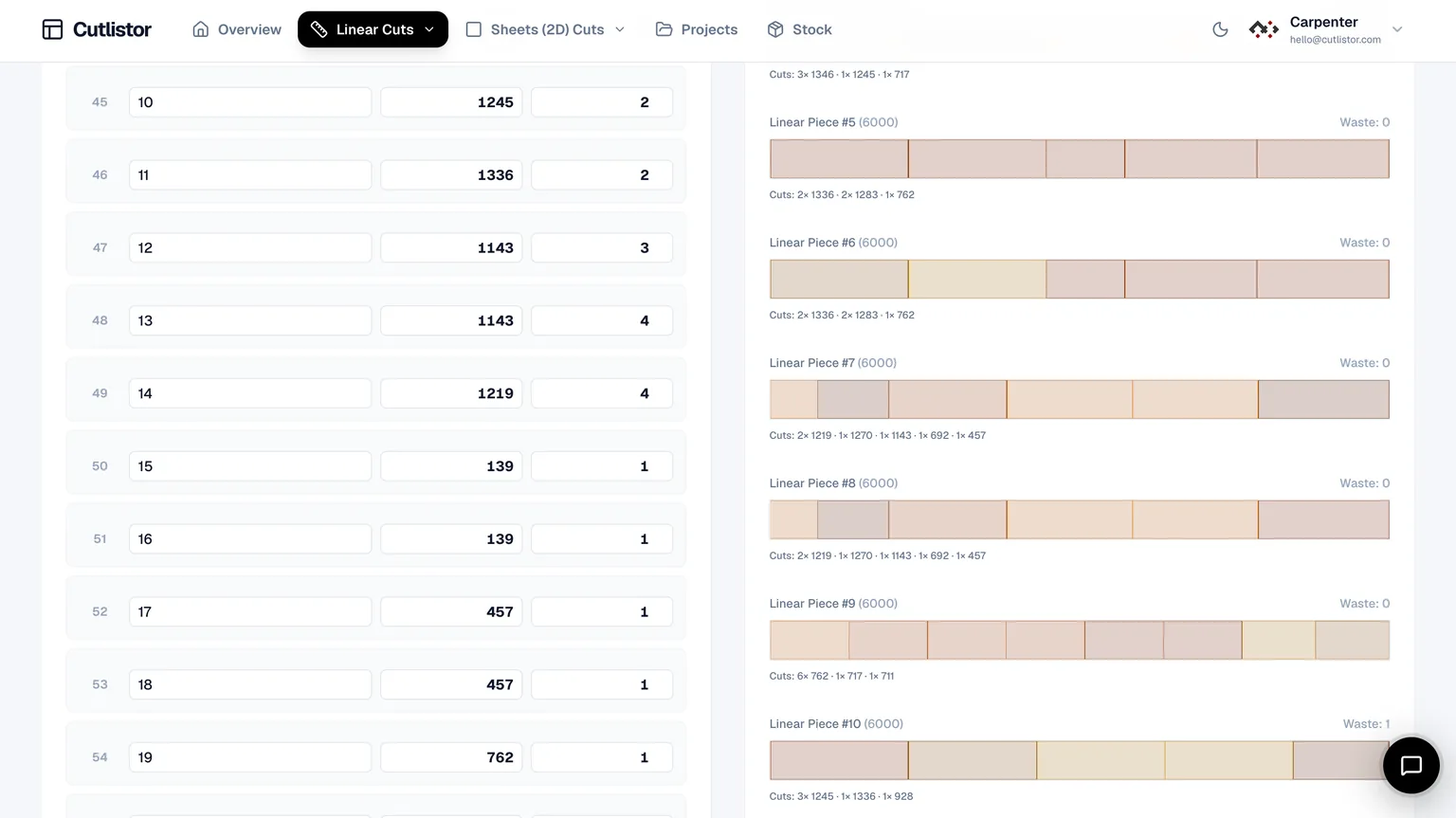
Suppose you buy 6 m sticks and need twelve cuts at 1.2 m each with 3 mm kerf. The linear optimizer sequences cuts on the fewest sticks, shows remaining offcuts, and exports a PDF for the crew.
Kerf for pipe and conduit
Update kerf to match your process - fine-tooth saw, abrasive wheel, or cold saw blades remove different amounts of material. The optimizer plans from the kerf value you enter.
Threads and fittings
Account for thread engagement or fusion allowances in the finished lengths you enter - the optimizer plans cuts from the numbers you provide.
Pipe nesting vs sheet nesting
Pipe on sticks is 1D. Do not model pipe as sheet rectangles — use linear optimizer for stick count.
Step-by-step pipe and conduit linear workflow
List every finished pipe and conduit length and quantity. Enter stock lengths you actually buy — 10 ft, 20 ft, 6 m, or 12 m sticks. Set kerf to 3 mm fine-tooth or wheel kerf per process.
Run the optimizer and read stick count plus offcuts. Compare 10 ft vs 20 ft conduit sticks on the same cut list when price per foot differs.
For mixed jobs, run panels in the sheet optimizer and sticks here. Link both PDFs in the job folder.
Kerf and stock lengths for pipe and conduit
Pipe and conduit are classic 1D jobs. Thread and fusion allowances belong in finished lengths you enter.
Kerf differs for abrasive wheel vs fine-tooth saw — measure per process.
| Stock option | Typical use |
|---|---|
| 10 ft (3 m) | North American EMT/PVC |
| 20 ft | Long conduit runs |
| 6 m / 12 m | Metric plumbing sticks |
Worked example: twelve cuts at 1.2 m from 6 m
Twelve 1.2 m cuts from 6 m PVC with 3 mm kerf — linear optimizer sequences sticks, shows offcuts, exports PDF for crew.
Import, export, and verification
Import linear CSV or XLSX from /samples/cutlist-import/ when Excel already holds pipe and conduit lengths.
Export PDF cut sequences for the crew. Paid plans add saved projects and mitered ends on linear parts in the dashboard.
Free anonymous use includes 3 calculations per day, up to 20 part rows, and CSV imports of up to 5 rows.
Before you cut pipe and conduit: checklist
Confirm pipe and conduit stock length matches the bundle on order. Confirm kerf for your cutting process.
Link sheet and linear PDFs when one job uses both material forms.
FAQ
- Is this the same as a pipe nesting calculator?
- Yes. Pipe nesting on stick stock is 1D optimization - Cutlistor’s linear tool handles the same math with kerf-aware sequencing.
- Is this pipe and conduit linear calculator free?
- Yes. The linear cut list optimizer runs in the browser with free-tier daily limits.
- Can I use multiple pipe and conduit stock lengths?
- Yes. Enter every stick length you buy — 10 ft, 20 ft, 6 m, or 12 m sticks — and compare yield.
- How do I set kerf for pipe and conduit?
- Measure once on scrap. For pipe and conduit, 3 mm fine-tooth or wheel kerf per process is a common starting point until tooling changes.
Related calculators
- Tube cutting calculatorTube cutting calculator for metal or plastic tubing: linear optimization, kerf, stock lengths, PDF export with Cutlistor.
- Bar stock cutting calculatorBar stock cutting calculator for metal and plastic bars: linear nesting, kerf-aware yield, exportable plans from Cutlistor.
- Beam cut list calculatorBeam cut list calculator for long heavy stock: plan cuts, apply kerf and check yield with a free linear optimizer, then export a PDF for the crew.
- Kitchen cabinet cut list calculatorKitchen cabinet cut list calculator for sides, decks, stretchers, and backs: nest melamine or plywood panels with kerf-aware PDF export.