Article
Face Frame vs Frameless Cabinets: Construction, Cut Lists, and Yield
Cutlistor Team5 min read
Introduction
Face-frame and frameless cabinets are the two dominant carcase systems in North American and European-influenced shops. The choice changes more than door overlay. It changes gable detailing, hardware, boring patterns, edge banding scope, and how your cut list splits between sheet nesting and linear stick cutting.
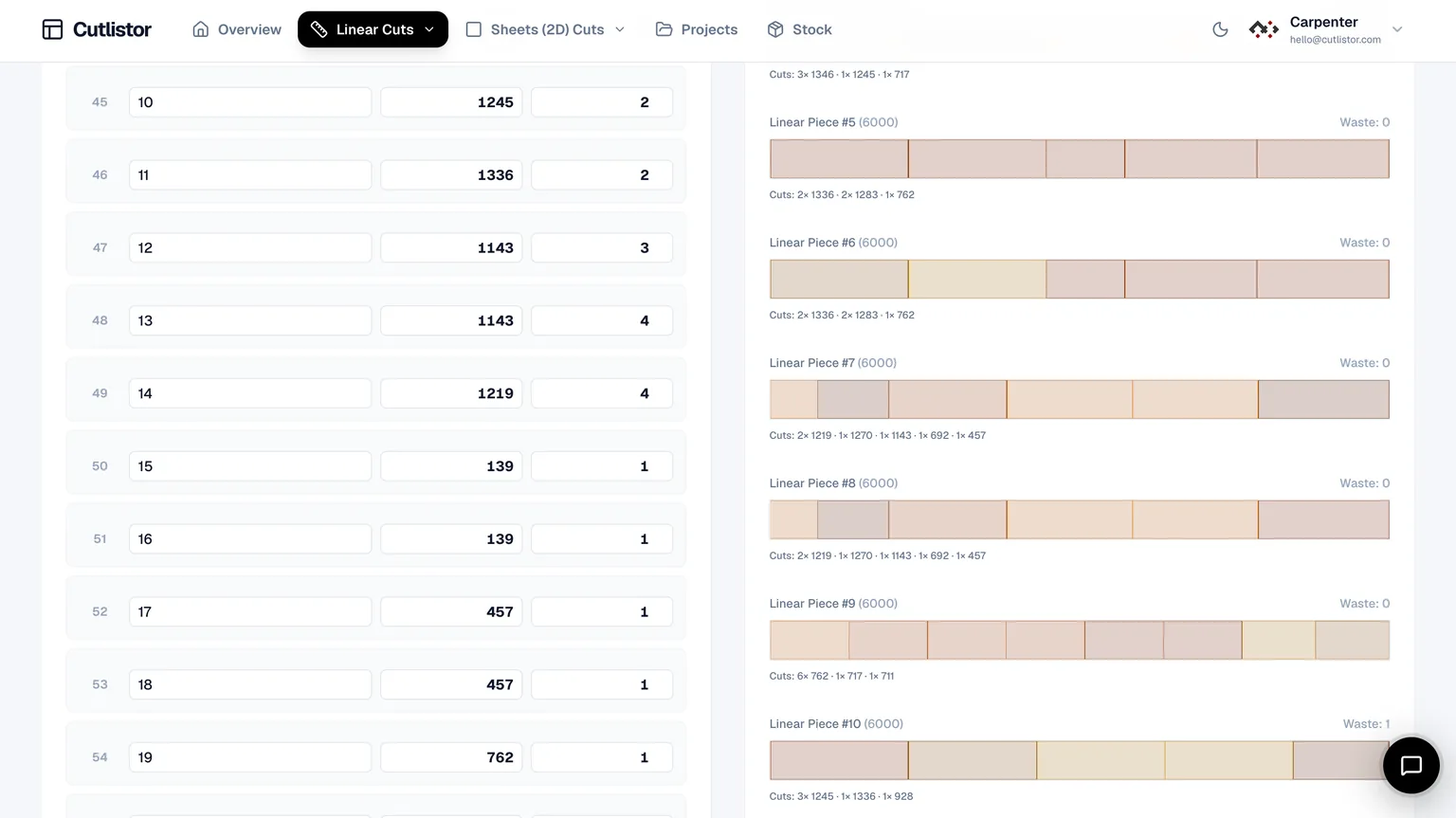
For production managers and estimators, the practical question is not style preference alone. It is which method fits the shop's equipment, labor mix, and material yield on the jobs you quote every week.
This comparison is written for cabinet makers planning BOMs and nests. Pair it with cabinet parts explained and the cabinet making hub for the full pillar.
Definitions
Face-frame cabinets attach a solid wood (or plywood) frame of stiles and rails to the front of the box. Doors and drawers typically overlay or inset relative to that frame. The frame hides raw panel edges and adds stiffness to the opening.
Frameless cabinets (often called European or full-access) omit the front frame. The box edge is edged-banded and becomes the reveal surface. Doors usually full-overlay the gables. The 32 mm boring system is common for hinges, slides, and shelf pins.
Construction Comparison
| Topic | Face frame | Frameless |
|---|---|---|
| Front edge of box | Covered by frame | Edge-banded gable/front |
| Door relationship | Partial overlay, full overlay, or inset | Usually full overlay |
| Interior access | Frame reduces clear opening | Full clear opening of box |
| Common hardware | Traditional hinges or modern overlays | Concealed cup hinges, 32 mm system |
| Typical materials | Plywood box + hardwood frame | Melamine or plywood box throughout |
| Squareness help | Frame can pull opening true | Relies on accurate box joinery |
| Reveal / style cues | Classic NA look | Modern / European look |
Cut List and Nesting Impact
Face-frame jobs are mixed stock by default: sheet nests for the box, linear nests for stiles and rails. Frameless jobs are sheet-heavy: more edge banding on front edges, often more consistent panel sizes, and fewer hardwood sticks unless the shop adds decorative light rail or fillers.
Yield behavior differs. Frameless shops burn banding on every front edge and care deeply about grain on exposed gables. Face-frame shops can hide some panel edges behind the frame but must buy and optimize hardwood efficiently.
Face-frame cut list pattern
- Sheet: gables, bottoms, shelves, backs, nailers
- Linear: stiles, rails, sometimes mullions
- Separate material groups for hardwood species and sheet core
- Door frames may add another linear family if shop-built
Frameless cut list pattern
- Sheet: gables, bottoms, tops/stretchers, shelves, backs, nailers
- Edge banding schedule is critical on front edges
- Linear mainly for fillers, scribe, and kick faces
- Boring maps stay in CNC software; sizes still feed Cutlistor for nesting
Dimensions and Clear Openings
Overall kitchen standards (base height about 34.5 in plus countertop, base depth about 24 in, wall depth about 12 in) apply to both systems. The difference is inside the opening: face-frame stiles steal width from the clear opening; frameless gives nearly the full interior width for drawers and pullouts.
When calculating finished panel sizes, face-frame shops subtract joinery for dados and account for frame thickness separately. Frameless shops calculate box width as the finished outside or inside dimension depending on whether gables are butt-joined or dados receive the bottom. Document the convention on every job.
Which Method Fits Which Shop?
Choose based on equipment and labor, not only design trends.
- Strong hardwood mill and traditional installers: face frame remains efficient
- CNC with 32 mm boring and edgebander capacity: frameless scales well
- Pre-finished melamine production: frameless is a natural fit
- Historic remodel matching existing frames: face frame often required
- Maximum drawer width in a tight run: frameless usually wins
Install, Scribe, and Field Reality
Face-frame cabinets historically forgave slightly out-of-square openings because the frame could hide small gaps and the installer could plane a stile. Frameless cabinets put the reveal on the banded edge and door gap, so wall fillers and careful leveling matter more.
Neither system removes the need for fillers. Both still need accurate overall widths from the elevation and a cut list that regenerates when the field measure changes a dishwasher gap by 1/4 in.
Quoting Labor and Material Mix
Estimators should track three buckets separately: sheet goods for boxes, linear stock for frames or fillers, and labor minutes for framing versus edgebanding. A frameless kitchen that looks cheaper on hardwood may cost more on banding and CNC setup. A face-frame kitchen that looks expensive on maple stiles may save edgebander hours.
Run both material families through an optimizer before you pick a winner on a competitive bid. Sheet count and stick count beat gut feel.
Hybrid Shops
Many custom shops offer both. That means two cut list templates, two banding rules, and clear job tickets so the floor does not mix conventions. Optimizers help either way: the nesting math does not care about door style, only about rectangles and sticks.
Most free optimizers meter the optimizing. Cutlistor does not — you can tweak parts and re-run the layout as often as a job needs. The daily ceiling of 3 applies to PDF exports and new projects only. Expect a 20-row cut list limit, a 5-row ceiling on each CSV or XLSX import, and no saved projects.
FAQ
Which is stronger?
A well-built box of either type is strong enough for kitchen duty. Face frames add stiffness at the opening. Frameless relies on joinery, back, and hardware plates. Failure modes are usually poor fastening to the wall or undersized nailers, not the presence or absence of a frame.
Which costs less to produce?
It depends on the shop. Frameless can reduce hardwood and simplify door overlay math but increases banding and demands accurate CNC. Face frame uses more linear stock and labor at the frame table. Nest both material families before you assume a cost winner.
Is frameless always European?
Frameless construction is strongly associated with European hardware and the 32 mm system, but North American shops build frameless daily with local sheet goods. 'European' in sales speech often means full-overlay frameless, not a specific country of manufacture.
Do both systems need fillers?
Yes. Walls are rarely square. Fillers and scribe strips appear on both face-frame and frameless installs. See the fillers guide for sizing practice.
Conclusion
Return to the cabinet making hub or run a sample BOM through the free sheet and linear optimizers.