Article
What Is Custom Metal Fabrication? Job Shops, Quoting, and Material Planning
Cutlistor Team6 min read
Introduction
Custom metal fabrication is built-to-order work: one enclosure prototype, twelve bracket variants for a retrofit, a stainless tank skin that exists on exactly one drawing. Unlike production fab that repeats the same nest every week, custom shops live inside changing BOMs, last-minute revision emails, and remnant bins that either save the margin or collect dust.
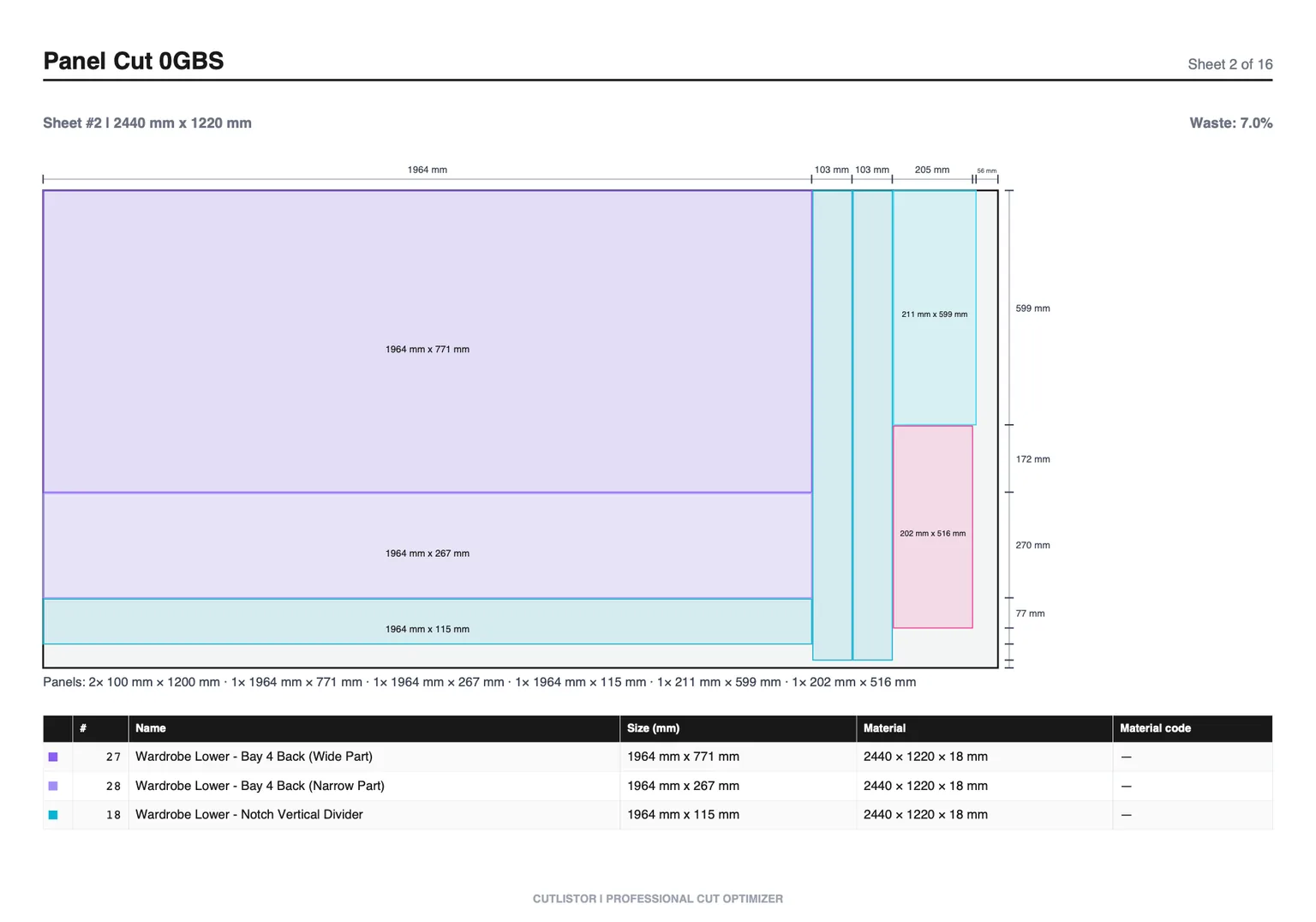
This guide defines custom fabrication, contrasts it with high-volume production, and explains why material planning and remnant-aware cut lists matter when no two jobs share the same part list. For broader process context, start with the metal fabrication guide.
What Is Custom Metal Fabrication?
Custom metal fabrication means manufacturing metal parts or assemblies to a customer-specific design, usually in low to medium volume. The shop interprets drawings or models, selects stock, programs cuts and bends, and delivers finished pieces rather than shipping catalog SKUs.
Custom work spans sheet metal enclosures, structural steel assemblies, architectural metalwork, repair parts, and R&D prototypes. What unifies them is variability: the next quote rarely reuses yesterday's nest unchanged.
- Low volume or one-off quantity per line item
- Customer-owned drawings, models, or verbal specs
- Mixed materials and thicknesses on a single job
- Engineering questions during quoting (tolerances, weld symbols, finish)
- Short lead times compared with tooling-heavy production routes
Custom Fabrication vs Production Fabrication
| Factor | Custom / job shop | Production fab |
|---|---|---|
| Typical lot size | 1 to low hundreds | Hundreds to thousands |
| Drawing stability | Revisions common | Frozen revision levels |
| Nesting strategy | Re-run per quote; use remnants | Repeat proven nests |
| Software priority | Fast estimates, CSV import | CAM integration, saved libraries |
| Margin risk | Quoting error, rush material buy | Downtime, changeover loss |
Quoting Custom Fabrication Jobs
A custom quote stitches together material, machine time, outside processing, and risk. Material is often the first number you can get wrong: guessing sheet count from a spreadsheet sum of areas ignores kerf, grain, and the fact that odd-sized brackets do not pack like perfect rectangles on a 5×10 plate.
Experienced estimators build a cut list early, even before CAM programming. That list feeds purchasing and proves the customer revision did not silently add a full sheet.
What goes into a sound quote
- Flat pattern sizes per thickness and alloy
- Linear cut lengths for tube, angle, and extrusion on the same job
- Kerf and bend allowance assumptions documented on the quote
- Finish and masking (powder, anodize, plating) called out separately
- Rework allowance when tolerances are tight or weld distortion is likely
Revision risk
Custom jobs change. When Rev C adds four holes and two new gussets, the estimator needs to re-nest in minutes, not rebuild a spreadsheet overnight. Browser-based optimizers with unlimited re-optimization help here: you edit parts, refresh yield, and re-export a PDF without burning a daily calculation cap on every dimension tweak.
Drawings, Models, and BOM Data
Custom shops receive PDF prints, STEP files, DXF flats, or photos of the broken part to reverse-engineer. The cut planning layer needs consistent dimensions regardless of source.
Cutlistor accepts CSV and XLSX imports when the BOM already lives in Excel, AI plan scanning when only a PDF or photo exists, and 3D mesh import on supported plans when a lightweight model is available. None of that replaces a full CAD seat, but it shortens the path from customer data to a nest you can price.
- Spreadsheet BOM: import rows as parts with width, length, and quantity
- PDF drawing pack: AI scan extracts rectangular cuts where dimensions are visible
- 3D mesh: extract bounding rectangles for early material estimates (not metrology)
- Manual entry: still valid for three-part rush jobs at the counter
Processes Custom Shops Use Most
Custom fabrication is not one machine. A typical job shop routes work through whichever cutting and forming tools match the drawing, often in different cells on the same floor.
Cutting and punching
Laser and plasma handle one-off flats. Waterjet appears on thick plate or when heat must stay away from the edge. CNC punching still wins on perforated panels when the shop has the tooling. Each process needs kerf in the plan even if CAM adjusts it later.
Bending and welding
Press brake work turns laser-cut blanks into boxes and channels. Welding joins subassemblies. Custom shops spend significant time in fit-up because jigs are often improvised compared with production fixtures.
Why Remnant Reuse Defines Custom Margins
Production lines buy full sheets on schedule. Custom shops inherit a remnant rack: half sheets, odd plate corners, and cutoffs labeled with chalk. Using a 48×30 in remnant for a bracket nest can beat buying a fresh 5×10 ft sheet on a small job.
Remnant-aware planning means entering usable offcuts as stock lines with real dimensions, then letting the optimizer consume them before new material. Skipping that step makes every quote assume virgin plate, which overstates material cost on winnable jobs and understates it when the rack is empty.
Mixed Sheet and Linear Stock on One Job
Cutlistor ships separate browser tools for rectangular sheet nesting and linear bar/tube/extrusion sequencing. See sheet vs linear cutting optimization for when each applies on mixed fab quotes.
Cutlistor for Custom Shop Estimates
Cutlistor targets the gap between spreadsheet guessing and full CAM programming: kerf-aware rectangular nests for sheet and plate, linear cut lists for bar stock, PDF plans for the floor, and paid DXF export when you need CAM handoff. It is not SigmaNEST-style true-shape nesting or machine control.
The free tier's limits sit around the edges of the work rather than in the middle of it. Editing and re-optimizing are unlimited; PDF exports and new projects share a daily budget of 3. A single session carries up to 20 part rows, each CSV or XLSX import up to 5 rows, and nothing is stored after you close it.
For a custom shop, unlimited edit and re-optimize on the free tier matters more than saved libraries: you can iterate a quote all day and export a few PDFs when the numbers settle. Paid plans add saved projects when repeat customers return with the same bracket family.
- Geometry-agnostic: mild steel, stainless, aluminum sheet or linear stock use the same tools
- CSV/XLSX import for BOMs exported from ERP or Excel quoting templates
- AI plan scan and 3D mesh import on supported tiers for faster takeoffs
- PDF cut plans for purchasing and operator reference; DXF export on paid plans
- Separate sheet and linear optimizers so mixed jobs stay organized
Material Guides for Custom Quotes
Custom work jumps between alloys as the drawing demands. Keep supplier grade, finish, and thickness consistent between the quote nest and the PO.
FAQ
Is custom fabrication the same as precision fabrication?
Not always. Custom describes quantity and variability; precision describes tolerance and inspection requirements. A shop can be custom-only, precision-only, or both. See our precision fabrication guide for tolerance-focused work.
When does custom fab need machining instead?
Three-dimensional features with tight locational tolerances often need mills or lathes. Many custom fab shops subcontract machining or keep a small CNC cell. Fabrication vs machining is a routing choice, not a shop identity.
Is Cutlistor enough for a small job shop?
For quoting and rectangular nest planning, yes. For laser lead-ins, common-line cutting, and machine post processors, keep your CAM stack. Cutlistor complements CAM by answering sheet count and stick count before you program.
Conclusion
Explore processes, software comparisons, and calculators in the metal fabrication guide, then run your next custom quote through the free sheet and linear optimizers before you send the material PO.