
Article
How to Optimize Melamine Sheets
Cutlistor Team3 min read
Introduction
Melamine (thermally fused laminate on particleboard or MDF core) is the production workhorse for kitchens, closets, and commercial casework. Optimizing melamine sheets is how shops keep wipe-clean boxes profitable when sheet prices move.
Focus on the right SKU size, finish separation, grain on printed woodgrain faces, and a nest that drives the PO instead of a pad factor.
Match melamine stock SKUs
| SKU example | Best fit | Purchasing tip |
|---|---|---|
| 2440 × 1220 mm | Small shops, mixed yards | Confirm actual after trim |
| 2750 × 1830 mm | Kitchen and closet runs | Often fewer sheets on tall parts |
| White vs woodgrain | Same thickness, different faces | Never one nest for both finishes |
| 16 vs 18 mm | Carcass vs door programs | Separate material rows always |
Finish codes and woodgrain direction
White and solid colors usually allow free rotation unless you care about texture direction. Printed woodgrain must stay consistent across doors and exposed ends. Lock grain on those parts; leave interior shelves free when the face is solid color.
Chip-out, scoring, and kerf
Melamine chips when the exit face is unsupported. Process choices (score blade, climb cut, tape) affect quality more than nesting math, but kerf still belongs in the optimizer. Enter the full kerf of your panel saw or CNC so finished sizes land on tape.
Worked example: white melamine base run
| Method | Sheets | Yield | PO at $85/sheet |
|---|---|---|---|
| Manual rip list | 10 | 71% | $850 |
| Optimized nest | 8 | 84% | $680 |
| Difference | −2 | +13 pts | $170 |
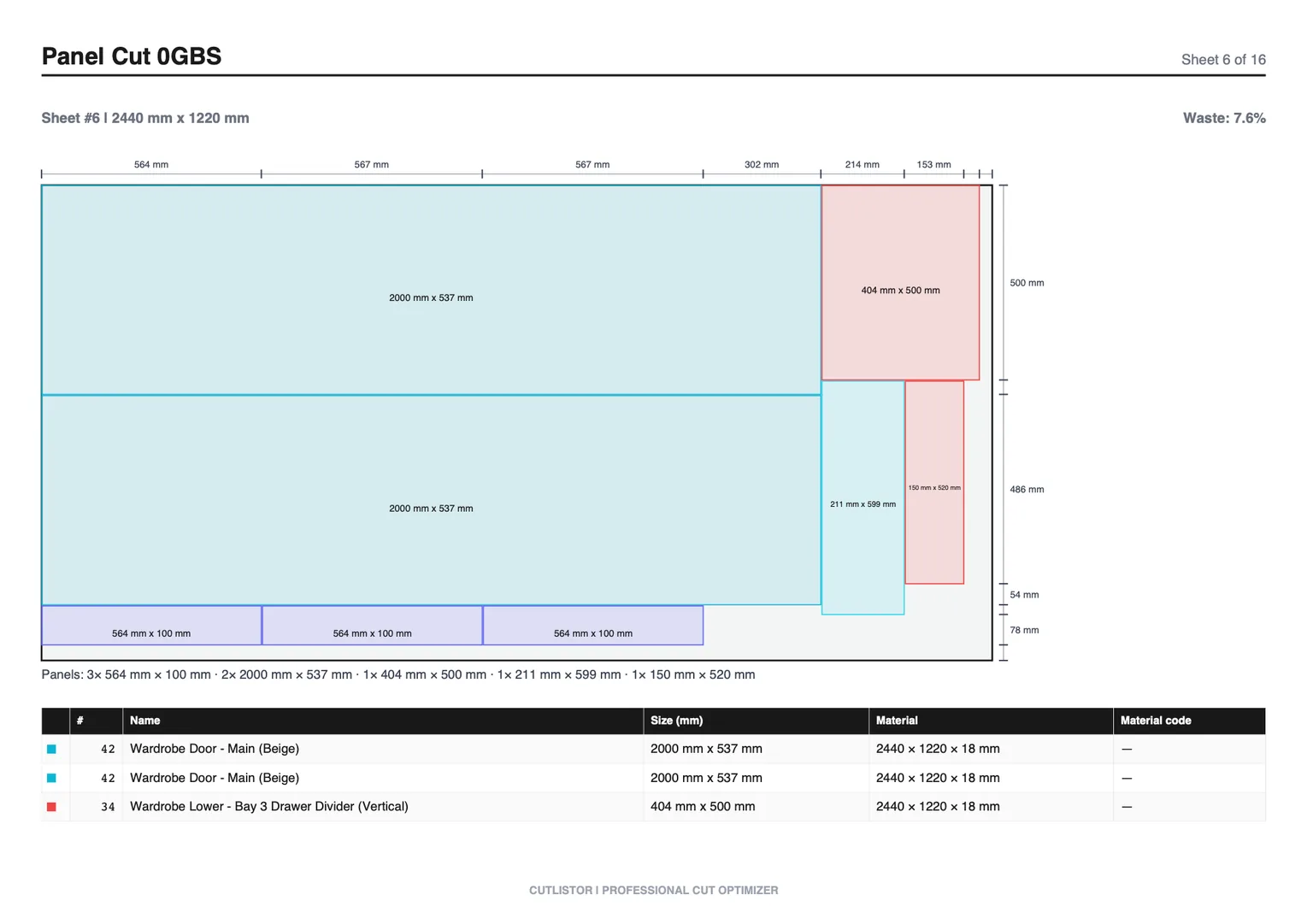
On woodgrain doors for the same kitchen, expect fewer packing gains because grain lock constrains rotation. Nest doors as their own material group and accept a slightly lower yield in exchange for matching faces.
Batch multiple melamine jobs
Closet packs and multi-unit kitchens on the same white 18 mm SKU should nest together when install dates allow. Combining jobs consumes awkward offcuts that would otherwise become scrap after a single vanity run.
Cutlistor for melamine nesting
The free tier draws its line at output, not at effort. Rearranging parts and re-running the nest as many times as you like costs nothing; the daily allowance of 3 is spent only when you export a PDF or open a new project. Sessions hold up to 20 part rows, CSV and XLSX files import up to 5 rows each, and closing the tab clears the work.
FAQ
Does edge banding change the nest?
Edge banding uses linear stock, not sheet area. Nest panels on the sheet optimizer, then run banding lengths on the linear tool or your banding program.
Can melamine and plywood share a nest?
Only if thickness, process, and purchasing truly match. In practice, separate material codes keep POs and labels honest.
What yield should we expect on white melamine?
Low to mid 80s is realistic on many carcass runs with free rotation. Woodgrain door packs often land lower. Track yield by finish, not one shop-wide number.
Floor Practice That Protects Yield
Melamine punishes vagueness. A kerf guess, an unmarked face, or a scoring pass skipped on the last sheet of the day all surface as chipped edges you cannot sand out.
Run a test cut and measure kerf on melamine specifically; a scoring setup behaves differently from a single blade. Lock grain on visible faces only, because decorative TFL patterns are directional even when the board looks uniform.
Label melamine offcuts with the exact decor and finish code, not just the size. A 16×30 in remnant is useless if nobody can confirm it matches the run it is meant to join.
Make the melamine handling rules part of the written standard. Chip-out habits are learned, not intuited.
- Kerf from a test cut on the same material family
- Grain lock on doors, gables, and show shelves
- Trim allowances decided before nesting, not at the saw
- Offcut shelf with minimum size rules your shop respects
Conclusion
Melamine optimization is SKU accuracy, finish separation, smart grain rules, and nest-backed purchasing. Shops that still pad every kitchen by two sheets are funding scrap instead of margin.