
Article
How Rising Lumber Prices Affect Woodworking Costs
Cutlistor Team4 min read
Introduction
When lumber headlines spike, every shop feels it — but not every SKU moves the same way. Framing studs, select pine, hardwood boards, and furniture plywood each have their own supply chains. Understanding what actually rose (and what you can substitute) keeps quotes honest without panicking into the wrong material.
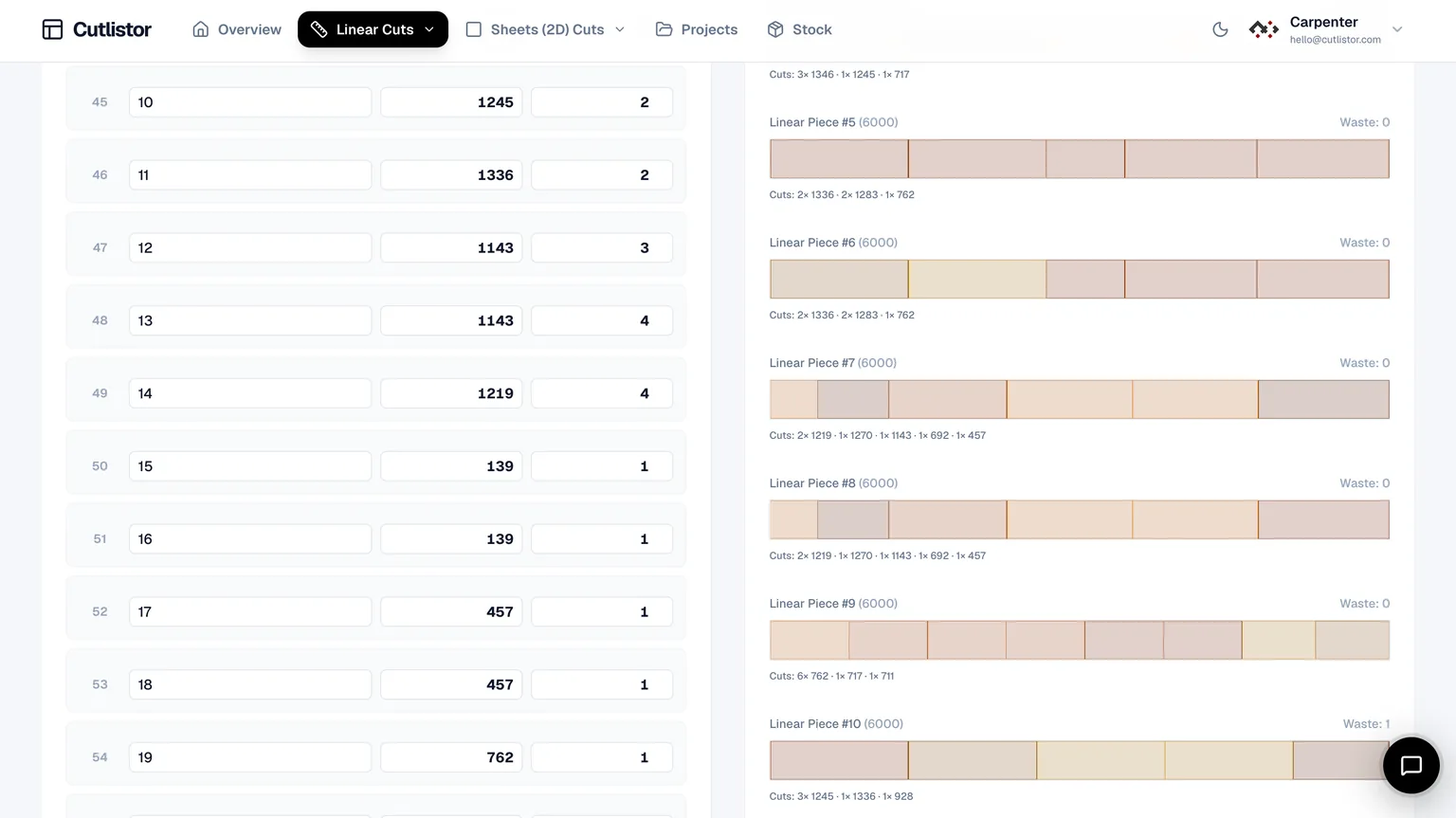
This article maps how price swings hit woodworking costs in 2026, where waste amplifies the pain, and how nesting and linear optimization protect margin when stock is expensive.
What moves when “lumber” rises
| Material family | Tied to framing spikes? | Shop impact |
|---|---|---|
| Dimensional softwood (2x, select pine) | Directly | Face frames, rustic furniture, shop lumber |
| Hardwood boards | Loosely / delayed | Solid tops, doors, furniture parts |
| Construction plywood / OSB | Often correlated | Shop fixtures, not fine casework |
| Cabinet hardwood plywood | Partially | Carcass cost on custom work |
| Baltic birch / import ply | Freight & FX sensitive | Drawers and specialty panels |
| MDF / particle / melamine | Resin & energy costs | Doors and production boxes |
The real job cost stack
Material is one line. When sheet prices rise 15%, a kitchen that was eight sheets does not go up 15% on the invoice if labor and hardware dominate — but pure material-heavy runs (closet packages, shop cabinets) feel it immediately.
Break every quote into sheet goods, solid lumber, hardware, finish, and labor. When softwood spikes, only the lumber and maybe construction-ply lines need revisiting. When Baltic birch freight jumps, drawer-heavy jobs move while paint-grade MDF door jobs barely budge. Blanket “add 10% for lumber” surcharges anger clients when half the job never touched a stud.
- Sheet and board purchase price
- Yield loss (kerf, grain lock, bad nests)
- Freight and minimum orders
- Finish materials and shop time
- Remakes from undersized parts when kerf was ignored
Waste is a price multiplier
At $40 a sheet, a sloppy nest is annoying. At $100 a sheet, the same waste is a margin killer. Grain-locked doors, ignored kerf, and mixed thicknesses on one mental layout are the usual culprits.
Optimize before you buy. One saved sheet often beats an hour of hunting for a cheaper grade that will not pass inspection.
Offcut libraries help only if you label and re-enter usable scraps as stock. A pile of unmarked triangles is not inventory — it is floor space. When prices rise, disciplined remnant reuse pays for the labeling habit.
Smart substitutions (without cheapening the job)
| Was | Consider | Keep in mind |
|---|---|---|
| All hardwood plywood boxes | Melamine boxes + better doors | Edge banding & fasteners |
| Solid hardwood panels | Plywood panel + solid edge | Stability often improves |
| Baltic birch everywhere | Baltic birch drawers only | Hide lesser ply in carcass |
| Thick MDF shelves | Plywood shelves or add cleats | Sag resistance |
| Premium face on hidden parts | Shop-grade for interiors | Split the shopping list |
Quoting when prices are moving
Clients accept material surcharges more readily when you show the nest and the sheet count. A vague “lumber is up” line invites pushback; “seven sheets of birch at today’s yard price, valid ten days” reads like a professional quote.
- Date your material assumptions on every quote.
- Nest the job so sheet/board counts are evidence, not guesses.
- Add a short validity window when yards warn of weekly changes.
- Separate lumber (linear) and sheet (2D) lines — they do not spike together.
- Track actual yield after the job to tighten the next estimate.
- Re-nest if the yard substitutes a different sheet size or thickness.
How Cutlistor helps when stock is expensive
Cutlistor will not set market prices, but it turns expensive stock into a known sheet or stick count before you pay. Nest plywood, MDF, melamine, particle board, and Baltic birch with kerf, grain locking, and material grouping. Optimize hardwood and softwood lumber on the linear tool.
Free tools: /free-cut-list-optimizer and /free-linear-cut-list-optimizer — 3 PDF exports per day and 20 part rows on the free tier, with unlimited editing and re-optimizing in a session. Re-run the nest when the yard substitutes a different sheet size so the buy list stays accurate.
Takeaways
- Framing lumber spikes ≠ every plywood SKU moved the same amount.
- Yield loss multiplies high prices — nest with real kerf.
- Substitute by performance (melamine boxes, MDF doors), not by panic.
- Quote with dated assumptions and evidence-based sheet counts.