Article
What Is Sheet Metal Fabrication? Processes, Materials, and Cost Planning
Cutlistor Team7 min read
Introduction
Sheet metal fabrication turns flat metal stock into finished parts: panels, brackets, enclosures, ducts, and thousands of shop-built assemblies. The work starts with a rectangle of steel, stainless, or aluminum and ends after cutting, forming, and often welding or hardware installation.
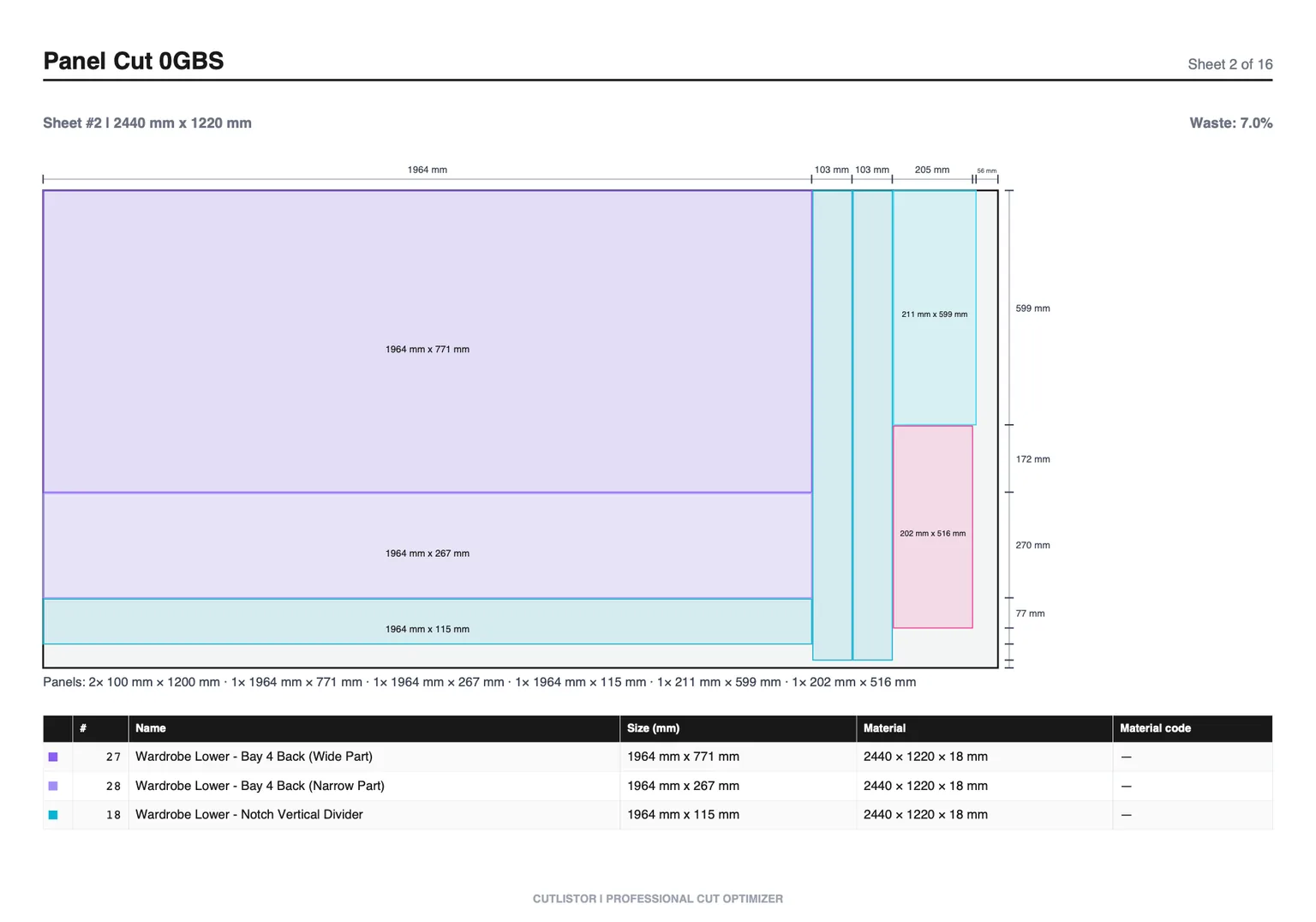
Whether you run a job shop, a production line, or an in-house maintenance fab bay, the same question appears on every quote: how much sheet do we need, and can we nest these parts efficiently before the laser or shear runs? Material yield on flat stock is one of the largest levers on margin after machine time.
This guide defines sheet metal fabrication in shop terms, compares sheet to plate, walks through typical processes, and shows where metal fabrication planning and rectangular nesting fit before you release a cut file to the floor.
What Is Sheet Metal Fabrication?
Sheet metal fabrication is the family of processes that cut, form, and join thin to medium-gauge flat metal into parts and assemblies. In everyday shop language, fabrication here means building from sheet or plate stock rather than machining from solid bar or casting.
The workflow usually moves from flat pattern to cut blanks, then through press brake bending, rolling, or hardware insertion, and finally welding, finishing, or assembly. CNC cutting (laser, plasma, waterjet, or punch) replaced much manual layout, but the estimator still needs accurate flat sizes and a realistic sheet count before purchasing.
- Input: flat sheet or plate in standard sizes (4×8 ft, 5×10 ft, 1250×2500 mm, and similar)
- Output: 2D blanks and formed 3D parts ready for paint, powder coat, or assembly
- Core trades: cutting, shearing, punching, bending, welding, and finishing
- Planning layer: BOM, flat patterns, nest layouts, and kerf-aware cut lists
Sheet vs Plate: Thickness and Shop Language
| Term | Typical thickness range | Common handling |
|---|---|---|
| Sheet (shop language) | About 0.5 mm to 6 mm (under ~1/4 in) | Coil, lift by hand or vacuum table |
| Heavy-gauge sheet | 3 mm to 6 mm | Still nested on laser/plasma tables |
| Plate | Above ~6 mm (1/4 in+) | Often plasma or oxy; heavier nests, more kerf |
| Gauge (steel) | Higher GA = thinner (e.g. 16 GA ≈ 1.5 mm) | Check supplier chart for exact mm |
Core Sheet Metal Fabrication Processes
Most sheet jobs combine at least two operations: a cutting step to release flat blanks, and a forming or joining step to reach final geometry. High-volume shops chain these on the same shift; custom shops may batch cutting one day and bending the next.
Cutting: laser, plasma, waterjet, punch, shear
Laser cutting dominates thin to medium sheet for speed and edge quality on steel and stainless. Plasma suits thicker plate and painted or rusty stock where laser reflectivity is a concern. Waterjet handles thick plate and heat-sensitive alloys without a HAZ. CNC punching excels at hole patterns and louvers in repetitive work. Shearing remains the fastest path for straight rectangles when tolerances allow.
Forming: press brake, rolling, and hardware
Press brake bending turns flat blanks into channels, boxes, and brackets. Roll forming and slip rolls produce cylinders and cones. PEM inserts, rivets, and clinching add fasteners without downstream welding. Bend allowance and K-factor errors show up as assembly gaps, not as nesting waste, but both hit the quote.
Welding and assembly
MIG and TIG welding join cut and formed pieces into frames, cabinets, and duct runs. Fit-up tolerance from cutting and bending determines weld rework. Fabricators often nest slightly oversized tabs or use fixture keys when repeatability matters.
Typical Sheet Metal Products
If you walk a fabrication floor, the same part families appear across industries. They differ in alloy and finish, not in the underlying cut-form-weld sequence.
- Electrical enclosures and server cabinets (folded boxes with louvers and PEM hardware)
- Machine guards and panels (perforated or solid, often mild steel or stainless)
- HVAC ductwork, plenums, and transitions (galvanized or stainless sheet)
- Brackets, gussets, and mounting plates (laser-cut flats with bend lines)
- Signage faces, kiosk skins, and architectural cladding (aluminum or coated steel)
- Food and pharma equipment skins (304/316 stainless, tight bend radii)
Materials Used in Sheet Metal Fabrication
| Material | Typical uses | Fabrication notes |
|---|---|---|
| Mild (carbon) steel | Frames, guards, general brackets | Easy to laser; watch scale on hot-rolled |
| Stainless (304/316) | Food, medical, corrosive environments | Higher sheet cost; tighter nest planning pays off |
| Aluminum (5052, 6061 sheet) | Enclosures, transport, lightweight panels | Reflectivity on CO2 laser; fiber lasers common |
| Galvanized steel | Duct, outdoor cabinets | Zinc fumes: verify machine ventilation rules |
How Nesting and Cut Lists Affect Cost
Sheet is priced by weight or by the full rectangle you buy, not by the area your parts occupy. A nest that needs four sheets instead of three on a large job can erase an hour of laser savings. Kerf, common-line cutting assumptions, and grain direction (on brushed stainless or directional coatings) all change the true sheet count.
Professional CAM nesting (SigmaNEST and similar) targets true-shape parts, common-line laser paths, and machine post processors. Cutlistor deliberately occupies a different layer: fast rectangular nesting and kerf-aware cut lists for estimating, purchasing, and shop-floor PDF plans before or alongside CAM.
Yield, kerf, and remnants
Yield is usable part area divided by purchased sheet area. Kerf is the material removed by the beam or blade. Remnants are offcuts large enough to reuse on a future job. Tracking remnants in inventory turns today's scrap into tomorrow's free stock.
Rectangular nesting vs true-shape CAM
Most BOM lines in a fab quote are still rectangles: flat blanks before bending, panel sizes, and plate strips. Rectangular nesting answers purchasing questions quickly. Irregular silhouettes and machine-specific lead-in paths belong in CAM, not in a spreadsheet.
Using Cutlistor for Sheet Metal Estimating
Cutlistor runs in the browser as a rectangular sheet (2D) optimizer plus a separate linear (1D) tool for tube, bar, and extrusion. It is not a full CAM suite or true-shape laser controller. It helps estimators and lead hands answer: how many sheets, what is the layout, and what PDF can the shear or laser operator reference?
Most free optimizers meter the optimizing. Cutlistor does not — you can tweak parts and re-run the layout as often as a job needs. The daily ceiling of 3 applies to PDF exports and new projects only. Expect a 20-row cut list limit, a 5-row ceiling on each CSV or XLSX import, and no saved projects.
Paid plans add saved projects, higher import quotas, AI plan scanning from PDF or photos, 3D mesh import (glTF, GLB, Collada), and DXF export for CNC handoff. PDF cut plans remain the core shop-floor deliverable on every tier within daily export limits.
- Enter standard sheet sizes and quantities (4×8, 5×10, metric plate sizes)
- Add rectangular parts with kerf gutters between cuts
- Import BOM rows from CSV or XLSX when the job already lives in a spreadsheet
- Export kerf-aware PDF nest diagrams for purchasing and floor reference
- Run the linear optimizer separately for angle, tube, and extrusion lengths on the same job
A Practical Sheet Metal Planning Workflow
- Collect flat pattern sizes from CAD or bend tables (blank width × blank length before forming)
- Group parts by material, thickness, and finish so nests stay purchasable
- Run rectangular nesting with kerf set to your laser, plasma, or shear blade
- Compare sheet count against supplier minimums and remnant inventory
- Release PDF plans to the floor; export DXF on paid plans when CAM needs rectangles
- Log usable remnants with dimensions for the next quote
FAQ
Is sheet metal fabrication the same as metal fabrication?
Sheet metal fabrication is a subset of metal fabrication focused on flat stock. Broader fab shops also weld plate assemblies, cut pipe, and machine parts. The parent discipline includes any build-from-stock metal work.
What thickness counts as sheet metal?
Shop language varies, but many North American fabricators call stock under about 1/4 in (6 mm) sheet and thicker material plate. Always verify against your supplier catalog and machine capacity table.
Can Cutlistor replace laser CAM?
No. Cutlistor optimizes rectangular sheet and linear stock for estimates and PDF cut plans. Full CAM with true-shape nesting, lead-ins, and machine post processors remains the job of tools like SigmaNEST or your laser OEM software. Many shops use Cutlistor upstream for quoting and purchasing, then CAM for the final program.
Conclusion
For the full picture on processes, software, and mixed stock jobs, see the metal fabrication guide. Try the free sheet optimizer on your next panel nest and compare sheet count to your usual spreadsheet method.