
Article
How to Calculate the True Cost of Wood Waste
Cutlistor Team3 min read
Introduction
Wood waste is not just the offcut in the scrap bin. The true cost includes the sheet you had to buy because the nest was poor, the hour spent re-cutting a wrong size, machine time, disposal fees, and delayed installs.
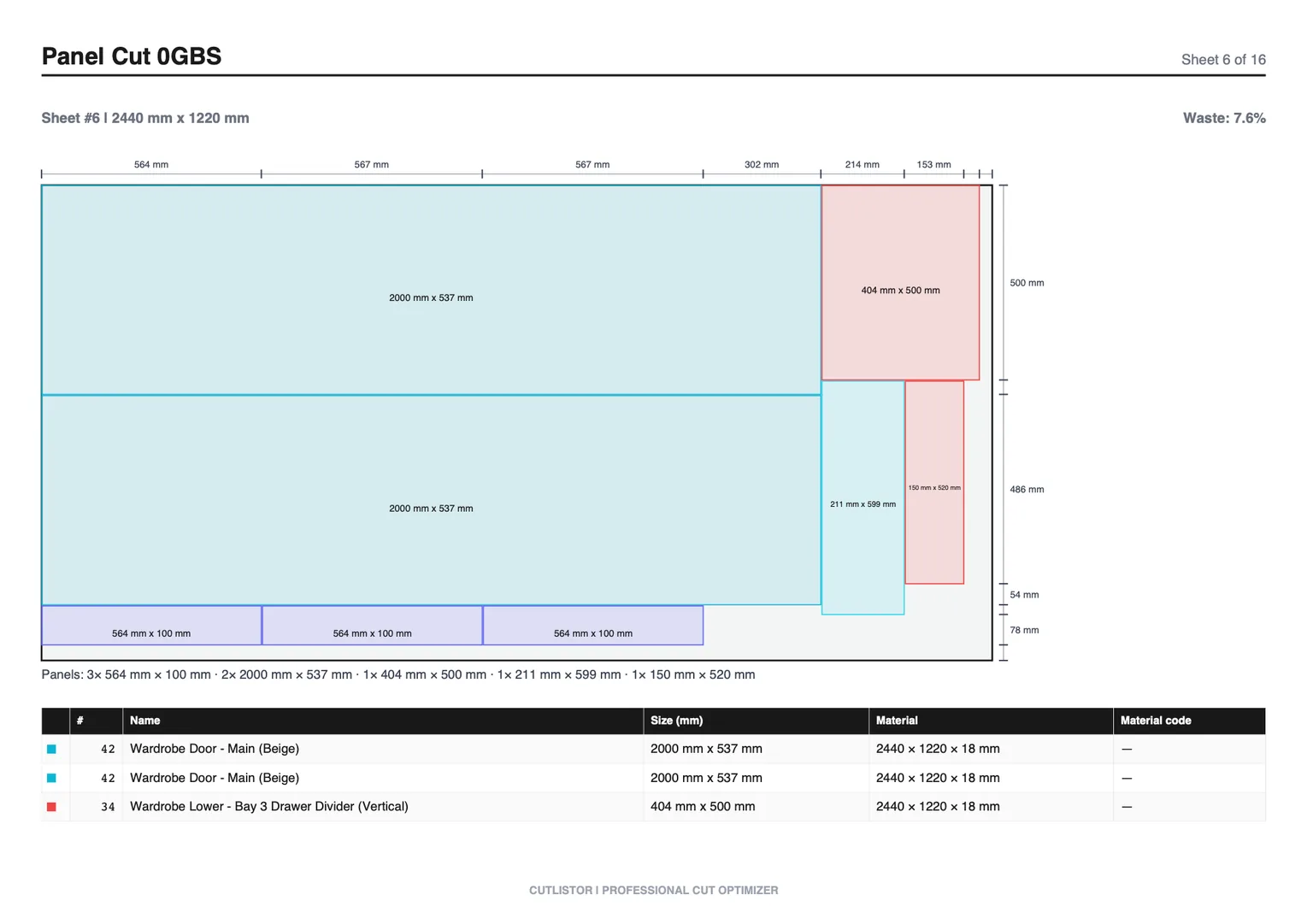
This article gives a simple cost model, worked examples for sheet and lumber, and how Cutlistor reduces the controllable share of waste through kerf-aware nesting and linear packing.
The five buckets of wood waste cost
| Bucket | What it includes | Controllable with nesting? |
|---|---|---|
| Purchased scrap | Area/length bought but not in finished parts | Yes—primary target |
| Kerf & process loss | Sawdust, trim, scoring | Partly—model kerf correctly |
| Remake material | Parts cut wrong or damaged | Indirect—better plans reduce errors |
| Labor & machine | Extra setups, re-cuts, sorting chaos | Yes—clear PDFs and batching |
| Disposal / carrying | Dumpster, dusty remnants that block space | Yes—fewer useless offcuts |
A practical true-cost formula
True waste cost ≈ (extra stock purchased × unit price) + (remake stock × unit price) + (extra labor hours × shop rate) + disposal + rush freight if any.
Yield percent alone understates cost when labor and remakes dominate. A 5% yield gain that prevents one remake day can beat a 10% gain that still ships late.
- Extra stock = sheets or board-feet bought beyond a good nest
- Shop rate = loaded labor + machine burden
- Remake = material + labor for the replacement part
- Track monthly, not only per job, for small shops
Worked example: plywood kitchen run
| Item | Calculation | Cost |
|---|---|---|
| Extra sheets (manual) | 2 × $95 | $190 |
| Remake material | 0.3 × $95 | $28.50 |
| Sorting + remake labor | 1.5 × $75 | $112.50 |
| True waste delta vs optimized | 190 + 28.50 + 112.50 | $331 |
On one kitchen, $331 is already material-plus-labor. Repeat weekly and the annual figure justifies process change long before you argue about software price.
Worked example: hardwood face frames
| Item | Calculation | Cost |
|---|---|---|
| Extra board-feet | 4 × $3.50 | $14 |
| Labor saved by clear stick plan | 2 × $75 | $150 |
| True cost delta | 14 + 150 | $164 |
On cheap poplar, labor dominates. On walnut or quartersawn oak, material dominates—run the same table with your species price.
How Cutlistor reduces true waste cost
Most free optimizers meter the optimizing. Cutlistor does not — you can tweak parts and re-run the layout as often as a job needs. The daily ceiling of 3 applies to PDF exports and new projects only. Expect a 20-row cut list limit, a 5-row ceiling on each CSV or XLSX import, and no saved projects.
Track waste monthly
Pick three metrics: sheets purchased vs parts area yield, board-feet purchased vs cut length yield, and remake hours. Review once a month. Batch jobs that share SKUs to convert remnants into parts instead of trash.
Next steps
Continue to worked savings examples, then plywood and lumber how-tos. Compare manual lists vs software if you are still on graph paper.