Article
MDF vs Particle Board for Cabinets: Doors, Cores & Production Specs
Cutlistor Team4 min read
Introduction
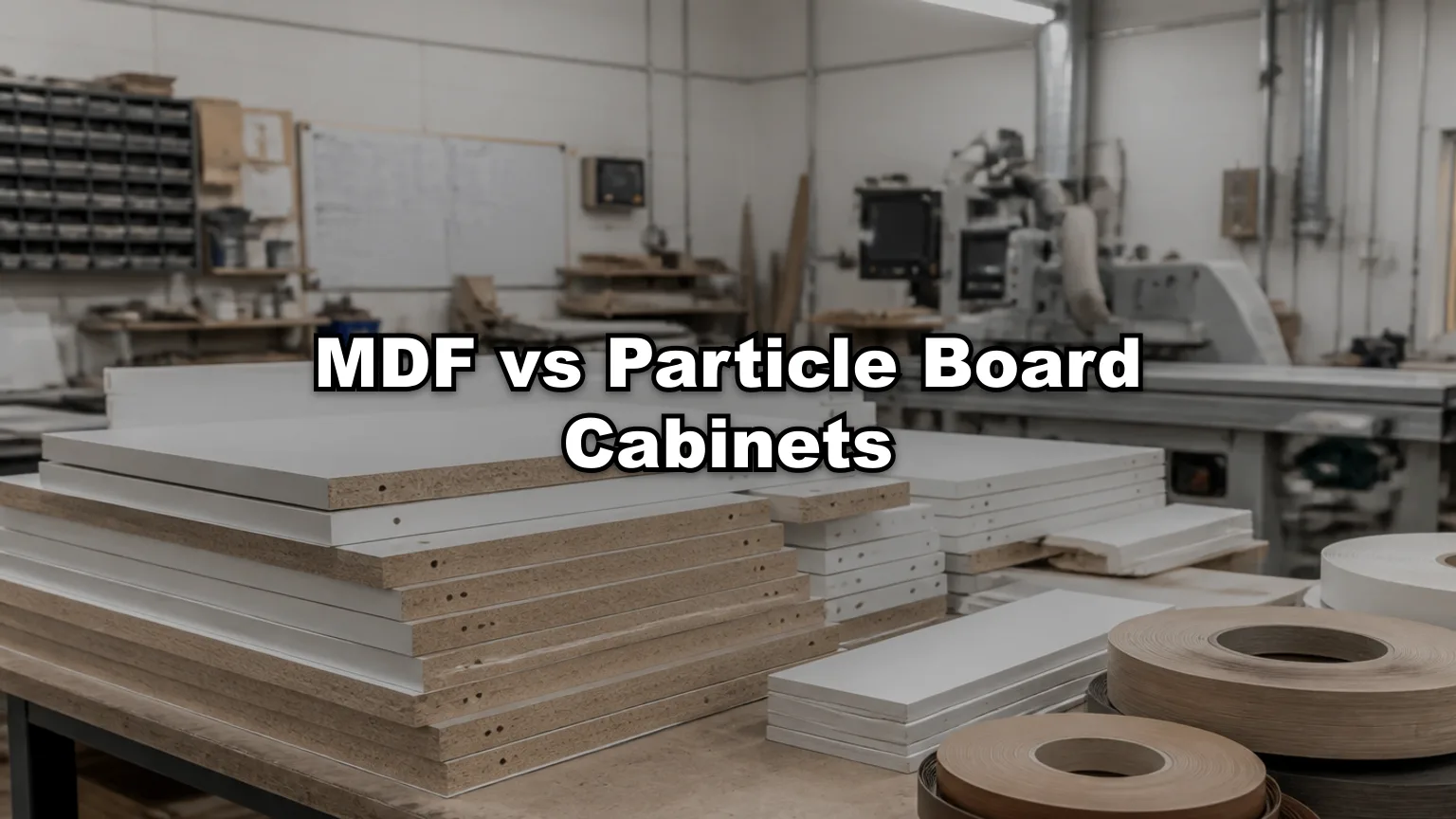
In cabinet commerce, MDF and particle board show up in different PO lines. MDF is the paint-door and profile substrate. Particle board is usually the core under melamine (TFL) for production boxes. Treating them as interchangeable “composite” is how quotes and callbacks go wrong.
This article is cabinet-focused and commercial. For a broader woodworking comparison, see the general MDF vs particle board guide. Here we cover doors, carcass cores, hardware, moisture at the sink, nesting, and approximate 2026 cost bands (regional variation applies).
Shop Roles: Doors vs Melamine Cores
| Attribute | MDF | Particle board (cabinet context) |
|---|---|---|
| Primary cabinet use | Paint/foil doors, panels | Core under TFL melamine boxes |
| Surface | Smooth, takes primer | Needs laminate/veneer for show work |
| Screw holding | Fair; use correct inserts | Fair to poor; system screws matter |
| Weight | Heavy | Heavy |
| Moisture | Swells if wetted | Edges and cores vulnerable if unsealed |
| Machining profiles | Excellent | Poor for fine profiles |
Doors: Why MDF Beats Particle Board
Painted shaker and slab doors want MDF. Particle board chips at profiled edges and does not machine like fiberboard. If a budget door arrives as melamine slab on particle core, that is a finished product path, not a paint substrate path.
Spec thickness (often 3/4 in), moisture grade if needed, and nest door blanks with kerf on their own stock row.
Boxes: Particle Core Under Melamine Is Normal
Most white melamine kitchen boxes are particle core with TFL faces. That is a proven production system when banding and fasteners are correct. It is not the same as building boxes from raw chipboard.
When a client upgrades to plywood boxes, you are changing core behavior and finish path, not just color. Quote that upgrade explicitly.
Hardware and Moisture: Spec Like a Pro
Both materials dislike standing water. Seal sink cutouts, protect toe kicks during mopping, and avoid storing sheets on damp floors. For hardware, use manufacturer-recommended screws and consider metal inserts where doors get heavy use.
Long shelves in particle-core melamine need span discipline. Upgrade long spans to plywood if the design is open and loaded.
Approximate 2026 Cost Planning
Approximate mid-2026 North American shop bands: raw MDF often $35–$70 per 4×8 (3/4 in), melamine-faced particle panels often $45–$95 depending on color and size, raw particle board cheaper but rarely quoted alone for show cabinets. Confirm with your distributor; freight swings totals.
Cheapest core is not cheapest job if rework and extra sheets from bad nests show up later.
Nesting MDF Doors and Melamine Boxes Separately
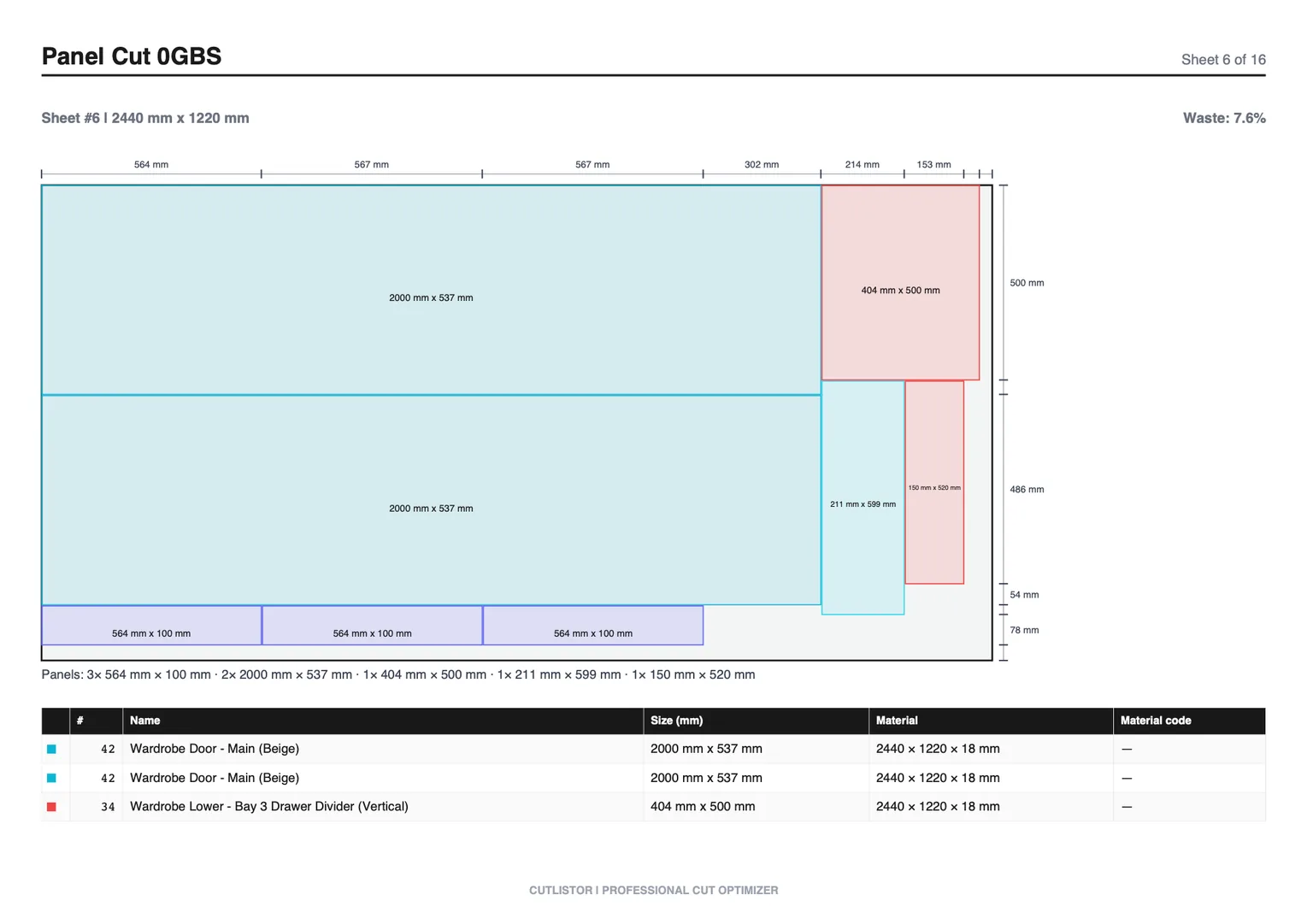
Run MDF door blanks and melamine box parts as separate optimizer jobs. Set kerf for each process. Lock grain on woodgrain melamine. Cutlistor handles rectangular sheet nesting and linear stock in the browser; it is not a design suite.
Worth knowing before you test it: the free tier never charges you for iterating. Editing part sizes and re-nesting are unlimited. Only PDF exports and new projects count, 3 of them a day. Lists are capped at 20 rows, CSV and XLSX imports at 5 rows per file, and no work carries over between sessions.
Pro is $12/mo for saved projects and DXF export.
FAQ
Is melamine the same as particle board?
Melamine cabinets usually mean laminate faces on a particle (or sometimes MDF) core. Particle board alone is the core product. Spec the faced panel you will actually cut.
When should I upgrade from particle-core melamine to plywood?
Custom strength, clear wood interiors, long shelves, wet-prone bases, and client specs that call for plywood carcasses. Price the upgrade as a package, including nest yield.
Floor Practice That Protects Yield
Substrate arguments usually get settled on price per sheet, which is the wrong denominator. Yield, edge quality, and screw holding are what decide the real cost per cabinet.
Both substrates cut to a predictable kerf, so measure once per blade and reuse the value. Neither has grain to protect in raw form; the constraint only returns once the panel arrives already faced.
Keep the two substrates separated on the rack and clearly labelled. They look alike from three feet away, and confusing them mid-job is an expensive way to learn the difference.
Fix the substrate choice per product line in writing so quoting and purchasing stop diverging.
- Kerf from a test cut on the same material family
- Grain lock on doors, gables, and show shelves
- Trim allowances decided before nesting, not at the saw
- Offcut shelf with minimum size rules your shop respects
Conclusion
For cabinet shops, MDF owns paint doors and profiles; particle board mainly appears as the core under melamine boxes. Spec each for its job, seal wet zones, and nest materials separately so purchasing numbers match the floor.