
Article
How Many Sheets of Plywood Do I Need for Cabinets?
Cutlistor Team4 min read
Introduction
“How many sheets of plywood for cabinets?” only has one honest answer: nest the real part list with kerf and grain rules on the sheet size you will buy. Square footage math and rules of thumb underbuy on grain-locked doors and overbuy when remnants could have been planned.
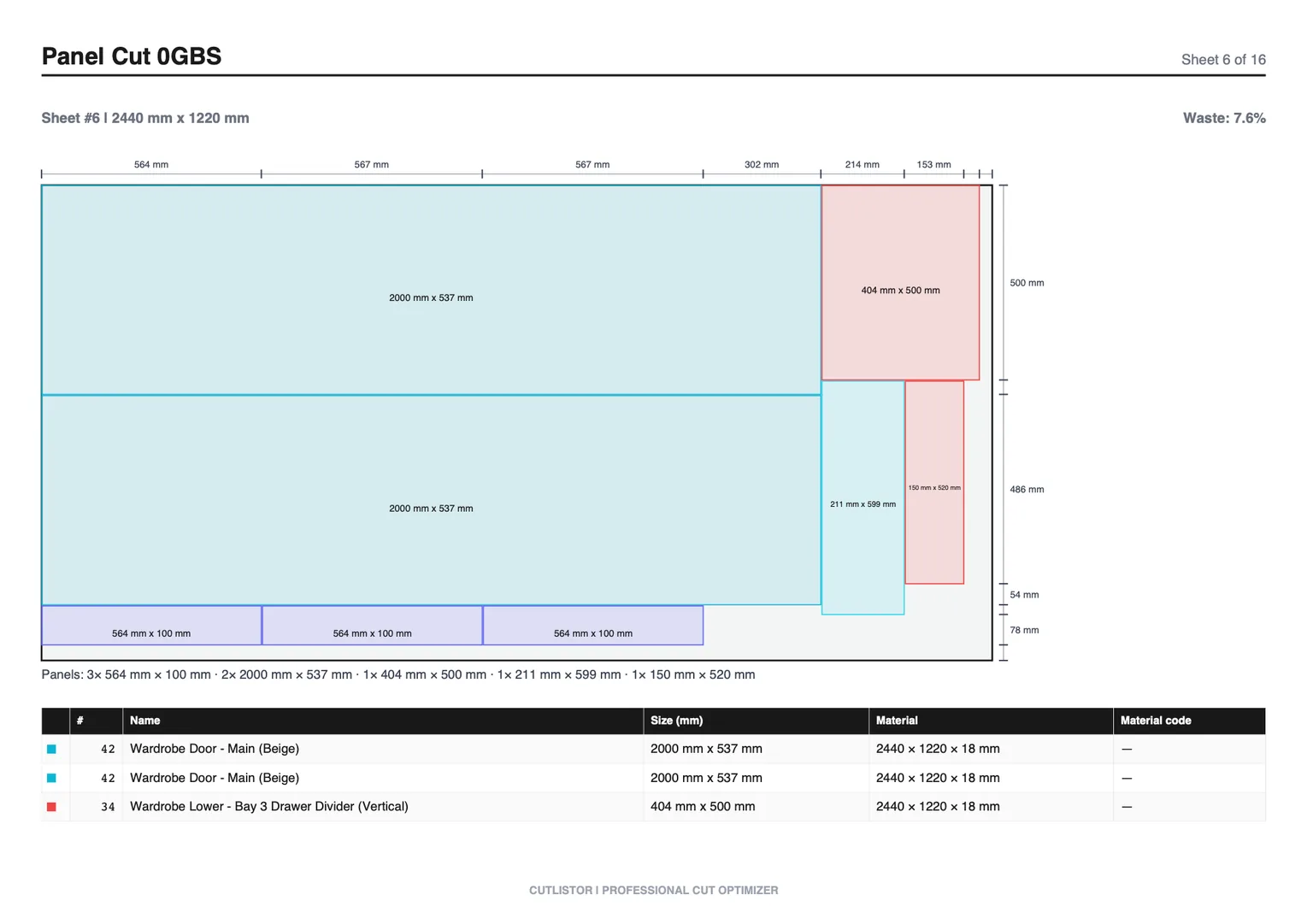
This guide shows commercial estimators how to get from cabinet count to sheet count, with sample ranges for planning (not bids), and links to calculators that do the nesting.
Why Square Footage Alone Fails
Part area divided by sheet area ignores kerf gutters, unusable strips, grain direction, and part geometry. A run of tall sides can force an extra sheet even when area math says you are fine.
Commercial quoting should treat nested sheet count as the purchasing number and keep a small contingency only for damage or site changes, not for bad math.
Shop Method: From Elevations to Sheet Count
- List every plywood part: sides, decks, shelves, stretchers, backs if plywood, door blanks if plywood
- Split by thickness and SKU (3/4 in carcass vs 1/2 in drawers vs prefinished)
- Enter true sheet size (4×8, 4×10, metric, or 5×5 Baltic birch)
- Set kerf to panel saw or CNC tooling
- Lock grain on show faces; allow rotation on hidden parts when finish allows
- Read sheet count and remnant sizes; decide whether to buy one more sheet or redesign a blank
- Export PDF for purchasing and the floor
Sample Planning Ranges (Not Quotes)
| Project scope (approx.) | Plywood sheets (planning band)* | What swings the number |
|---|---|---|
| 6–8 base + wall boxes, melamine or MDF doors | 6–12 sheets of 3/4 in | Shelf count, backs, pantry |
| Galley kitchen, plywood boxes, painted MDF doors | 10–20 sheets | Tall units, plywood shelves |
| Full custom kitchen, plywood boxes + some ply doors | 18–35+ sheets | Door blanks, islands, offices |
| Drawer boxes only (Baltic birch) | 1–4 sheets of 5×5 (typical) | Drawer count and thickness |
*Illustrative only for mid-2026 planning conversations. Not a bid and not Cutlistor pricing. Nest your parts.
Count Sheets per Material, Not per Kitchen
A kitchen might need 14 sheets of prefinished maple, 8 sheets of MDF for doors, and 2 sheets of Baltic birch for drawers. Saying “24 sheets” without SKUs confuses purchasing. Report counts per material code.
Hybrids are normal. See box and door material guides when you split the BOM.
Get the Number in Minutes
Paste or type the part list, set stock and kerf, and compare layout methods if your shop allows. Cutlistor is a sheet and linear cut list optimizer in the browser. It is not a 3D kitchen designer.
No account is needed to try it, and the free tier does not count the optimizing itself — parts can be edited and re-nested indefinitely. It counts finished PDFs and new projects, at 3 a day. Lists are limited to 20 rows, CSV and XLSX uploads to 5 rows per file, and work does not survive the session.
Pro is $12/mo for saved projects and DXF export when CNC needs rectangles.
FAQ
Is there a sheets-per-cabinet rule of thumb?
Rough rules (for example “one sheet per base”) fail on pantries, islands, and plywood doors. Use them only for ballpark phone quotes, then nest before you buy.
How much waste factor should I add?
If you nested with kerf, you already included cutting waste. Add contingency for damage or change orders (often a remnant strategy or one spare sheet on large jobs), not a blanket 20% on top of a bad estimate.
Floor Practice That Protects Yield
Sheet counts drift when the estimate and the nest run on different assumptions. Square footage divided by 32 will always undercount; only a real layout tells you what to buy.
Sheet counts move with kerf more than most people expect. Measure it once, apply it to every material row, and mark grain lock only on visible parts so the count reflects what the saw will really do.
Count large remnants as inventory when you estimate the next kitchen. Shops that skip this buy sheets they already own, which is the most common reason actuals beat estimates.
Log estimated versus actual sheets on every kitchen so next quarter's estimates come from your own data, not a rule of thumb.
- Kerf from a test cut on the same material family
- Grain lock on doors, gables, and show shelves
- Trim allowances decided before nesting, not at the saw
- Offcut shelf with minimum size rules your shop respects
Conclusion
Sheet count for cabinets comes from a kerf-aware nest on real stock sizes, split by material and thickness. Use planning ranges only to start the conversation, then optimize before the PO.