
Article
How to Optimize MDF Sheets
Cutlistor Team3 min read
Introduction
MDF dominates painted cabinet doors, shaker panels, and many profiled faces. Optimizing MDF sheets protects paint-grade material cost and keeps door packs from forcing emergency sheet buys when the spray booth is already scheduled.
MDF has no wood grain to match, which helps packing, but thickness mix-ups and kerf errors still destroy yield. Treat MDF as its own material group every time.
Where MDF shows up in cabinet jobs
Common MDF lines: paint-grade doors and drawer fronts, light rail and filler skins, toe covers, and some interior panels where weight and moisture risk are acceptable. Do not nest MDF doors on the same sheets as melamine carcasses.
- Separate 12 mm, 16 mm, 18 mm, and 25 mm programs
- Keep moisture-sensitive exterior work off standard MDF
- Watch sag on long shelves; carcass shelves often stay plywood or melamine
- Profiled doors still start as rectangular blanks for nesting
Use free rotation (MDF has no face grain)
Unlike plywood or woodgrain melamine, MDF blanks can usually rotate freely. That packing freedom is why door packs often nest tighter than veneer doors of the same sizes. Still enter accurate finished sizes after any profiling allowance your process needs.
Kerf, bit diameter, and dust control
CNC door shops should enter bit diameter (or effective kerf) so nests match CAM blanks. Panel saw shops should measure blade kerf. Dust extraction does not change sheet count, but short parts from ignored kerf do.
Worked example: paint-grade door pack
| Method | Sheets | Yield | Cost at $72/sheet |
|---|---|---|---|
| Manual door board layout | 9 | 74% | $648 |
| Optimized nest | 7 | 86% | $504 |
| Savings | 2 sheets | +12 pts | $144 |
Two sheets saved on doors alone often covers a large share of nesting software cost for the month when the shop runs multiple paint jobs per week.
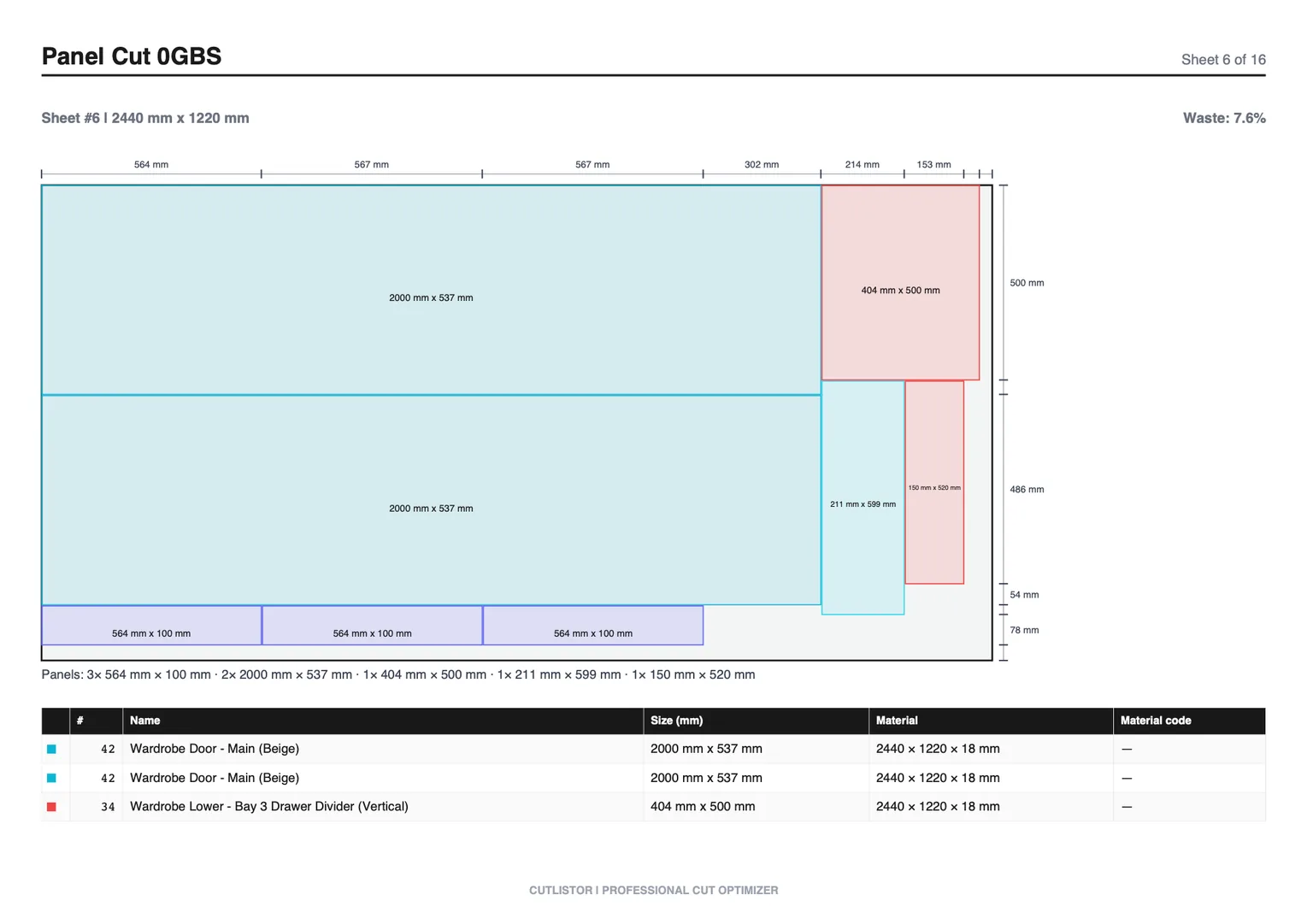
Combine MDF door jobs when spray schedules align
If two kitchens share the same 18 mm paint-grade MDF and the booth can take both packs, nest them together. Shared nests soak up door-sized remnants that die after a single job.
Cutlistor workflow for MDF
No account is needed to try it, and the free tier does not count the optimizing itself — parts can be edited and re-nested indefinitely. It counts finished PDFs and new projects, at 3 a day. Lists are limited to 20 rows, CSV and XLSX uploads to 5 rows per file, and work does not survive the session.
FAQ
Does moisture-resistant MDF nest differently?
Geometry is the same. Keep MR-MDF as its own stock SKU so purchasing and labels stay correct. Do not substitute standard MDF remnants into an MR job.
Should weight change how we nest?
Weight affects handling and shelf design, not rectangle packing. Nest for yield, then plan lifting and cart loads for large door packs.
What yield is typical for MDF door blanks?
Mid 80s is achievable on many packs with free rotation. Complex size mixes land lower. Compare against your own baseline rather than a universal target.
Floor Practice That Protects Yield
MDF hides its real costs. The sheets are heavy, the dust is relentless, and the edges need sealing — none of which shows up in a yield percentage unless the cut list accounts for it.
MDF cuts clean but dulls tooling quickly, so measure kerf against a blade with real hours on it. Grain lock is irrelevant on raw MDF, which means backs and shelves can rotate freely and nest tighter.
MDF remnants are worth keeping for jigs, drawer bottoms, and paint-grade panels. Mark the thickness on the edge, since 1/2 in and 5/8 in MDF are hard to tell apart on a rack.
Put the MDF dust, weight, and edge-sealing rules in the shop standard so the next batch does not rediscover them.
- Kerf from a test cut on the same material family
- Grain lock on doors, gables, and show shelves
- Trim allowances decided before nesting, not at the saw
- Offcut shelf with minimum size rules your shop respects
Conclusion
MDF sheet optimization is thickness discipline, measured kerf, free rotation, and nest-before-buy on door packs. Paint schedules stay on track when blank counts match the nest, not a whiteboard guess.