Article
How to Calculate Board Feet (Formula + Cut List Examples)
Cutlistor Team4 min read
Introduction
Hardwood yards sell most boards by the board foot. Softwood studs and mouldings often sell by the linear foot or by the piece. Sheet goods sell by the sheet. If you mix those units on a furniture takeoff, your material budget is fiction.
This article defines the board-foot formula, works through cut-list examples with real numbers, and shows when you still need linear (1D) cut optimization even after you know total board feet.
The Board Foot Formula
| Board | T x W x L | Board feet |
|---|---|---|
| Rough 4/4 oak | 1 x 8 in x 8 ft | (1 x 8 x 8) / 12 = 5.33 BF |
| Rough 5/4 maple | 1.25 x 6 in x 10 ft | (1.25 x 6 x 10) / 12 = 6.25 BF |
| Rough 8/4 walnut | 2 x 10 in x 6 ft | (2 x 10 x 6) / 12 = 10 BF |
| S4S 3/4 x 5-1/2 x 8 ft* | 0.75 x 5.5 x 8 | (0.75 x 5.5 x 8) / 12 = 2.75 BF |
*If the yard prices S4S on nominal 1x6, they may bill closer to (1 x 6 x 8) / 12 = 4 BF. Always match the seller's convention.
Board Foot vs Linear Foot vs Sheet Goods
| Unit | Measures | Typical stock | Optimization |
|---|---|---|---|
| Board foot | Volume | Rough / S2S / S4S hardwood | Buy BF; cut with 1D optimizer |
| Linear foot | Length | Moulding, tubing, some softwood | 1D linear cut list |
| Sheet / sq ft | Area | Plywood, MDF, melamine | 2D sheet nesting |
Worked Example: Table Project from a Cut List
A small dining table needs solid top boards and apron/leg stock. Top: glue up from 4/4 stock to a finished 36 x 60 in top, about 7/8 in thick after surfacing. Aprons: four pieces 3 x 2-1/2 x 32 in equivalent blanks. Legs: four at 2-1/2 x 2-1/2 x 29 in.
Top board feet
Finished top area is 36 x 60 = 2160 sq in. At 1 in nominal for 4/4: 2160 / 144 = 15 BF of finished volume. Add waste for defects, jointing, and trim — shops often buy 30–50% extra on tops. Order around 20–23 BF of 4/4 for the top alone if the boards are straight and wide.
Base board feet
Four apron blanks roughly 1.5 x 3 x 34 in (oversized): each (1.5 x 3 x 34) / 144 ≈ 1.06 BF → about 4.25 BF. Four legs 2.5 x 2.5 x 30 in: each (2.5 x 2.5 x 30) / 144 ≈ 1.30 BF → about 5.2 BF. Base subtotal ≈ 9.5 BF before defect waste; buy closer to 12–14 BF of thicker stock if legs are 10/4 or laminated 5/4.
Estimating Hardwood Purchases from a Cut List
Sum board feet of every solid part using the size you will cut from (rough blanks, not finished only). Then apply a waste factor for species grade, defects, and grain matching.
- Clear FAS boards, simple parts: +15–25%
- Grain-matched tops or bookmatched panels: +30–50%
- Knotty or lower grade: +40% or more
- Always round up to how the yard sells (full boards, not fractional dreams)
Why Board Feet Alone Is Not a Cut Plan
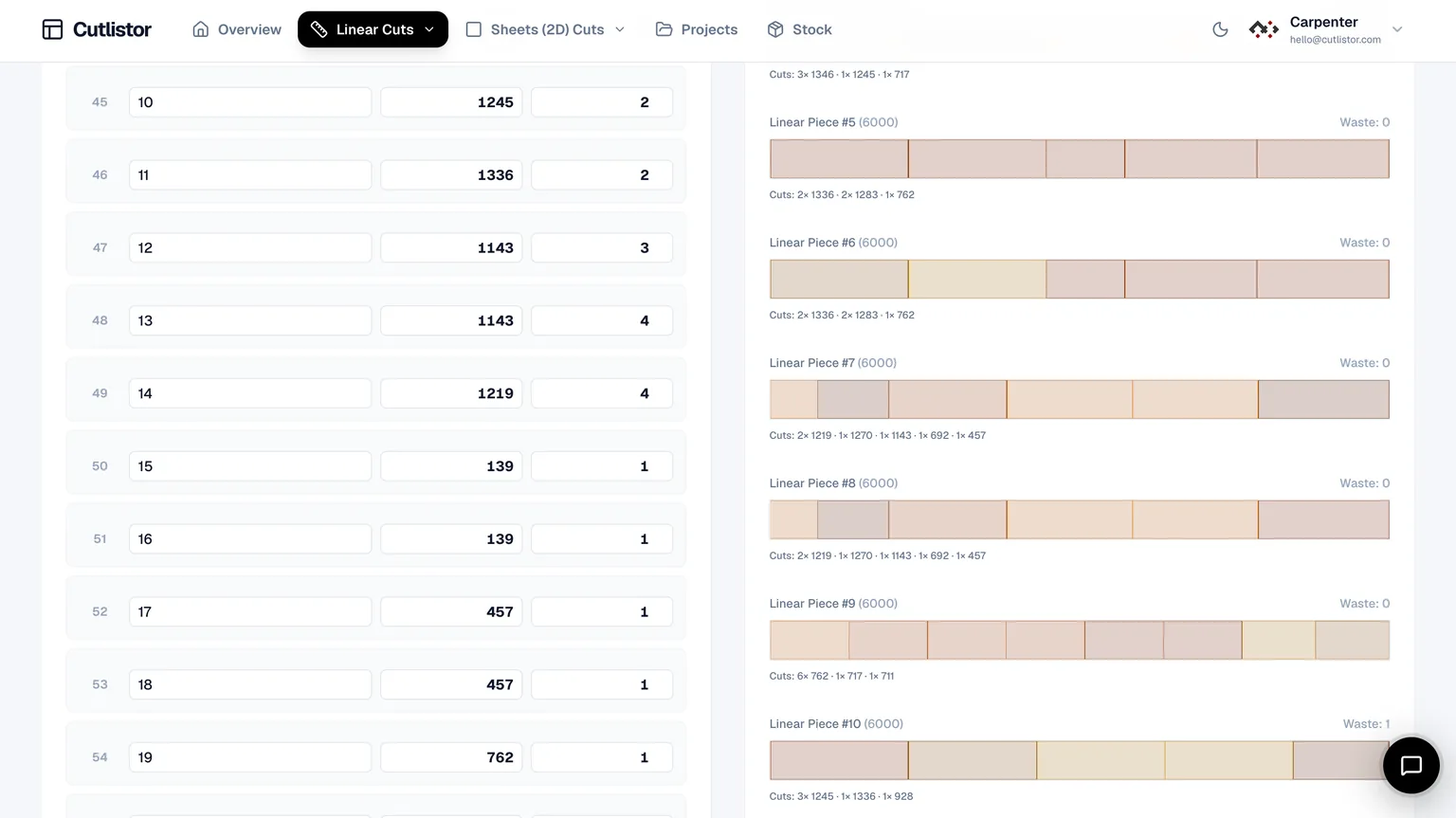
Total BF tells you how much volume to buy. It does not tell you how to cut 18 different lengths from 8 ft and 10 ft sticks with minimal scrap. Two projects with the same BF can need very different stick counts if one has many long rails and the other has short blocks.
After you estimate BF, run a linear cut list: enter each finished or rough length, quantity, kerf, and available stock lengths. Cutlistor's free linear optimizer packs those cuts in the browser so you see stick count and offcuts before you pay the yard.
Metric Shops and Board Feet
Outside North America, hardwood is often sold by cubic metres or by the piece at stated mm sizes. The BF formula still helps when reading US/CA supplier quotes. Convert: 1 BF ≈ 0.00236 m³. For day-to-day cutting, keep the cut list in mm and optimize lengths — do not convert every rail to BF unless you are buying from a BF-priced yard.
Quick Reference
BF = T(in) x W(in) x L(ft) / 12. Use it to budget hardwood volume. Use linear optimization to plan the cuts. Use sheet nesting for plywood — never convert plywood into board feet for purchasing.