Article
What Is Precision Metal Fabrication? Tolerances, Quality, and Planning
Cutlistor Team6 min read
Introduction
Precision metal fabrication is fabrication where dimensional accuracy, edge quality, and repeatability are part of the contract, not a nice-to-have. Medical device enclosures, aerospace brackets, instrumentation chassis, and semiconductor tool skins all land here: parts must fit on the first assembly, pass inspection, and look consistent batch to batch.
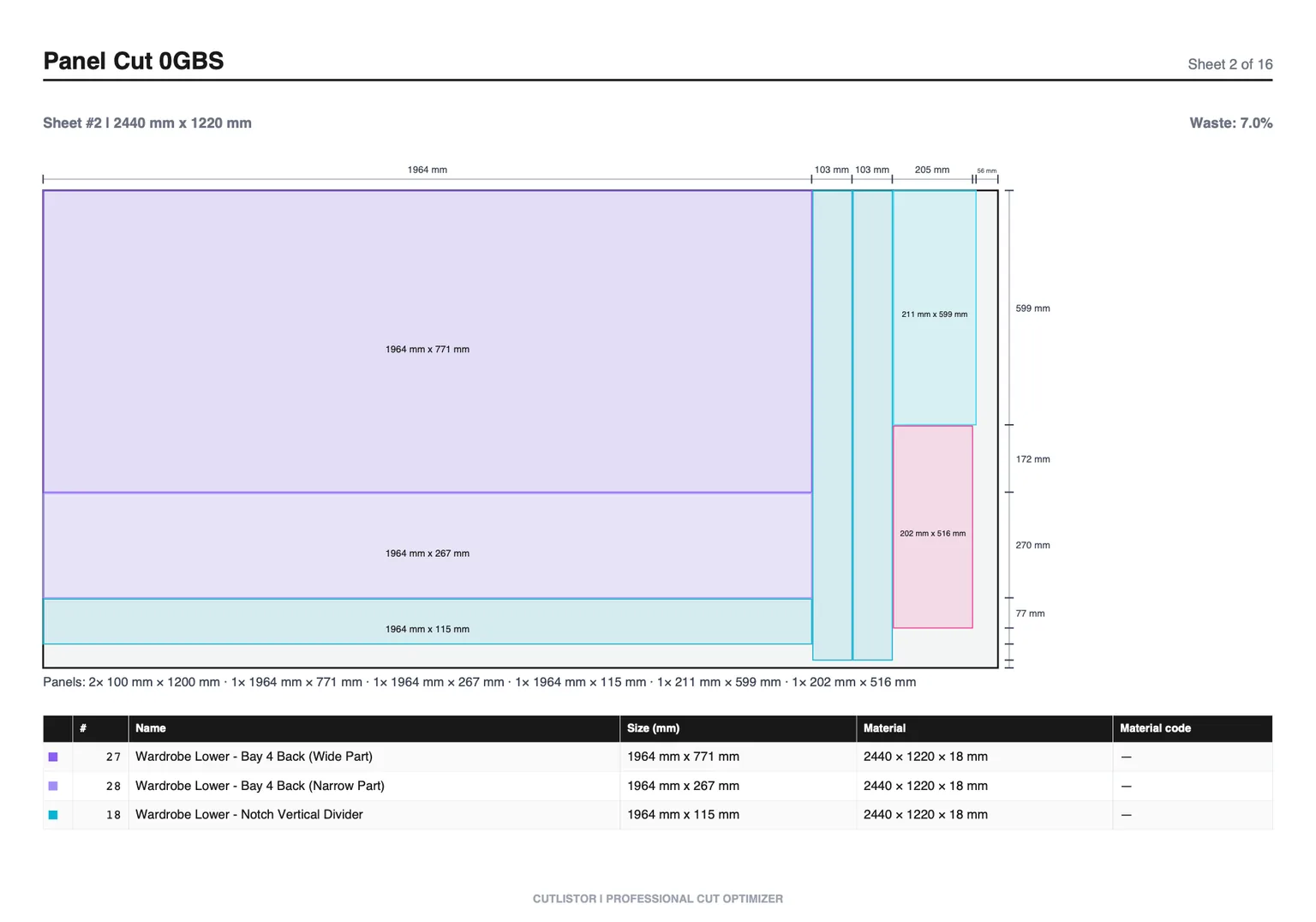
Precision work gets associated with expensive lasers and CMM rooms, but estimators still lose margin on basic sheet math when kerf and nest yield are treated as afterthoughts. This guide defines precision fabrication, where it differs from general job-shop work, and how metal fabrication planning tools like Cutlistor fit (material planning, not metrology or CAM).
What Is Precision Metal Fabrication?
Precision metal fabrication means producing sheet, plate, or formed metal parts held to tighter tolerances, better surface finish, and documented process control than general fabrication. The word precision describes the outcome and the quality system, not a single machine brand.
A precision shop may still laser-cut flats and brake-bend boxes. The difference shows up in machine calibration, nest stability, inspection frequency, material traceability, and how seriously the quote treats variation from kerf, grain, and thermal distortion.
- Tighter linear and angular tolerances on cuts and bends
- Controlled edge quality (minimal dross, consistent squareness)
- Repeatable setups with fixtures or documented first-article approval
- Inspection records: calipers, CMM, optical comparators where required
- Material certifications and finish specs traceable to the heat lot
When Precision Fabrication Matters
| Industry / application | Typical precision drivers | Planning implication |
|---|---|---|
| Aerospace structures | Fit-up, weight, traceability | Nest stability; certified material only |
| Medical devices | Clean edges, documentation | Stainless grade control; minimal rework scrap |
| Instrumentation / electronics | Panel fit, hole pattern accuracy | Laser over plasma on thin sheet |
| Semiconductor / lab equipment | Flatness, cosmetic finish | Grain direction on brushed faces |
| Defense / safety equipment | Repeatable FAI, lot control | Frozen nests after FAI approval |
Tolerances and Edge Quality
General fab might quote ±0.5 mm on laser-cut features without discussion. Precision work calls out tolerances on the drawing and maps them to machine capability tables. Holes near sheet edge, narrow webs, and acute bend reliefs all interact with kerf width and heat input.
Edge quality matters when parts slide into tracks, receive PEM inserts, or seal with gaskets. Dross, micro-cracks, and excessive heat-affected zone depth can fail inspection even when nominal dimensions are within tolerance.
Cutting tolerances
Fiber laser cutting on thin stainless often holds tighter feature-to-feature accuracy than plasma on thick plate. Waterjet trades speed for zero HAZ on sensitive alloys. The estimator should match process to tolerance block before pricing material, because rework on precision jobs is expensive scrap, not a quick re-bend.
Bend accuracy
Press brake precision depends on tooling, crowning, and material thickness variation within the same gauge spec. Angle errors stack across multi-bend enclosures. First-article inspection on bend samples prevents shipping fifty boxes with the same systematic error.
Repeatability and Process Control
Precision fabrication is as much about the second batch matching the first as about hitting numbers on a prototype. That pushes shops toward frozen nest revisions after first-article approval, calibrated machines, and change-control when the customer edits a dimension.
High repeatability does not eliminate yield planning. If anything, certified sheet is too expensive to over-buy because someone rounded each blank up 'for safety' without re-nesting.
- First-article inspection (FAI) before production release
- Documented nest and program revision tied to drawing level
- Scheduled machine maintenance and lens/nozzle change logs on lasers
- Operator checklists for grain direction and material orientation
- Non-conformance tracking when scrap rate spikes on a nest
Equipment Associated with Precision Work
Precision shops invest in machine accuracy and measurement, not just faster cycle times. Common equipment clusters include high-accuracy fiber lasers, CNC press brakes with angle control, deburring and grain machines, and inspection rooms.
Cutting and punching
Fiber lasers dominate thin precision sheet for speed and fine feature detail. CNC punching remains relevant for repetitive louvers with tool maintenance discipline. Plasma appears less often on cosmetic precision skins but still serves thick structural plate.
Inspection and finishing
Calipers and pin gauges handle routine in-process checks. CMM and optical systems verify complex hole patterns. Deburring, tumbling, and directional grain finishing protect edge quality before anodize or passivation on stainless medical work.
Materials in Precision Fabrication
Precision jobs often specify 304/316 stainless, aluminum alloys with stable bend behavior, or cold-rolled steel with tight thickness tolerance. Traceability from mill test report to traveler matters when audits ask which heat lot touched the part.
Cutlistor does not track heat lots or certifications. It does help you buy the right number of certified sheets once the grade is fixed, which keeps expensive precision stock from turning into unlabeled remnants.
Why Yield Planning Still Matters on Precision Jobs
Precision material costs more per kilogram and per sheet. A 5% yield loss on cheap mild steel hurts; the same loss on 316L at tight thickness tolerance can erase the profit on a small medical batch.
Kerf-aware rectangular nesting before purchase prevents ordering an extra certified sheet because someone padded every blank. Remnant tracking keeps usable offcuts labeled with grade and thickness so the next precision job does not accidentally mix alloys.
What Cutlistor Does (and Does Not Do) for Precision Shops
Cutlistor is a browser-based rectangular sheet (2D) nesting and linear (1D) cut list tool. It produces kerf-aware layouts, PDF cut plans, and paid DXF export for CNC handoff. It supports CSV/XLSX import, AI plan scanning, and 3D mesh import on supported tiers.
It is not a CMM, not a FAI system, and not a replacement for true-shape CAM or laser machine control (SigmaNEST-class tools). Precision shops typically use Cutlistor upstream for quoting, purchasing, and shop-floor reference PDFs, while CAM handles lead-ins, micro-joints, and post processors.
Most free optimizers meter the optimizing. Cutlistor does not — you can tweak parts and re-run the layout as often as a job needs. The daily ceiling of 3 applies to PDF exports and new projects only. Expect a 20-row cut list limit, a 5-row ceiling on each CSV or XLSX import, and no saved projects.
- Estimate certified sheet count before releasing POs
- Re-nest quickly when engineering changes a panel size pre-FAI
- Separate sheet nests from linear extrusion/angle cuts on mixed assemblies
- Export PDF plans operators can verify against drawing dimensions
- Paid DXF for rectangles when CAM import is faster than redrawing
Precision vs Custom vs General Fabrication
| Label | Emphasis | Cut planning focus |
|---|---|---|
| General fabrication | Cost and throughput | Standard kerf; commodity sheet sizes |
| Custom fabrication | Low volume, unique BOMs | Fast re-nesting; remnant use |
| Precision fabrication | Tolerances and records | Minimal over-buy on certified stock |
| Machining | 3D features from solid | Bar/plate stock sizing differs; see comparison guide |
FAQ
Does precision fabrication always require laser cutting?
Lasers are common on thin precision sheet, but waterjet, CNC punch, and controlled plasma on thick plate can meet spec when drawings allow. Process selection follows tolerance and finish requirements, not marketing labels.
Can Cutlistor verify parts pass inspection?
No. Cutlistor optimizes material layout and documents cut plans. Inspection remains your CMM, gauges, and quality system. Use Cutlistor to reduce material risk before parts reach the inspection table.
Does precision work use linear optimization?
Yes, when assemblies include extrusion frames, precision-cut tube, or angle with tight length tolerance. Run linear optimization separately from sheet nesting.
Conclusion
For processes, software comparisons, and calculators across fab types, see the metal fabrication guide. Run your next precision panel nest in the free sheet optimizer before you lock the certified material PO.