Article
How to Calculate Drawer Box Dimensions
Cutlistor Team4 min read
Introduction
Drawer box dimensions come from the cabinet opening and the slide hardware, not from the drawer front. The front is a cosmetic overlay or inset panel; the box must clear the slides, the case sides, and the front and back stops.
This guide covers side-mount and undermount patterns used in production casework. Always verify clearances against the slide data sheet for the exact model you buy.
Inputs: Opening, Slides, and Material
Collect these before calculating:
- Clear opening width between case sides or face-frame inside edges (where the box runs)
- Clear opening height for that drawer
- Cabinet depth and slide length available (often 450, 500, 550 mm or 18, 20, 22 in)
- Slide type: side-mount epoxy, ball-bearing side-mount, or undermount
- Box material thickness (12 mm / 1/2 in common; 15-16 mm also used)
- Bottom thickness and whether it sits in a groove or on cleats
Drawer Box Width
| Slide type | Typical width rule | Check |
|---|---|---|
| Side-mount ball-bearing | Box width = opening - ~1/2 in (12.7 mm) | Per-side clearance in data sheet |
| Epoxy side-mount | Often opening - 1 in (25 mm) class | Older systems vary |
| Undermount | Opening - manufacturer deduction | Also check rear notch / clips |
Worked example (side-mount): opening width 414 mm, total side clearance 13 mm → box outside width = 401 mm. Left and right sides are cut to the box depth × box height; front and back widths equal box outside width minus 2×side thickness for butt-joined fronts/backs between sides.
Drawer Box Height
Box height is usually less than the opening height so the box clears the unit above and any front stretcher. A common practice: box height = opening height - 1/2 in (13 mm) or another shop standard, while still matching slide height limits.
For banks of drawers, set each opening from the elevation, then apply the same deduction so reveals on the fronts stay even.
Drawer Box Depth (Front to Back)
| Inside case depth | Common slide | Box depth note |
|---|---|---|
| 560 mm case | 500 mm slide | Box length per slide chart (often ~500 mm class) |
| 24 in case | 22 in slide | Confirm rear clearance |
| Shallow vanity | 250-350 mm slide | Do not force a kitchen-length slide |
Part Breakdown: Sides, Front, Back, Bottom
| Part | Qty | Formula |
|---|---|---|
| Sides | 2 | Box depth × box height |
| Front & back | 2 | (Box width - 2T) × box height |
| Bottom (groove) | 1 | (Box width - groove_setback) × (Box depth - groove_setback) |
If the bottom sits on cleats or is screwed under the box, use the full inside width and depth instead of groove setbacks. CNC pocket bottoms follow your machine library.
Full Worked Example
| Item | Value |
|---|---|
| Box outside width | 414 - 13 = 401 mm |
| Box height | 180 - 13 = 167 mm (shop deduction) |
| Box depth | 450 mm (per slide) |
| Sides (2) | 450 × 167 mm |
| Front/back (2) | (401 - 24) × 167 = 377 × 167 mm |
| Drawer front (separate) | From overlay rules, not box width |
Nesting Drawer Parts for Production
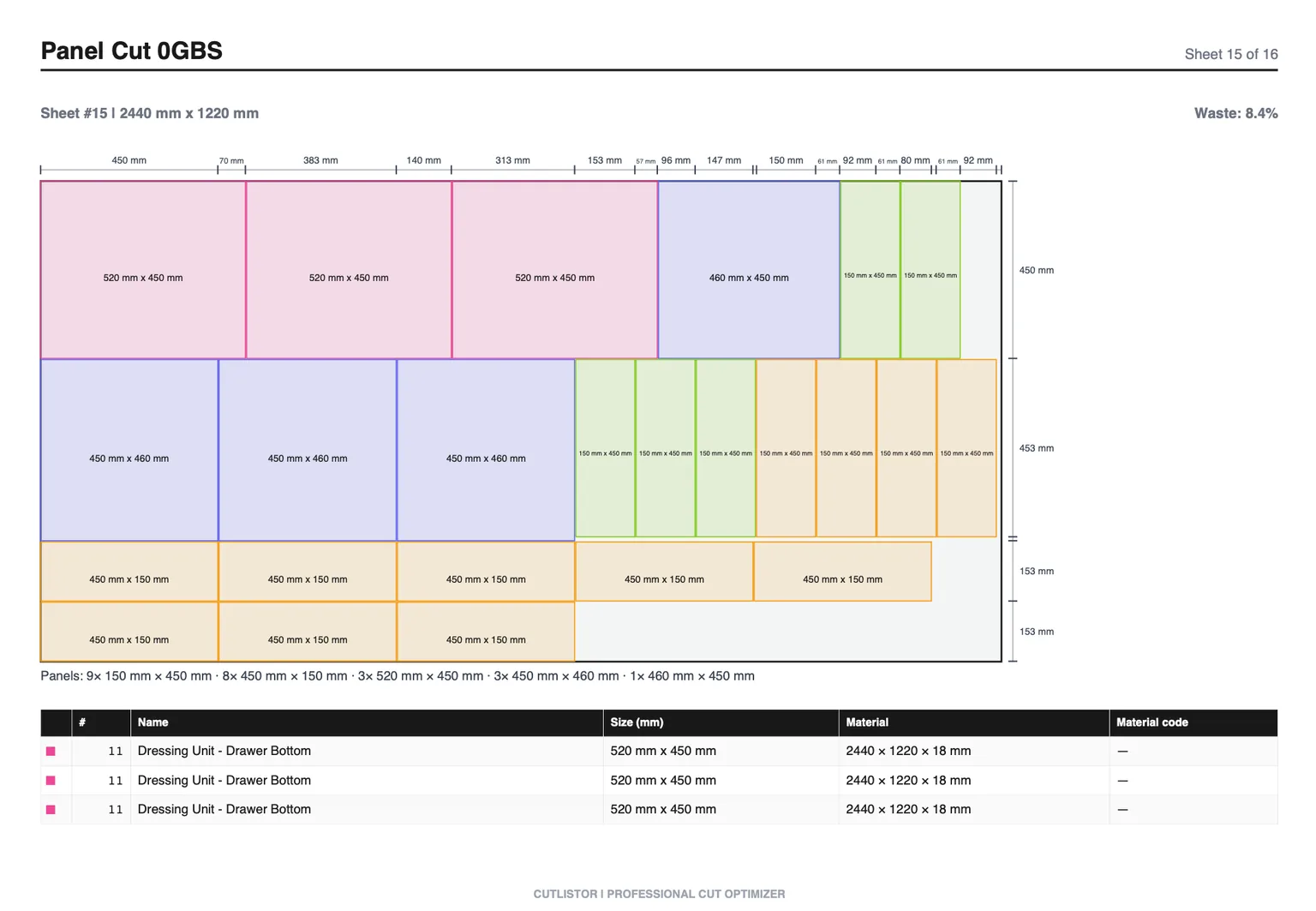
Batch drawer sides across the kitchen on the drawer-stock SKU. Keep cabinet and drawer IDs on every label (B12-DR2-SIDE-L). Nest bottoms on thinner plywood separately.
The free tier's limits sit around the edges of the work rather than in the middle of it. Editing and re-optimizing are unlimited; PDF exports and new projects share a daily budget of 3. A single session carries up to 20 part rows, each CSV or XLSX import up to 5 rows, and nothing is stored after you close it.
Pro ($12/mo) adds saved projects and DXF export for CNC drawer parts. Cutlistor is a nesting tool, not a slide configurator.
FAQ
Why is the drawer front wider than the box?
Because the front overlays the case or face frame. The box only needs to clear the slides inside the opening. Size them with different formulas.
Are undermount formulas interchangeable across brands?
No. Blum, Accuride, Knape & Vogot, and others publish different width deductions, notch sizes, and rear bracket positions. Copy the chart for the SKU on the PO.
Do face-frame cabinets change box width?
Yes if the drawer runs behind the face frame. Measure the clear opening where the slides mount (often behind the frame) and apply the slide clearance to that width.
Conclusion
Drawer boxes are opening width minus slide clearance, height minus your shop deduction, and depth matched to slide length. Break out sides, front, back, and bottom with joint and groove rules, then nest by material across the job.
Add drawer rows to your cabinet cut list in Cutlistor and keep fronts on the overlay list where they belong.