
Article
How to Optimize Cabinet Doors on a Sheet
Cutlistor Team4 min read
Introduction
Door packs are where grain rules and sheet waste collide. A kitchen carcass can nest tightly while doors force an extra sheet because every face must run the same direction. Optimizing cabinet doors on a sheet is about blank accuracy, orientation rules, and separating door SKUs from carcass nests.
Get door sheet count wrong and you delay finishing, not just cutting. That delay hits throughput as hard as material margin.
Nest finished blank sizes, not frame members
For slab and many CNC-profiled doors, nest the outer blank rectangle. Five-piece doors may nest stile and rail stock as linear or as sheet strips depending on your process. Be consistent: the optimizer can only pack what you enter.
- Include hinge-side and reveal allowances already in the finished blank
- Separate door thickness from carcass thickness
- Group matching grain sets (same elevation) when customers require continuous grain
- Keep paint-grade MDF doors off veneer plywood nests
Grain and matching rules that cost sheets
| Rule | Yield impact | When to use |
|---|---|---|
| Free rotation (paint MDF) | Best packing | Paint-grade slabs and profiles |
| Grain locked vertical | Moderate | Standard woodgrain or veneer doors |
| Continuous match across bay | Highest waste | Feature walls, clear finishes |
| Drawer fronts match doors | Extra constraint | Specify in BOM as locked orientation |
MDF, plywood, and melamine door paths
Paint MDF: free rotation, often the highest door yield. Veneer plywood: lock grain, watch face grade. Woodgrain melamine: lock print direction like veneer. Nest each path on its own stock size.
Worked example: woodgrain door pack vs MDF
| Material / rule | Sheets | Yield | Notes |
|---|---|---|---|
| MDF, free rotation | 6 | 87% | Best packing |
| Woodgrain melamine, grain locked | 8 | 78% | +2 sheets for orientation |
| Manual woodgrain layout | 9 | 72% | Pad and fear of shorting |
The two-sheet gap between optimized grain-locked and free-rotation packs is real money. Price continuous-match upgrades with that gap in mind, not as a flat percentage.
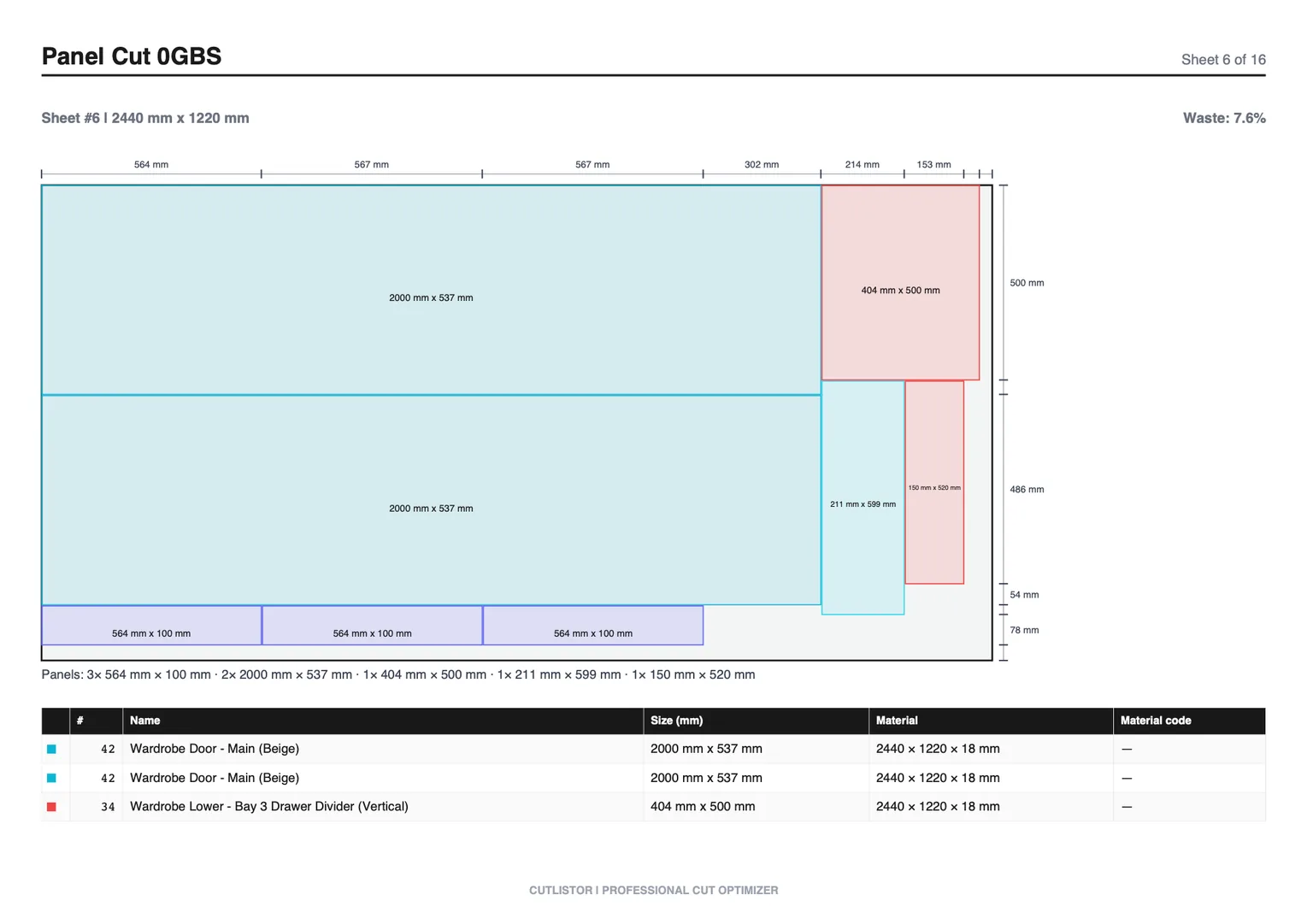
Kerf still applies to door blanks
Door blanks cut on a beam saw or CNC still lose kerf between every part. Zero-kerf nests create undersize doors that fail reveal checks. Measure once per machine setup.
Cutlistor workflow for door sheets
Cutlistor's free tier meters something different: editing parts and re-optimizing the layout are unlimited, and only PDF export and starting a new project count against a daily allowance of 3. Cut lists are capped at 20 rows, CSV and XLSX import is limited to 5 rows per file, and nothing is saved between sessions.
FAQ
Should doors nest with carcass parts?
Only when material and thickness are identical and the floor can sort labels cleanly. Most shops nest doors separately for finishing flow.
How do I keep left/right pairs matched?
Use part labels and, when needed, nest matched pairs as a constraint in your shop process. Continuous grain sets may be nested as ordered groups; communicate that on the PDF.
Do door nests affect profit as much as carcass nests?
Often more on paint jobs, because door material plus finishing labor is a large share of the box price. Sheet savings and fewer remakes both matter.
Dimension Discipline on Cabinet Jobs
Doors are where size conventions cause the most expensive mistakes, because reveal and overlay are baked into the number. Write on the sheet whether a listed door size is the finished dimension or the blank before edge treatment.
Group doors by size and finish rather than by cabinet. A run of eighteen identical drawer fronts nests and cuts as one operation, while the same fronts scattered across cabinet-by-cabinet rows force a setup change that was never necessary.
A late reveal change affects every door but nothing else. Re-nest the door material group alone and leave the carcass layouts untouched, so one adjustment does not invalidate sheets already cut.
Standardize the door nesting rules in writing so grain and reveal decisions repeat correctly across jobs.
- One source of truth for openings vs carcase blanks
- Job number and revision date on every printed plan
- Separate sheet goods from linear face-frame stock
- Re-nest after any size change that touches a bought sheet
Conclusion
Optimizing cabinet doors on a sheet means blank honesty, orientation rules priced into the quote, measured kerf, and a nest that is separate from carcass purchasing when materials differ. That keeps finishing schedules and margins aligned.