Article
Best Plywood for Cabinets: Grades, Cores & Shop Specs
Cutlistor Team4 min read
Introduction
The “best plywood for cabinets” is the SKU that matches the finish, hardware, moisture risk, and bid. Cabinet shops do not need one heroic sheet for every job. They need a shortlist: paint-grade, clear birch or maple, prefinished interiors, and specialty Baltic birch for drawers.
This guide ranks plywood choices the way a purchasing lead thinks: core type, face grade, thickness, sheet size, yield under grain lock, and approximate 2026 price bands (confirm locally; markets move).
2026 Cabinet Plywood Shortlist
| Plywood type | Best cabinet use | Watch-outs |
|---|---|---|
| Birch veneer-core, sanded | Paint or clear custom boxes | Cost; check voids on cheap lots |
| Maple veneer-core | Clear/light interiors, painted | Face matching across sheets |
| Prefinished maple/birch | Fast custom carcasses | Touch-up kits; color lot matching |
| Baltic birch (multi-ply) | Drawer boxes, jigs, exposed edges | Often 5×5 sheets; price |
| ApplePly / similar multi-ply | Premium exposed-edge work | Lead time and cost |
| Shop/utility plywood | Garage/utility only | Not for show kitchens |
Core Types That Matter on the Floor
Veneer-core plywood screws well and stays relatively light. Combination cores (veneer faces over engineered inner plies) can improve flatness and cost. Lumber core is less common for standard kitchen boxes. Particle-core “plywood look” products are closer to melamine territory; label them clearly so estimators do not treat them as veneer-core.
Ask your supplier for actual thickness (many “3/4 in” sheets run undersize) and for void policy. Undersize stock changes dado and cam hardware fit.
Face Grades and Finish Path
| Finish path | Preferred plywood | Nesting note |
|---|---|---|
| Site or shop paint | Paint-grade birch/maple | Rotation often OK on hidden parts |
| Clear / stained | Higher face grade, matched lots | Lock grain on show faces |
| Factory UV prefinish | Prefinished maple/birch | Protect faces in handling |
| Exposed edge aesthetic | Baltic birch / multi-ply | Plan edge sanding time |
Thickness and Sheet Size for Cabinet Work
Most North American kitchen boxes still center on nominal 3/4 in (about 18–19 mm) for sides and decks, 1/2 in or 1/4 in for backs depending on system, and 1/2 in or 5/8 in for some drawer parts. Confirm metric if you buy imported panels.
Standard 4×8 ft dominates. Some shops buy 5×5 Baltic birch for drawers and 4×8 for boxes. Nesting must use the true purchased size or your sheet count is fiction.
Approximate 2026 Price Context
Cabinet plywood is often one of the largest material lines on a custom kitchen. Approximate mid-2026 North American shop bands for common 4×8 sheets: utility $45–$90, cabinet birch $70–$140, prefinished $90–$180, Baltic birch (by size/thickness) often higher per square foot. Freight and grade swing these numbers hard.
When plywood prices rise, yield and remnant tracking protect margin more than arguing over a few dollars on a mid-grade sheet. See our guides on rising prices and cost reduction.
Spec the Sheet, Then Nest It
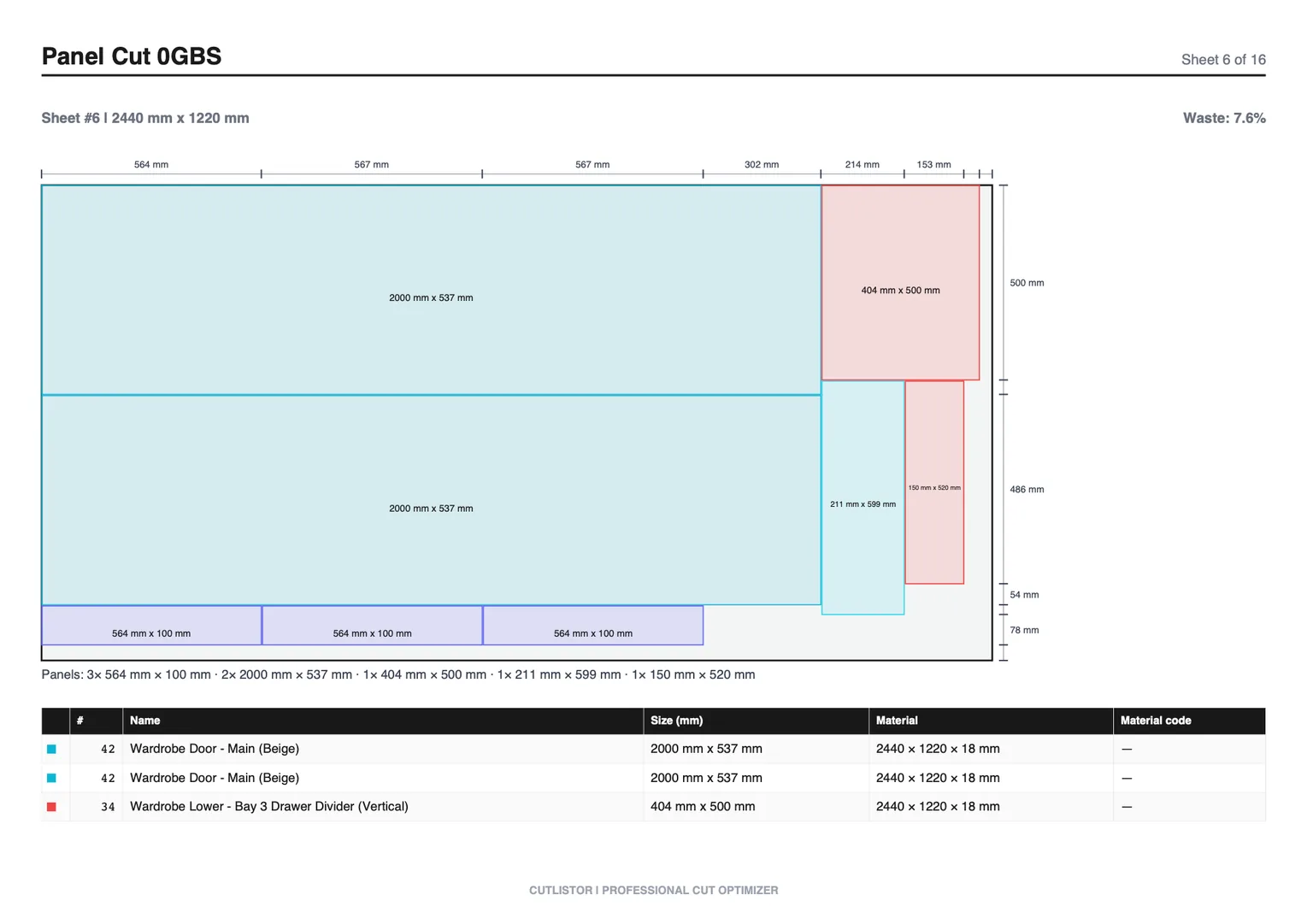
Pick the plywood SKU first, then run a kerf-aware nest with grain rules. Cutlistor is a sheet and linear optimizer in the browser for rectangular cut lists and PDF plans. It is not a design suite that draws elevations for you.
On the free plan you can edit parts and re-optimize without limit — those actions are never counted. What is counted is finished output: PDF exports and new projects draw down an allowance of 3 per day. The working list tops out at 20 rows, spreadsheet imports at 5 rows per file, and nothing persists once you leave.
Pro is $12/mo when you need saved projects and DXF export for CNC rectangles.
FAQ
Birch or maple plywood for cabinets?
Both work. Birch is a common clear and paint workhorse. Maple is popular for light clear interiors. Choose by finish sample and local availability, then stick to that house SKU for remnant reuse.
Is plywood always better than melamine?
No. Melamine often wins production cost and wipe-clean interiors. Plywood wins custom strength and finish paths. Compare roles, not absolutes.
Conclusion
Best plywood for cabinets means a disciplined shortlist: veneer-core for custom boxes, prefinished for speed, Baltic birch for drawers, and honest nesting before the PO. Match thickness to hardware, lock grain where it shows, and re-check prices every bid cycle.