
Article
Standard Plywood Sizes for Cabinets: 4×8, Metric & Specialty
Cutlistor Team4 min read
Introduction
Cabinet purchasing starts with sheet size. If the nest assumes 4×8 ft and the truck delivers 2750×1830 mm melamine, your sheet count and ripping plan are wrong before the saw starts. Standardize stock sizes in your BOM and optimizer.
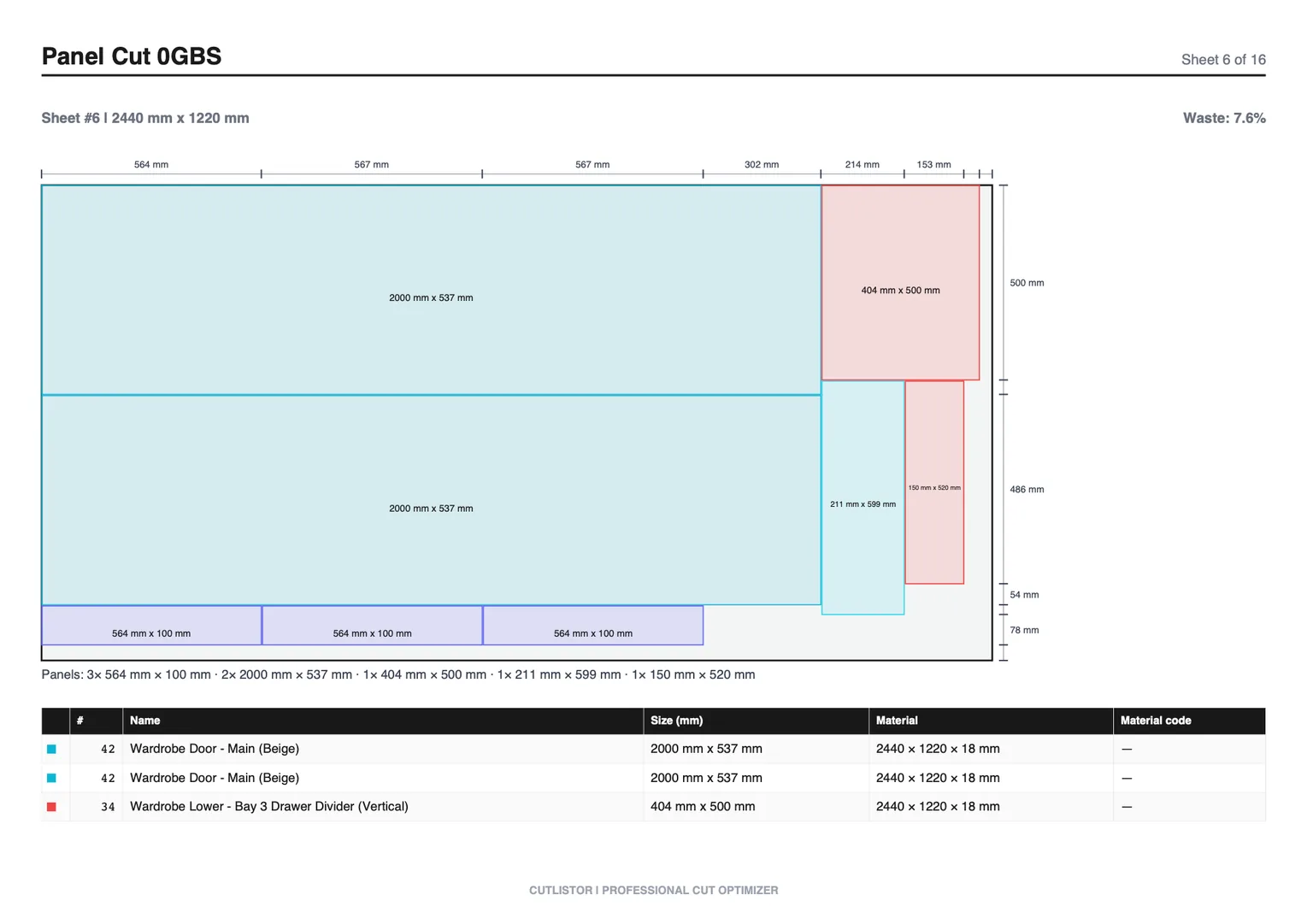
This guide lists the panel sizes cabinet shops actually buy, how they affect kitchen yield, and how to avoid mixing size systems on one job.
North American Cabinet Standards
| Sheet size | Typical cabinet use | Yield note |
|---|---|---|
| 4×8 ft | Default boxes, doors, shelves | Plan rips around 96 in / 48 in |
| 4×10 ft | Tall pantry sides, long decks | Fewer end seams; higher sheet cost |
| 5×5 ft | Baltic birch drawers / specialty | Different nest geometry than 4×8 |
| 5×8 / 5×10 | Occasional specialty | Confirm handling equipment |
Metric Panels Common in Production
| Metric example | Approx. inches | Common material |
|---|---|---|
| 2440×1220 mm | ≈ 96×48 | Plywood / MDF import |
| 2750×1830 mm | ≈ 108×72 | Melamine production |
| 2800×2070 mm | ≈ 110×81 | Large melamine panels |
| 1525×1525 mm | ≈ 60×60 | Baltic birch |
How Sheet Size Changes Cabinet Part Layout
A 34-1/2 in base cabinet side fits easily on 4×8 with room for companions. Tall pantry sides may force 4×10 or careful grain-wise nesting on 4×8 with seams or split panels. Door blanks for large pantry doors can waste a full sheet if grain lock and size are ignored.
Standardize cabinet heights and depths in your product line so nests reuse the same blank patterns across jobs.
Purchasing Rules That Prevent Floor Chaos
One job, one size system per material code. If you mix 4×8 birch and metric white melamine, that is fine, but each gets its own stock row. Label remnant racks with true dimensions so the next estimator can reuse them.
Approximate 2026 pricing is driven by size and grade: larger specialty sheets cost more and are harder to handle. See the cost guides when plywood markets move.
Nest on the Size You Will Buy
Set stock width and length to the distributor SKU, add kerf, lock grain where needed, and export PDF layouts for the panel saw. Cutlistor is a browser sheet and linear optimizer for rectangular cut lists, not a full design suite.
No account is needed to try it, and the free tier does not count the optimizing itself — parts can be edited and re-nested indefinitely. It counts finished PDFs and new projects, at 3 a day. Lists are limited to 20 rows, CSV and XLSX uploads to 5 rows per file, and work does not survive the session.
Pro is $12/mo for saved projects and DXF export.
FAQ
Should I always buy 4×10 for kitchens?
Only when tall parts justify it. Oversized sheets that leave unusable remnants can cost more than an extra 4×8. Nest both options before purchasing.
Do factory edges reduce usable size?
Sometimes shops trim factory edges for clean banding. If you always trim 1/8 in per edge, put the usable size in the optimizer, not the nominal sheet size.
Floor Practice That Protects Yield
Sheet dimensions look like the one thing you can safely assume. They are not: oversize sheets, metric stock, and 5×5 Baltic birch all break a hardcoded 48×96.
Enter the measured sheet size and the measured kerf together. A 4×8 that is really 48-1/2 × 96-1/2 hands you free trim margin; assuming that margin when it is absent costs you a part.
Record the actual dimensions of each remnant instead of rounding them. A drop logged as 24×48 that is really 23-3/4 × 47-1/2 will fail on the one job that needed the full size.
Keep true sheet sizes in your material library so nobody nests against a nominal 48×96 that never arrived.
- Kerf from a test cut on the same material family
- Grain lock on doors, gables, and show shelves
- Trim allowances decided before nesting, not at the saw
- Offcut shelf with minimum size rules your shop respects
Conclusion
Standard plywood sizes for cabinets are 4×8 for most North American work, metric panels for many melamine lines, and 5×5 for Baltic birch programs. Nest on true purchased sizes and keep material codes separate so sheet counts stay real.