Calculator page · 6 min read
Cutting list calculator
If you call it a cutting list rather than a cut list, this is the page for you - the term is standard in the UK, South Africa, Australia, Ireland and India, and the working assumptions that come with it are different too. Everything here is in millimetres, the board sizes are the ones your supplier actually delivers, and the worked examples are shopfitting and built-in joinery rather than stick framing. The calculator underneath is the same one, but you should not have to translate a page written for someone else's timber yard.
Board sizes your supplier actually stocks
Enter the board you buy, not a nominal description. This is the single input most likely to be wrong, and it silently changes the board count.
Note in particular that 2440 × 1220 mm is not the same as 8' × 4' - it is 1.6 mm longer and 0.8 mm wider. That sounds like nothing until your parts divide the board almost exactly, at which point it is the difference between a row fitting and not.
| Board | Common sizes (mm) | Typical thicknesses |
|---|---|---|
| Melamine faced chipboard (MFC) | 2750 × 1830, 2440 × 1220, 2800 × 2070 | 16, 18, 25 |
| MDF | 2440 × 1220, 3050 × 1220 | 3, 6, 9, 12, 16, 18, 25 |
| Melamine faced MDF | 2750 × 1830, 2440 × 1220 | 16, 18 |
| Plywood / shutterply | 2440 × 1220 | 6, 9, 12, 15, 18, 21 |
| Supawood / SupaWood MDF | 2750 × 1830 | 16, 18, 22 |
| Chipboard | 2750 × 1830, 3660 × 1830 | 16, 18 |
| Hardboard / masonite | 2440 × 1220 | 3, 4.8 |
Sizes vary by supplier and country - South African board yards commonly work in 2750 × 1830, UK merchants in 2440 × 1220. Always confirm on the delivery note.
Cutting list workflow in millimetres
Work entirely in one unit. Mixed millimetres and inches survive a spreadsheet import perfectly happily and then produce a cutting plan that is quietly wrong.
- List every part as length × width × quantity, at finished sizes
- Split the list by board type and thickness - 18 mm carcass and 3 mm backing never share a board
- Enter the board size from the delivery note
- Set kerf: 3.2 mm for a table saw, 4.4-4.8 mm for a beam saw, 6 mm for a 6 mm router bit
- Lock grain only on woodgrain decors and visible faces; plain white melamine has no grain to lock
- Run it, read the board count, then check the plan is one your panel saw can actually cut
Free use needs no account: 20 part rows per session, CSV or XLSX import up to 5 rows, and 3 PDF exports a day with unlimited re-running while you compare options.
Worked example: shopfitting counter in 18 mm MFC
A retail counter 3000 mm long, 900 mm high, 600 mm deep, built as three 1000 mm modules from 18 mm melamine faced chipboard on 2750 × 1830 boards.
Per module: two gables at 882 × 600 (900 less an 18 mm top), a top at 964 × 600, a bottom deck at 964 × 600, and two rails at 964 × 100. Across three modules that is six gables, three tops, three decks and six rails - eighteen parts, all 600 mm deep or less.
Every horizontal part is 964 mm because the module is 1000 mm wide and the two 18 mm gables take 36 mm. That subtraction is the one people get wrong, and it is invisible until assembly.
On a 2750 × 1830 board with a 4.4 mm beam saw kerf, 600 mm deep parts give three strips across the 1830 width (3 × 600 + 2 × 4.4 = 1808.8 mm, which fits) with 21 mm to spare. The calculator returns the board count for the whole run rather than per module, which is what you order against.
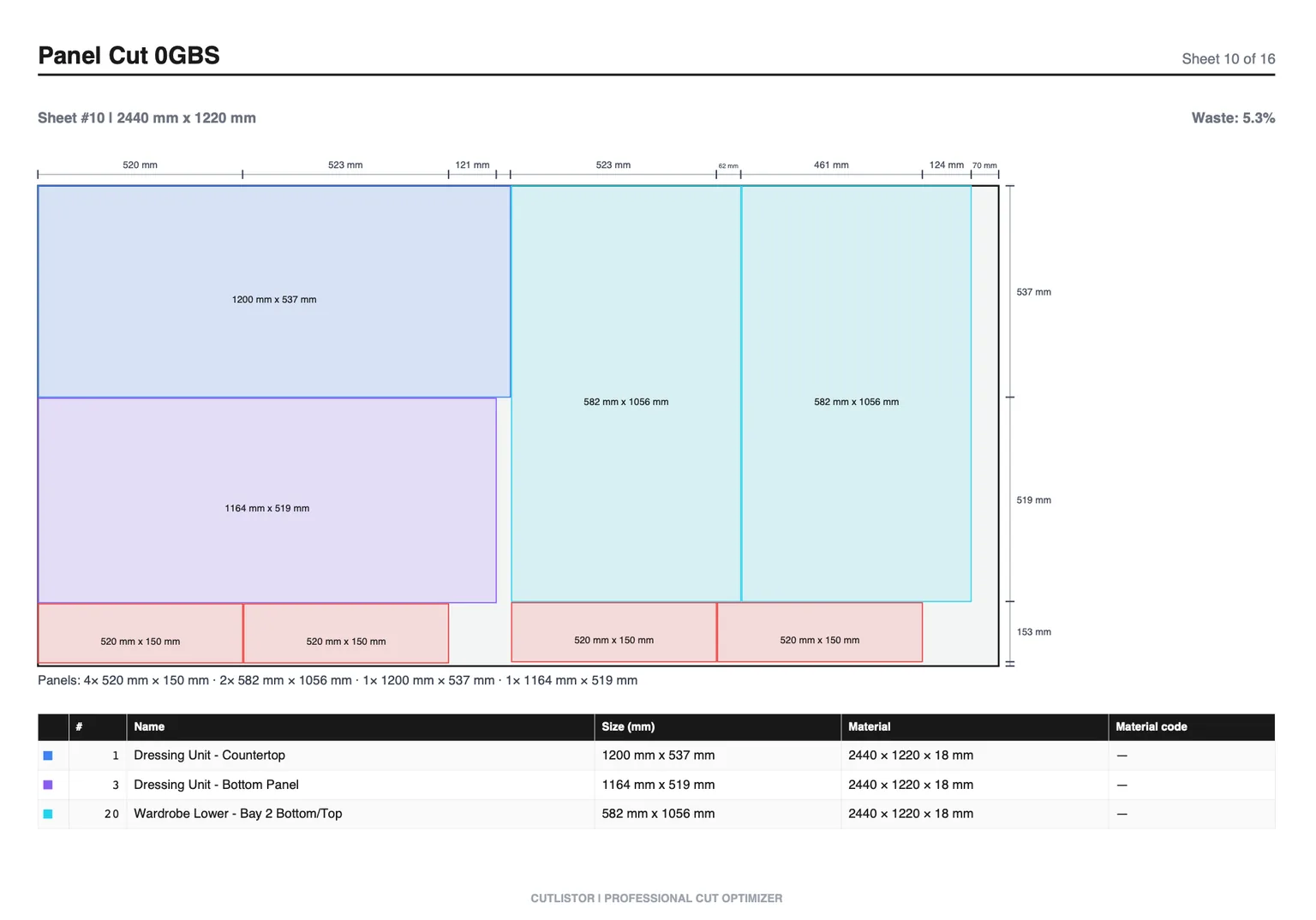
Edging, thickness and the parts table
A cutting list for board work carries two things a timber cutting list does not: which edges get banded, and whether the size quoted is before or after edging.
Pick one convention and state it at the top. Most shops list finished sizes including edging and let the machine allowance handle the rest; the alternative is to list the cut size and note the edging separately. Mixing the two across one job produces doors that are 2 mm proud on one cabinet and flush on the next.
Thickness belongs to the board, not the part. If a job uses 18 mm carcass, 16 mm backs and 22 mm tops, that is three board rows and three separate cutting plans.
Linear stock: timber, tube and trim
Boards are only half the job. Skirting, architrave, cornice, PAR timber, steel tube and aluminium extrusion pack onto stock lengths rather than nesting on a board, and need the linear calculator instead.
Enter the stock lengths your merchant sells - commonly 2.4, 3.0, 3.6, 4.2 and 4.8 m for timber, 6 m for tube and bar - and the calculator sequences the cuts and reports the drop on each length. Comparing two stock lengths on the same cutting list is usually worth more than any algorithm change, because the drop is where the money goes.
Where cutting lists go wrong
- Forgetting the two side thicknesses on every horizontal part - 1000 mm wide means 964 mm shelves in 18 mm board
- Quoting nominal timber sizes rather than PAR finished sizes
- Leaving kerf at zero, or using a table saw value on a beam saw that removes 4.8 mm
- Mixing 16 mm and 18 mm board on one cutting plan because both are melamine
- Locking grain on plain white decor, which disables rotation for no benefit and costs boards
- Working in millimetres in the office and inches on the floor
FAQ
- Is a cutting list the same as a cut list?
- Yes - same document, different regional term. Cutting list is standard in the UK, South Africa, Australia, Ireland and India; cut list is the North American form.
- Is the cutting list calculator free?
- Yes. It runs in the browser with no account and no download, within daily PDF export limits.
- Does it work in millimetres?
- Yes, and it is the sensible default for board work. Use one unit throughout - mixed units are the most common cause of a wrong cutting plan.
- What kerf should I use on a beam saw?
- Typically 4.4 to 4.8 mm, against about 3.2 mm for a table saw. Measure once on scrap and write the number on the machine.
- Can it handle 2750 × 1830 boards?
- Yes. Enter any board size you purchase - the calculator is not limited to 2440 × 1220 or to imperial sheet sizes.
Related calculators
- Cupboard cutting list calculatorFree cupboard cutting list calculator for kitchen and bedroom cupboards. Work out carcass parts in millimetres, nest them on melamine, export a cutting plan.
- Plywood cut calculator for real sheet sizesFree plywood cut calculator: nest parts on standard sheets, apply kerf, preview the cut layout, and export a PDF cut plan in your browser.
- 4×8 plywood cut calculatorFree 4×8 plywood cut calculator - enter your parts, get the sheet count and a kerf-aware cutting diagram in seconds. Grain direction, PDF export, no download.
- MDF cut list calculatorMDF cut list calculator for raw and primed panels: nest parts, kerf-aware cuts, yield focus, free browser tool on Cutlistor.