Calculator page · 6 min read
How many pieces can you cut from a 4×8 sheet?
A 4' × 8' sheet is 48 × 96 inches, or 32 square feet - 1219 × 2438 mm, about 2.97 m². Dividing that by the area of your part gives an upper bound that you will never actually reach, because the parts have to tile in whole rows and columns and because every cut destroys a few millimetres. This page gives the honest arithmetic: a reference table of common part sizes with and without kerf, the strip calculation people usually want, and the geometry puzzle that sends a surprising number of people here.
The arithmetic, without hand-waving
Pieces per sheet is not area divided by area. It is how many whole parts fit along each edge, multiplied together, for each of the two orientations - then take the better one.
Along one edge, the number of parts that fit is the largest n where n × part + (n − 1) × kerf ≤ sheet dimension. Without kerf that collapses to a simple division, which is why textbook answers and real answers diverge.
The divergence is not uniform. When a part size divides the sheet almost exactly, kerf costs you an entire row. When it does not, the kerf hides in slack that was going to be offcut anyway and costs nothing at all.
Reference table: pieces per 4×8 sheet
Calculated for a true 48 × 96 inch sheet, in a single orientation, using a 1/8" (3.2 mm) saw kerf. Note how the penalty appears only on the exact divisors.
| Part size | No kerf | With 1/8" kerf | Why |
|---|---|---|---|
| 12" × 12" | 32 | 21 | Exact divisor both ways - loses a row and a column |
| 24" × 24" | 8 | 3 | Worst case: exact divisor with few, large parts |
| 12" × 48" strips | 8 | 7 | Exact along 96" - the eighth strip does not fit |
| 1¼" × 48" strips | 76 | 69 | Many thin rips, so kerf compounds on every cut |
| 11¼" × 30" | 12 | 12 | Neither dimension divides evenly - kerf hides in the offcut |
| 15" × 30" | 9 | 9 | Same: slack absorbs the kerf |
| 23¼" × 30¾" (cabinet side) | 6 | 6 | Awkward sizes are forgiving of kerf |
| 16" × 24" | 12 | 5 | Exact along 96" and 48" - collapses badly |
Single orientation only, and no mixing of part sizes. A real optimizer will beat several of these by rotating parts or filling the offcut with different parts from the same job.
Strips: the calculation most people want
"How many 12-inch strips from a 4×8 sheet?" The textbook answer is 96 ÷ 12 = 8. The shop answer is 7 full strips plus an 11⅛" remainder, because eight strips need 8 × 12 + 7 × 0.125 = 96.875 inches and the sheet is 96.
"How many 1¼" × 4' pieces?" Textbook: 96 ÷ 1.25 = 76.8, so 76. With kerf, each strip consumes 1.25 + 0.125 = 1.375 inches, giving 96 ÷ 1.375 = 69.8, so 69. That is seven pieces fewer - a 9% error, entirely from a number the question does not mention.
The rule of thumb worth remembering: with thin rips, kerf costs you roughly kerf ÷ part width as a fraction of your yield. At 1/8" kerf on 1¼" strips that is 10%. On 12" parts it is 1%.
The 4 congruent rectangles puzzle
A recurring competition-maths question asks: a 4-foot by 8-foot sheet is cut into 4 congruent rectangles with no waste and no kerf - what is the positive difference between the greatest and least possible perimeter of a single piece?
Each piece must have area 32 ÷ 4 = 8 square feet. The tilings that work give pieces of 1' × 8' (four strips down the length), or 2' × 4' (either four strips across, or a 2 × 2 grid). Perimeters are 2(1 + 8) = 18 feet and 2(2 + 4) = 12 feet.
The difference is 6 feet. Worth noting the phrasing: the question stipulates no wood lost to the cuts, which is precisely the assumption that makes it a maths problem rather than a woodworking one. In a real shop, four 1' × 8' strips need three cuts and leave each strip 3/32" narrow.
From 'how many' to a real cut plan
Single-part arithmetic is only the start, because real jobs cut several different sizes from the same sheet and the offcut from one part becomes the space for another.
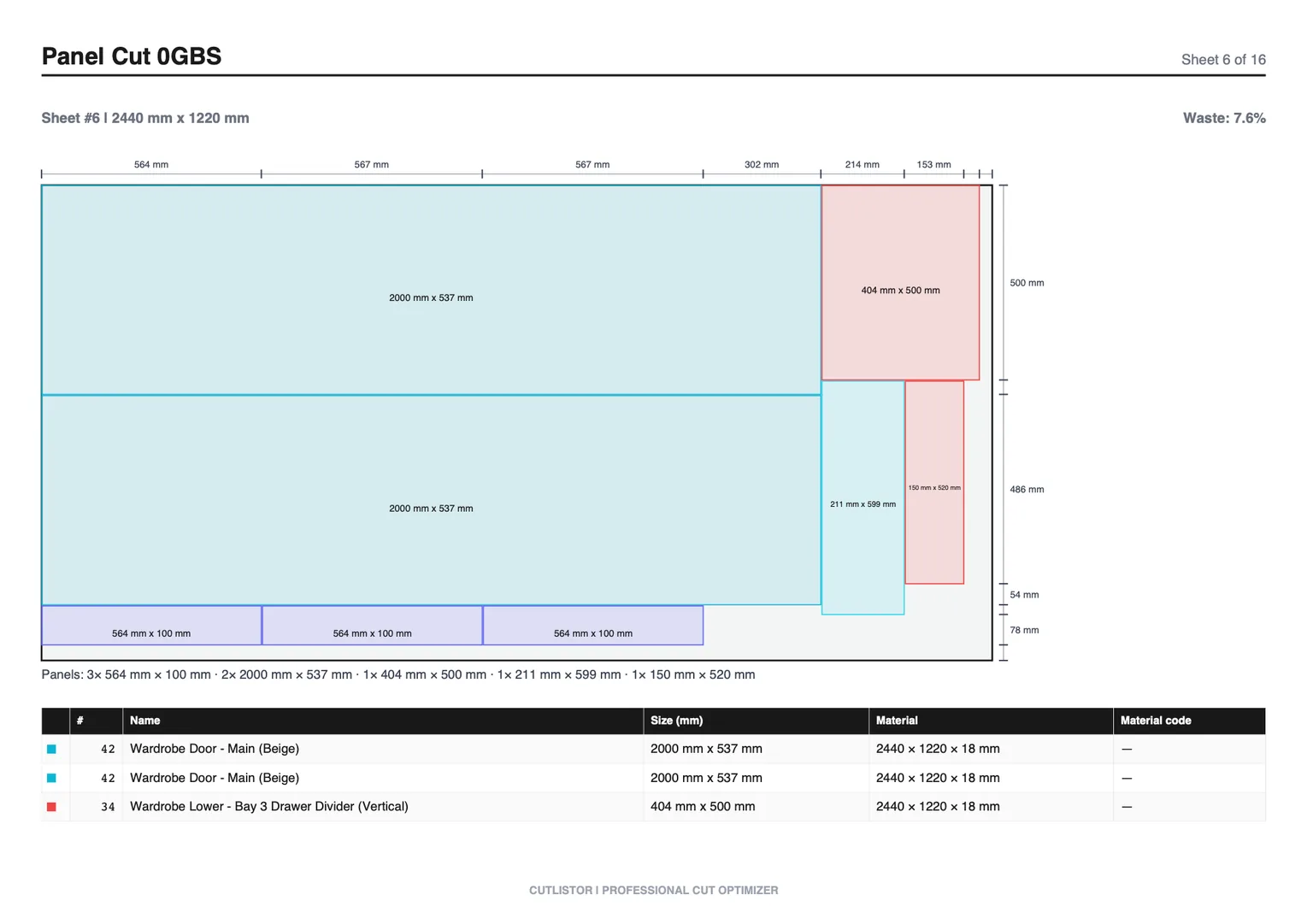
That is where the numbers above stop being useful. A sheet that yields three 24 × 24 parts with kerf has a large L-shaped remainder that could hold a dozen smaller parts - but only an optimizer that sees all the parts at once will find that placement.
Enter every part from the job, set your stock size and kerf, and read the sheet count. It is nearly always fewer sheets than the part-by-part arithmetic suggests, and it is the number you can order from.
Sheet facts worth having to hand
- A 4' × 8' sheet is 32 square feet, 48 × 96 inches, 1219 × 2438 mm
- Metric 2440 × 1220 mm sheets are about 1.6 mm longer and 0.8 mm wider than a true 4 × 8 - not enough to rescue an exact-divisor layout
- Sheets are frequently delivered slightly oversize; measure before assuming, especially on imported stock
- Cutting a sheet into thirds along its length gives three 32" × 48" pieces, or 31⅞" with kerf
- Half sheets are 48 × 48; quarter sheets are usually sold as 24 × 48
- Standard sheet weights vary hugely by material - 18 mm MDF is roughly twice the weight of 18 mm softwood ply
FAQ
- How many square feet is a 4×8 sheet?
- 32 square feet - 48 × 96 inches, or about 2.97 square metres.
- How many 12-inch strips can I cut from a 4×8 sheet?
- Eight on paper, seven in practice. Eight 12-inch strips plus seven 1/8-inch kerfs need 96.875 inches and the sheet is 96.
- How many 1¼" by 4' pieces can you cut from a 4' × 8' sheet?
- 76 ignoring kerf, 69 with a 1/8-inch saw kerf, because each rip consumes 1.375 inches rather than 1.25.
- A 4×8 sheet cut into 4 congruent rectangles - what is the perimeter difference?
- 6 feet. The pieces are either 1' × 8' with an 18-foot perimeter or 2' × 4' with a 12-foot perimeter.
- Why does kerf sometimes cost nothing?
- Because it only matters when a row only just fits. If your part sizes leave slack against the sheet dimension, the kerf comes out of material that was going to be offcut anyway.
- How do I get an accurate count for a job with mixed part sizes?
- Run all the parts through a sheet optimizer at once. Part-by-part arithmetic ignores the fact that small parts fit in the space left by large ones.
Related calculators
- Cut list calculatorFree cut list calculator for sheet goods and linear stock. Enter parts, stock and kerf, get sheet or stick counts and a printable cut plan - no account needed.
- Cutting list calculatorFree cutting list calculator in millimetres. Enter parts, board sizes and kerf, get board counts and a printable plan for melamine, MDF and plywood.
- Cupboard cutting list calculatorFree cupboard cutting list calculator for kitchen and bedroom cupboards. Work out carcass parts in millimetres, nest them on melamine, export a cutting plan.
- Plywood cut calculator for real sheet sizesFree plywood cut calculator: nest parts on standard sheets, apply kerf, preview the cut layout, and export a PDF cut plan in your browser.